
Resources
Explore a wide range of valuable resources on GCED to deepen your understanding and enhance your research, advocacy, teaching, and learning.
19 Results found
 Dialogue Protocols (Fawaz and Nora Series, Episode 29) Year of publication: 2018 Corporate author: Tatweer Company | Saudi Arabia. Ministry of Education The clip is a short video that talks about etiquette of dialogue between children. The teacher enters the classroom and finds quarrels between the children and begins to teach them etiquette of dialogue.
  The Role of Education Towards Enhancing the Peaceful Coexistence Culture and Devoting the Citizenship Values of Postmodern Society Year of publication: 2019 Author: Lilia Bensouilah Corporate author: Research & Development of Human Resources Center REMAH This study aims to examine the role of education in creation the peaceful coexistence culture, promote opportunities for cosmopolitan openness to the other, preserve mutual respect and legitimize culture of difference, tolerance and pluralism of religions, beliefs and ideologies away from all manifestations of intolerance, hatred and destructive conflicts that violate human rights.
  Intolerance and Its Relationship to Extremism and Violence Year of publication: 2017 Author: Jad Al-Karim Al-Jabaei | Aladdin Zaatari | Karim Abu Halawa Corporate author: Damascus Center for Research and Studies This document is a set of research papers discussing intolerance and its relationship to extremism and violence. In this production, the researchers tried to shed light on one of the issues facing societies, which is intolerance.
  The Role of the Teacher in Spreading the Culture of Peace among Secondary School Students in Riyadh Year of publication: 2015 Author: Ali bin Saad Al-Qahtani Corporate author: Fayoum University The study aimed to identify the role of the teacher in spreading the culture of peace among secondary school students in the city of Riyadh, and to clarify the statistically significant differences among the sample members in relation to the role of the teacher in spreading the culture of peace among secondary school students in Riyadh from the point of view of students and teachers. The study population included all day public high school students and teachers in the city of Riyadh, which numbered (51044) students and (3564) teachers.
  Report of the Director-General of the United Nations Educational, Scientific and Cultural Organization on the follow-up to the implementation of the Declaration and Program of Action on a Culture of Peace Year of publication: 2013 Corporate author: United Nations. Secretary-General, 2007-2016 (Ban, Ki-moon) | UNESCO. Director-General, 2009-2017 (Bokova, I.G.) This is a report submitted by the Director-General of the United Nations Educational, Scientific and Cultural Organization, pursuant to General Assembly resolution 67/1, to follow up on the implementation of the Declaration and Program of Action on a Culture of Peace. The Director-General has reviewed an overview of the activities carried out to promote a culture of peace and non-violence, jointly with the United Nations Educational, Scientific and Cultural Organization (UNESCO) as the lead agency in the United Nations system on this subject.
  Manuscript Heritage of Uzbekistan and Its Current State Year of publication: 2021 Author: Asror Abdukhakimov The study of the cultural and educational heritage of past centuries, developed by the entire history of mankind, is one of the main tasks in the construction of a new society and its culture, because only accurate knowledge of culture and science created by the entire development of mankind, and their processing can build a progressive culture. Of particular importance in this is the study of medieval written sources, which are one of the main sources of information about the historical past of people.
  Backtalk: The Participatory Film and Its Residency in the Space of Cultural Violence and Creative Education towards a Conceptual Understanding of Peace Year of publication: 2017 Author: Ruchika Gurung Corporate author: Mahatma Gandhi Institute of Education for Peace and Sustainable Development (MGIEP) Cultural violence is defined as the beliefs, attitudes and values that justify structural and direct violence (Galtung 1990). It dulls us into seeing exploitation and repression as normal or in not actively witnessing it, and the media plays a vital role in its dissemination. Media and in particular film studies occupies a space through which notions of culture, ideology, peace and violence are negotiated.While the observational approach to film is well established in education, participatory filmmaking as an educational tool is what this paper addresses, with reference to concepts of cultural violence and peace education.This paper uses Brantmeier’s (2011) five stage model, that encourages social and cultural change towards a future that is nonviolent, sustainable and renewable, and Bery’s (2003) conceptualisation of empowerment to propose that participatory film functions as a transformative creative process and challenges notions of identity and culture while helping learners describe the world around them (Zembylas & Bekerman 2013).Through analysing existing cases in the field of participatory video (Schwab-Cartas & Mitchell 2014), the author argue that participatory film functions as a tool for creative education practices that promotes a more hands-on approach to raising awareness about cultural violence and engaging with identity formation, and as a creative tool for knowledge creation and dissemination.
 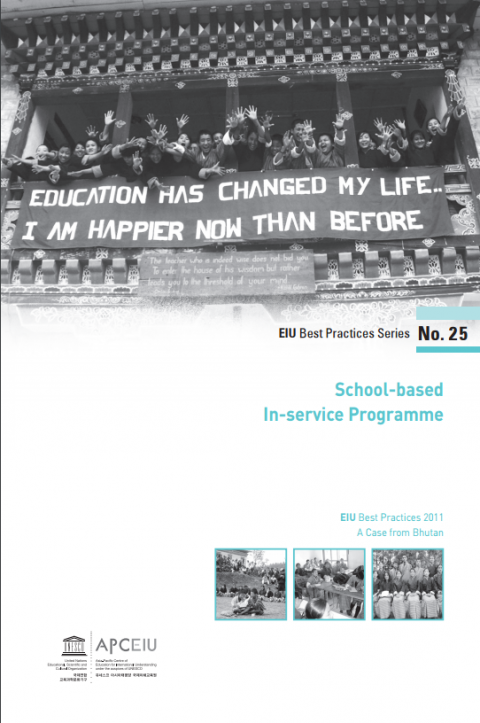 EIU Best Practices Series No. 25: School-based In-service Programme Year of publication: 2011 Author: Yeshi Pemo Corporate author: APCEIU This monograph is one of APCEIU's EIU Best Practices Series, which aims to encourage educators, scholars, and activists to implement and share local initiatives on EIU. The Series No.25 introduces the case of the Damphu Lower Secondary School in Bhutan, which carried out a number of initiatives to promote culture of peace and EIU through workshops, literary activities, and contests for students, teachers, parents, and nation-wide UNESCO clubs. The case showcases that the educators’ aspirations toward education for peace can be achieved through the combination of excellent school leadership, strong commitment, high competency, and available resources.
 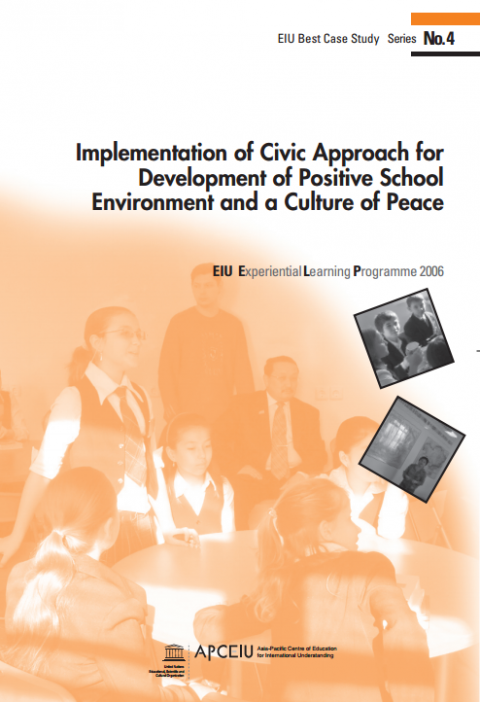 EIU Best Practices Series No. 4: Implementation of Civic Approach for Development of Positive School Environment and a Culture of Peace Year of publication: 2006 Corporate author: APCEIU This monograph is one of APCEIU's EIU Best Practices Series, which aims to encourage educators, scholars, and activists to implement and share local initiatives on EIU. The Series No.4 is an experimental research conducted by the Information and Research Center to promote culture of peace and teaching and learning outcomes that support positive development of school environment. Three pilot schools in Kazakhstan were analyzed upon implementation of teacher training workshops, instructional materials, and programs in civic and human rights education.