
Resources
Explore a wide range of valuable resources on GCED to deepen your understanding and enhance your research, advocacy, teaching, and learning.
23 Results found
 Bank of Digital Task Sheets Corporate author: Council of Europe Around forty sheets of tasks anchored in real life and reflective tasks are available. The proposed tasks implement the didactic framework that promotes a socio-interactional approach and extends the usual typology of tasks with tasks anchored in real life.These tasks, carried out on online participatory sites, allow the people who carry them out to experience both authentic (inter)actions and digital citizenship.Alongside these tasks, reflective tasks invite learners to reflect on online practices and in particular on their own uses of digital technology. They are to be adapted according to the contexts of use and provide examples of the implementation of the approach defined in the Didactic Framework. Banque de fiches de tâches numériques Corporate author: Conseil de l'Europe Une quarantaine de fiches de tâches ancrées dans la vie réelle et de tâches réflexives sont disponibles. Les tâches proposées mettent en œuvre le cadre didactique qui promeut une approche socio-interactionnelle et étend la typologie habituelle des tâches avec des tâches ancrées dans la vie réelle.Ces tâches, réalisées sur des sites participatifs en ligne, permettent aux personnes qui les réalisent de faire l'expérience, à la fois, d'(inter)actions authentiques et de la citoyenneté numérique.A côté de ces tâches, des tâches réflexives invitent les apprenant·es à réfléchir sur les pratiques en ligne et notamment sur leurs propres usages du numérique. Elles sont à adapter en fonction des contextes d'utilisation et permettent de donner des exemples de mise en œuvre de l'approche définie dans le Cadre didactique.
  Citizens as Users of Languages and Digital Technology Year of publication: 2021 Corporate author: European Centre for Modern Languages (ECML) | Council of Europe A recent meta-analysis of the literature portrays male and female citizens who are users of languages and digital technologies. This helps to understand the goals of an education aimed at developing male and female citizens capable of using digital technology in a competent, informed, safe, responsible, ethical, and critical manner. Citoyens et citoyennes usagers et usagères des langues Year of publication: 2021 Corporate author: European Centre for Modern Languages (ECML) | Conseil de l'Europe Une méta-analyse de la littérature récente dresse le portrait des citoyens et citoyennes usagers et usagères de langues et du numérique. Cela permet de connaitre les objectifs d’une éducation qui vise le développement de citoyens et citoyennes capables d’utiliser le numérique d’une façon compétente, informée, sûre, responsable, éthique et critique.
 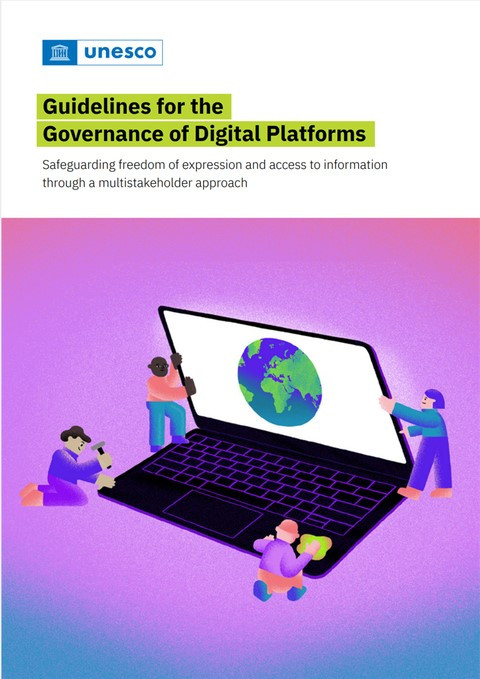 Guidelines for the governance of digital platforms: safeguarding freedom of expression and access to information through a multi-stakeholder approach Year of publication: 2023 Corporate author: UNESCO Guidelines for an Internet for TrustSafeguarding freedom of expression and the right to information while dealing with dis- and misinformation, hate speech, and conspiracy theories requires a multistakeholder approach. This is the reason why UNESCO, the leading UN agency for the promotion and protection of freedom of expression and to information, is launching Guidelines for the Governance of Digital Platforms. The Guidelines outline a set of duties, responsibilities and roles for States, digital platforms, intergovernmental organizations, civil society, media, academia, the technical community and other stakeholders to enable the environment where freedom of expression and information are in the core of digital platforms governance processes. The Guidelines were produced through a multi-stakeholder consultation that gathered more than 10,000 comments from 134 countries. These global-scale consultations fostered inclusive participation, ensuring a diversity of voices to be heard, including those from groups in situation of marginalization and vulnerability. Cultivating an Internet of Trust is a shared responsibility among all stakeholders. It calls upon us all to sustain an enabling environment for freedom of expression and the right to information.
  The Butterfly Effect on Social Networks Year of publication: 2021 Corporate author: Canada Learning Code This video shows the dangers of the internet and social networks through the story of 12-year-old Amira in the form of a comic strip. L'effet papillon sur les réseaux sociaux Year of publication: 2021 Corporate author: Canada Learning Code Cette vidéo montre les dangers d'internet et des réseaux sociaux à travers l'histoire d'Amira 12 ans sous la forme d'une bande dessinée.
 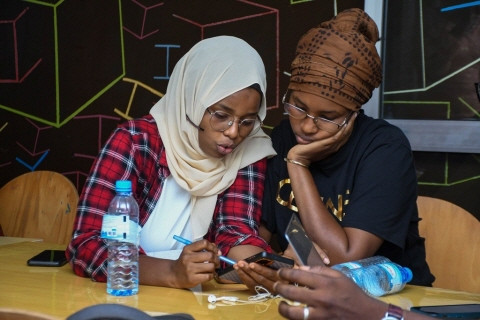 Fighting Against Disinformation and Hate Speech Year of publication: 2024 Corporate author: Association of Guinean Bloggers (ABLOGUI) This online MOOC is completely free. It is offered by the Association des Blogueurs de Guinée (ABLOGUI) through the IMPACT project (Implication of Digital Media in the Active Prevention of Conflicts and Tensions). It aims at raising awareness among young Guineans of the dangers of misinformation and hate speech, and to equip them with the knowledge and skills they need to combat information disorder in a digital world. Lutte contre la désinformation et les propos haineux Year of publication: 2024 Corporate author: Association of Guinean Bloggers (ABLOGUI) Ce MOOC en ligne est entièrement gratuit. Il est proposé par l'Association des Blogueurs de Guinée (ABLOGUI) dans le cadre du projet IMPACT (Implication des médias numériques dans la prévention active des conflits et des tensions). Il vise à sensibiliser les jeunes Guinéens aux dangers de la désinformation et des discours de haine, et à les doter des connaissances et des compétences nécessaires pour lutter contre le désordre de l'information dans un monde numérique.
  Are Journalists Objective?: The Keys to the Media Year of publication: 2021 Corporate author: Centre pour l’éducation aux médias et à l’information (CLEMI) Dans cette vidéo proposée par Clemi nous suivons l'arrivée d'une nouvelle professeur de mathématiques dans un collège. Chacun a un avis très tranché sur elle. Kamel l’adore, Cindy ne comprend rien à ce qu’elle raconte, Leonard la trouve sévère et Fama l’aime bien. Qui a raison, qui a tort ? Peut-être un peu tout le monde… Chacun la regarde selon son point de vue. Cette comparaison permet de s'interroger sur l'objectivité des médias. In this video from Clemi, we follow the arrival of a new maths teacher at a secondary school. Everyone has a very strong opinion of her. Kamel adores her, Cindy doesn't understand a word she says Leonard thinks she's harsh and Fama likes her. Who's right, who's wrong? Maybe a bit of everyone... Everyone looks at her from their own point of view. This comparison raises questions about the objectivity of the media.