
Resources
Explore a wide range of valuable resources on GCED to deepen your understanding and enhance your research, advocacy, teaching, and learning.
39 Results found
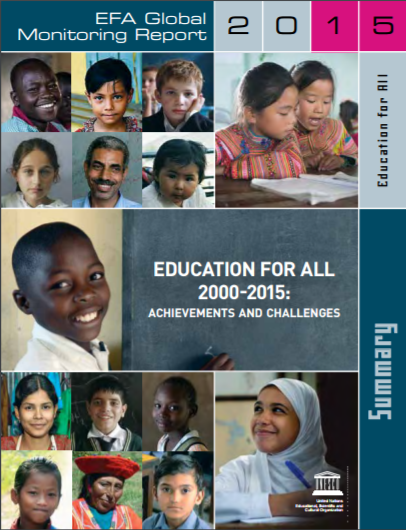 모두를 위한 교육 2000-2015: 성과와 과제; EFA 세계 현황 보고서, 2015; 요약본 Year of publication: 2015 Corporate author: 유네스코 At the World Education Forum in Dakar, Senegal, in 2000, governments from 164 countries, together with representatives of regional groups, international organizations, donor agencies, non-government organizations (NGOs) and civil society, adopted a Framework for Action to deliver Education for All (EFA) commitments. The Dakar Framework comprised 6 goals and their associated targets to be achieved by 2015, and 12 strategies to which all stakeholders would contribute. The EFA Global Monitoring Report (GMR) has monitored progress on an almost annual basis towards the EFA goals and the two education-related Millennium Development Goals (MDGs). The 2015 GMR provides a complete assessment of progress since 2000 towards the target date for reaching the Dakar Framework’s goals. It takes stock of whether the world achieved the EFA goals and stakeholders upheld their commitments. It explains possible determinants of the pace of progress. Finally, it identifies key lessons for shaping the post-2015 global education agenda.
 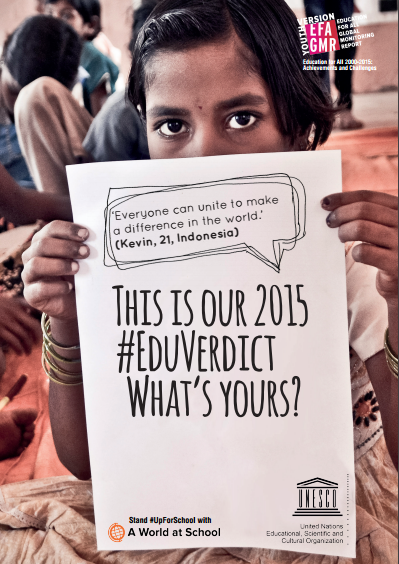 Education for All 2000-2015: Achievements and Challenges; Education for All Global Monitoring Report, 2015; Youth Version Year of publication: 2015 Corporate author: UNESCO This report highlights the progress and challenges of education that countries have faced over 15 years, brining together the voices of young people to show how Education for All (EFA) has affected their lives and hope for the future. L'Education pour tous 2000-2015: progrès et enjeux, rapport mondial de suivi sur l'EPT, 2015, youth version Year of publication: 2015 Corporate author: UNESCO This report highlights the progress and challenges that countries have faced over 15 years, brining together the voices of young people to show how Education for All (EFA) has affected their lives. La Educación para Todos, 2000-2015: logros y desafíos, informe de seguimiento de la EPT en el mundo, 2015: youth version Year of publication: 2015 Corporate author: UNESCO This report highlights the progress and challenges that countries have faced over 15 years, brining together the voices of young people to show how Education for All (EFA) has affected their lives. 这是我们的2015 教育回望#EduVerdict 你的呢? Year of publication: 2015 Corporate author: UNESCO This report highlights the progress and challenges that countries have faced over 15 years, brining together the voices of young people to show how Education for All (EFA) has affected their lives. Other lang. title: L'Education pour tous 2000-2015: progrès et enjeux, rapport mondial de suivi sur l'EPT, 2015, résumé; La Educación para Todos, 2000-2015: logros y desafíos, informe de seguimiento de la EPT en el mundo, 2015, resumen Year of publication: 2015 Corporate author: UNESCO At the World Education Forum in Dakar, Senegal, in 2000, governments from 164 countries, together with representatives of regional groups, international organizations, donor agencies, non-government organizations (NGOs) and civil society, adopted a Framework for Action to deliver Education for All (EFA) commitments. The Dakar Framework comprised 6 goals and their associated targets to be achieved by 2015, and 12 strategies to which all stakeholders would contribute. The EFA Global Monitoring Report (GMR) has monitored progress on an almost annual basis towards the EFA goals and the two education-related Millennium Development Goals (MDGs). The 2015 GMR provides a complete assessment of progress since 2000 towards the target date for reaching the Dakar Framework’s goals. It takes stock of whether the world achieved the EFA goals and stakeholders upheld their commitments. It explains possible determinants of the pace of progress. Finally, it identifies key lessons for shaping the post-2015 global education agenda. Образование для всех 2000-2015 гг.: достижения и вызовы, всемирный доклад по мониторингу ОДВ, 2015 г., резюме Year of publication: 2015 Corporate author: Организация Объединенных Наций по вопросам образования, науки и культуры (UNESCO) At the World Education Forum in Dakar, Senegal, in 2000, governments from 164 countries, together with representatives of regional groups, international organizations, donor agencies, non-government organizations (NGOs) and civil society, adopted a Framework for Action to deliver Education for All (EFA) commitments. The Dakar Framework comprised 6 goals and their associated targets to be achieved by 2015, and 12 strategies to which all stakeholders would contribute. The EFA Global Monitoring Report (GMR) has monitored progress on an almost annual basis towards the EFA goals and the two education-related Millennium Development Goals (MDGs). The 2015 GMR provides a complete assessment of progress since 2000 towards the target date for reaching the Dakar Framework’s goals. It takes stock of whether the world achieved the EFA goals and stakeholders upheld their commitments. It explains possible determinants of the pace of progress. Finally, it identifies key lessons for shaping the post-2015 global education agenda. 2000-2015年 全民教育: 成就与挑战; 全民教育 全球监测报告, 2015; 摘 要 Year of publication: 2015 Corporate author: UNESCO At the World Education Forum in Dakar, Senegal, in 2000, governments from 164 countries, together with representatives of regional groups, international organizations, donor agencies, non-government organizations (NGOs) and civil society, adopted a Framework for Action to deliver Education for All (EFA) commitments. The Dakar Framework comprised 6 goals and their associated targets to be achieved by 2015, and 12 strategies to which all stakeholders would contribute. The EFA Global Monitoring Report (GMR) has monitored progress on an almost annual basis towards the EFA goals and the two education-related Millennium Development Goals (MDGs). The 2015 GMR provides a complete assessment of progress since 2000 towards the target date for reaching the Dakar Framework’s goals. It takes stock of whether the world achieved the EFA goals and stakeholders upheld their commitments. It explains possible determinants of the pace of progress. Finally, it identifies key lessons for shaping the post-2015 global education agenda. Education for All 2000-2015: Achievements and Challenges; EFA Global Monitoring Report, 2015; Summary Year of publication: 2015 Corporate author: UNESCO At the World Education Forum in Dakar, Senegal, in 2000, governments from 164 countries, together with representatives of regional groups, international organizations, donor agencies, non-government organizations (NGOs) and civil society, adopted a Framework for Action to deliver Education for All (EFA) commitments. The Dakar Framework comprised 6 goals and their associated targets to be achieved by 2015, and 12 strategies to which all stakeholders would contribute. The EFA Global Monitoring Report (GMR) has monitored progress on an almost annual basis towards the EFA goals and the two education-related Millennium Development Goals (MDGs). The 2015 GMR provides a complete assessment of progress since 2000 towards the target date for reaching the Dakar Framework’s goals. It takes stock of whether the world achieved the EFA goals and stakeholders upheld their commitments. It explains possible determinants of the pace of progress. Finally, it identifies key lessons for shaping the post-2015 global education agenda. L'Education pour tous 2000-2015: progrès et enjeux, rapport mondial de suivi sur l'EPT, 2015, résumé Year of publication: 2015 Corporate author: Organisation des Nations Unies pour l'éducation, la science et la culture (UNESCO) At the World Education Forum in Dakar, Senegal, in 2000, governments from 164 countries, together with representatives of regional groups, international organizations, donor agencies, non-government organizations (NGOs) and civil society, adopted a Framework for Action to deliver Education for All (EFA) commitments. The Dakar Framework comprised 6 goals and their associated targets to be achieved by 2015, and 12 strategies to which all stakeholders would contribute. The EFA Global Monitoring Report (GMR) has monitored progress on an almost annual basis towards the EFA goals and the two education-related Millennium Development Goals (MDGs). The 2015 GMR provides a complete assessment of progress since 2000 towards the target date for reaching the Dakar Framework’s goals. It takes stock of whether the world achieved the EFA goals and stakeholders upheld their commitments. It explains possible determinants of the pace of progress. Finally, it identifies key lessons for shaping the post-2015 global education agenda.