
Resources
Explore a wide range of valuable resources on GCED to deepen your understanding and enhance your research, advocacy, teaching, and learning.
27 Results found
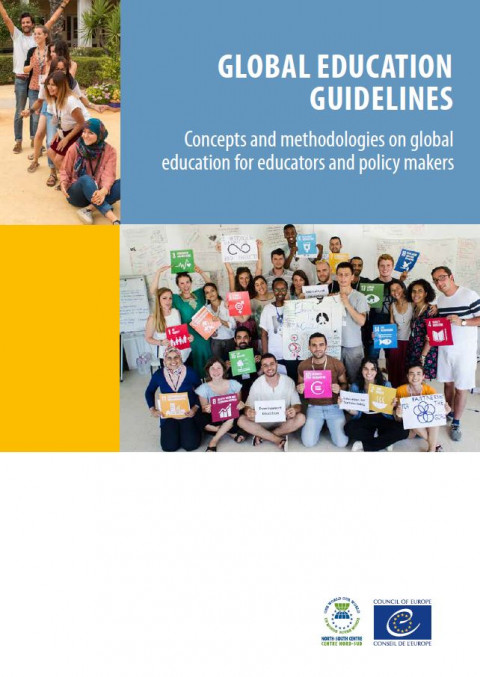 Pautas para una Educación Global: Manual para que las y los educadores entiendan e implementen una educación global Year of publication: 2019 Corporate author: North-South Centre of the Council of Europe | Council of Europe Esta guía práctica para la educación para la ciudadanía mundial responde a una necesidad expresada por los profesionales de la red de la Semana de Educación para la Ciudadanía Mundial del Centro Norte-Sur (CNS) del Consejo de Europa, quienes expresaron su deseo de tener un instrumento común, configurado a la luz de la experiencia adquirida por la red y otros socios, que pueden ayudar a los educadores a diseñar y llevar a cabo iniciativas en GCED. Esta guía práctica para la educación para la ciudadanía mundial responde a una necesidad expresada por los profesionales de la red de la Semana de Educación para la Ciudadanía Mundial del Centro Norte-Sur (CNS) del Consejo de Europa, quienes expresaron su deseo de tener un instrumento común, configurado a la luz de la experiencia adquirida por la red y otros socios, que pueden ayudar a los educadores a diseñar y llevar a cabo iniciativas en GCED.
  Educación de adultos y desarrollo: La educación para la ciudadanía mundial (no 82, 2015) Year of publication: 2015 Corporate author: DVV International Issue 82/2015 of the international journal Adult Education and Development (AED) explores the topic global citizenship education.In the international debates, we are witnessing a growing interest in the concept of global citizenship education. It is one of the three pillars of the Global Education First Initiative (GEFI) launched by the United Nations Secretary-General in 2012 and is being internationally promoted by the work of UNESCO. According to the GEFI, education that fosters global citizenship “must fully assume its central role in helping people to forge more just, peaceful, tolerant and inclusive societies”. The 2030 Agenda for Sustainable Development, adopted by the United Nations General Assembly in September 2015, refers to global citizenship as one tool to “ensure that all learners acquire the knowledge and skills needed to promote sustainable development”.The ambitions are high, but the concrete understanding of global citizenship education and its implications differ widely. Is it just another abstract concept? What meaning can the word citizenship have if it does not refer to a specific nation? What do people in different parts of the world understand by global citizenship? And how can global citizenship education be put into practice?Adult Education and Development decided to engage in the debate and invited authors from different regions, backgrounds and disciplines to share their thoughts and experiences on the topic and related questions such as identity, migration, peace, the meaning of citizenship, globalisation and sustainable development.Irina Bokova, Director-General of UNESCO, explains the organisation’s understanding of global citizenship education, and why adult education and “learning beyond the classrooms” are crucial when it comes to promoting global citizenship. Canadian author and journalist Doug Saunders (“Arrival City: How the Largest Migration in History Is Reshaping Our World”) talks about the challenges and opportunities of what he refers to as the last great human migration, that from the countryside to the cities, and about the positive role adult education can play during this transition.In the section “Citizens’ voices” people from all over the world talk about what global citizenship means to them and in what ways they see themselves as global citizens. And photographer Viktor Hilitksi travelled through Belarus and captured with his camera how villages rediscover their local traditions and cultures.
  Localización de la agenda 2030 y la educación para la ciudadanía global: Un diálogo imprescindible Year of publication: 2020 Corporate author: Diputació de Barcelona Este documento pretende contribuir al diálogo entre los procesos de localización de la Agenda 2030 y la ECG, así como ofrecer orientaciones concretas para la acción local.
  La Educación para la ciudadanía global: Una apuesta por la democracia Year of publication: 2019 Author: Manuela Mesa Corporate author: Autonomous University of Madrid | Red Iberoamericana de Investigación sobre Cambio y Eficacia Escolar (RINACE) En este artículo se hace una reflexión sobre el papel de la educación en el actual contexto internacional, marcado por profundos cambios y por una situación de incertidumbre e inestabilidad y de retroceso en derechos. Se abordan los diversos marcos interpretativos que explican el mundo actual y que se articulan en torno al eje global-local y al eje identitario. En un mundo caracterizado por la complejidad y la rapidez de cambios es muy importante superar la compartimentalización del conocimiento en áreas estanco (matemáticas, sociales, lengua, etc.) para abordarlo de manera global. La educación como práctica transformadora no puede estar al margen de los grandes retos que enfrenta la humanidad en el ámbito nacional y multilateral. La Agenda 2030 y los Objetivos de Desarrollo Sostenible abre oportunidades para consolidar la educación para la ciudadanía global.
  Good Practices in Education for Global Citizenship: XI Edition of the “Vicente Ferrer” National Prize for Education for Development Year of publication: 2021 Author: Rosa Elena Román Pajares | Concepción Aránzazu Vilor Barros | Jose Manuel de Frutos San Miguel | Lara Ormeño Vasco | Uxua Azpiroz Armendáriz | Susana Álvarez Martínez | Liliana Piñeiro Piñeiro | Silvia Lijó López | Clara Díaz-Salazar de la Flor | Susana Gómez Garzón | Encarnación Díaz Carmona | Isabel Santacruz Prieto | José Antonio Guillén Medina | Raquel Jiménez Gutiérrez | Josefa Mª Amorós Campos | Raimundo Fenoll Pellin | Mª Teresa García de Dios | Juan Antonio Pérez Orquín | Mª José Amorós Martínez | Mª Paz Ruiz Barrero | María Soledad Aneas Franco | Isabel Hermoso Lorente | José Julio Fuentes López | Mª Covadonga Villimer Sandoval | Luis Agudo Jiménez | David Jiménez Góme Corporate author: Spain. Ministry of Foreign Affairs, European Union and Cooperation (MAEUEC) | Spanish Agency for International Development Cooperation (AECID) This publication is part of the Collection of good practices in education for global citizenship that the MEFP and the AECID have been publishing since the first edition of the “Vicente Ferrer” National Education Award for development and includes, in this new format, the 15 winning proposals from the 11th edition of 2019. The “Vicente Ferrer” National Development Education Award aims to empower students so that the 2030 Agenda and the Sustainable Development Goals are the engine of change that the planet needs for its advancement and transformation, both on the social and environmental levels. The Award promotes the sense of global citizenship, respect and care for the environment, as well as the values of social justice, solidarity, equality, inclusion and peace. Buenas prácticas en educación para la ciudadanía global: XI edición Premio Nacional de Educación para el Desarrollo "Vicente Ferrer" Year of publication: 2021 Author: Rosa Elena Román Pajares | Concepción Aránzazu Vilor Barros | Jose Manuel de Frutos San Miguel | Lara Ormeño Vasco | Uxua Azpiroz Armendáriz | Susana Álvarez Martínez | Liliana Piñeiro Piñeiro | Silvia Lijó López | Clara Díaz-Salazar de la Flor | Susana Gómez Garzón | Encarnación Díaz Carmona | Isabel Santacruz Prieto | José Antonio Guillén Medina | Raquel Jiménez Gutiérrez | Josefa Mª Amorós Campos | Raimundo Fenoll Pellin | Mª Teresa García de Dios | Juan Antonio Pérez Orquín | Mª José Amorós Martínez | Mª Paz Ruiz Barrero | María Soledad Aneas Franco | Isabel Hermoso Lorente | José Julio Fuentes López | Mª Covadonga Villimer Sandoval | Luis Agudo Jiménez | David Jiménez Góme Corporate author: Spain. Ministry of Foreign Affairs, European Union and Cooperation (MAEUEC) | Spanish Agency for International Development Cooperation (AECID) Esta publicación forma parte de la Colección de buenas prácticas en educación para la ciudadanía global que el MEFP y la AECID han venido publicando desde la primera edición del Premio Nacional de Educación para el desarrollo "Vicente Ferrer" y recoge, en este nuevo formato, las 15 propuestas ganadoras de la XI edición del 2019. El Premio Nacional de Educación para el Desarrollo "Vicente Ferrer" pretende empoderar al alumnado para que la Agenda 2030 y los Objetivos de Desarrollo Sostenible sean el motor de cambio que el planeta necesita para su avance y transformación, tanto en el plano social, como en el ambiental. El Premio impulsa el sentido de ciudadanía global, el respeto y el cuidado del medio ambiente, así como los valores de justicia social, solidaridad, igualdad, inclusión y paz.
  The Contribution of the New Mexican Culture to Education for World Citizenship(Sinéctica, Revista electrónica de educación; no. 60) Year of publication: 2023 Author: Gloria Esther Briceño Alcaraz Corporate author: Sinéctica, Revista Electrónica de Educación A couple of years ago, UNESCO suggested transforming educational models based on an in-tegral and humanist paradigm in order to train new generations with a social and civic di-mension, based on human rights. In this essay we propose to analyze the work of education as a preferential instrument not only to develop traditional school skills, but also as an ac-tion to form citizens with a sense of responsibility and social self-awareness that promote a culture of peace. The citizen-subject represents an identity or discursive construction that is forged in the social framework in which it is situated, always in tension between individual freedom, autonomy and collective normative frameworks (Cerda, 2004), hence the interest in approaching from a critical perspective of discourse analysis (Van Dijk, 2014) to the pro-posal of the new educational model of Mexico called the New Mexican School (2022) and open the discussion on this pedagogical model and the formative fields that affect education for global citizenship. El aporte de la nueva cultura mexicana a la educación para la ciudadanía mundial(Sinéctica, Revista electrónica de educación; núm. 60) Year of publication: 2023 Author: Gloria Esther Briceño Alcaraz Corporate author: Sinéctica, Revista Electrónica de Educación La UNESCO sugirió hace un par de años transformar los modelos educativos con base en un paradigma integral y humanista a fin de formar a las nuevas generaciones con dimensión social y ciudadana, cuya base fueran los derechos humanos. En este ensayo nos planteamos analizar el quehacer de la educación como instrumento preferente no solo para desarrollar las capacidades escolares tradicionales, sino como acción formadora de ciudadanos con sentido de responsabilidad y autoconciencia social que promuevan una cultura de paz. El sujeto-ciudadano representa una construcción identitaria o discursiva que se va forjando en el entramado social en el que este se sitúa, siempre en tensión entre la libertad individual, la autonomía y los marcos normativos colectivos (Cerda, 2004), de ahí el interés en aproximarnos desde una perspectiva crítica del análisis del discurso (Van Dijk, 2014) a la propuesta de la llamada nueva escuela mexicana (2022) y abrir la discusión sobre este modelo pedagógico y los campos formativos que inciden en la educación para la ciudadanía mundial.
  Imaginando una educación para la ciudadanía global después del Covid-19 Year of publication: 2020 Author: Marta Estelles | Gustavo E. Fischman Corporate author: State University of Ponta Grossa La pandemia del Covid 19 ha creado condiciones sin precedentes en todas las áreas de la vida. A medida que la suspensión de las actividades escolares se ha convertido en "la nueva normalidad", numerosos expertos y formadores de opinión se han apresurado a lanzar sus recomendaciones a gobiernos y organizaciones educativas para normalizar las operaciones escolares. En este contexto novedoso, analizamos las propuestas para expandir el modelo de Educación para la Ciudadanía Global (ECG) que está siendo cada vez más apoyada por organizaciones internacionales, gobiernos y académicos.En este artículo, sostenemos que la orientación redentora que los modelos y propuestas de ECG han desarrollado en las últimas décadas resulta muy limitada para entender y resolver problemas actuales como la restricción de derechos de privacidad de la ciudadanía o el fortalecimiento de los nacionalismos excluyentes. En cambio, se necesitan modelos más realistas de ECG. Este documento concluye con nuevas preguntas para robustecer el debate y las alternativas para imaginar una ECG realista y no redentora. Palabras clave: Educación para la ciudadanía global. Pandemia de Covid-19. Pedagogía redentora. Educar para una ciudadanía global: construir un mundo justo desde la escuela Year of publication: 2009 Author: Colette Grech | Roderick Mallia | William Grech Corporate author: Conectando Mundos Consortium (Cidac, inizjamed, Intermon Oxfam, Ucodep) This publication is based on an initiative about the development education, intercultural education, popular education, the education of values, human rights education, education for sustainability, education for peace, education for gender equality, etc. The pedagogical proposal of Global Citizenship Education aspires to integrate in a coherent and challenging vision all these themes, keeping them in a close relationship with one another and taking into consideration the (increasing) interdependence of human beings living in a planet whose sustainability is under threat. This book is the fruit of a process that was triggered off by the joint effort of four European development NGOs, namely Cidac, Inizjamed, Intermón Oxfam and Ucodep within the frame of a project co-financed by the European Commission. These organisations set for themselves the objective to promote the acknowledgment and the inclusion of the contents and the methodology of Global Citizenship Education in the formal educational contexts in their respective countries, in order to kick-start a process of change in attitudes, values, and the beliefs of the pupils. Thanks to the initiative and efforts of the above-mentioned four organisations, and through various meetings and seminars carried out over the last three years in Spain, Italy, Portugal and Malta, groups of educators have been able to come face-to-face with each other, exchange experiences and reflect on the role of formal education with respect to the challenges of our times. Among the other experiences, the publication contains that of a key moment in the process. This took place in July 2008 in Cortona, a small and beautiful Tuscan city close to the border with Umbria, and in which many educators shared the benefit of what was the first international encounter of educators for global citizenship. The Cortona experience, in which around ninety teachers coming from Spain, Portugal, Malta, Italy, the Dominican Republic and Costa Rica have participated, was one of the stages – the starting point, in fact – of a process and a relationship that it is our aim to develop at the regional, national and international levels. In this publication, therefore, one can find theoretical cues put forward at Cortona that encourage educators to share their experiences and to compare the work done by different groups.This publication has two parts. The first part contains contributions of a theoretical type, whereas the second part concentrates on the educational experiences of the participants in the Cortona meeting.