
Resources
Explore a wide range of valuable resources on GCED to deepen your understanding and enhance your research, advocacy, teaching, and learning.
31 Results found
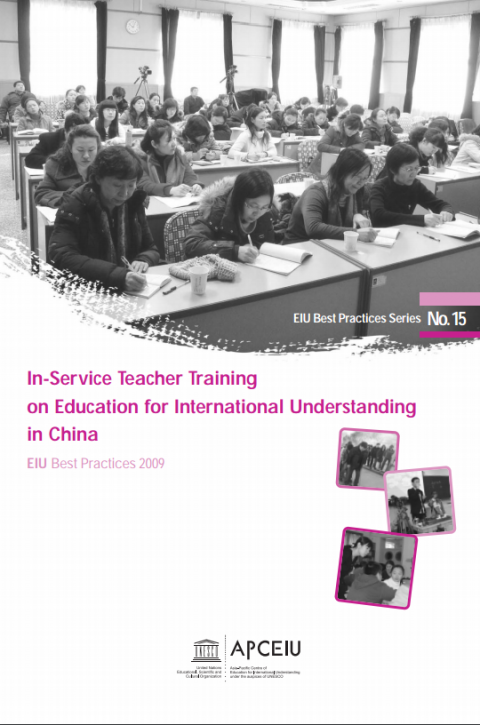 EIU Best Practices Series No.15: In-service teacher training on education for international understanding in China Year of publication: 2009 Author: Yu Xin Corporate author: APCEIU This document introduces an effective and systematic in-service teacher training programme on Education for International Understanding (EIU) in Beijing, China. In order for this training to take place, the Beijing Institute of Education (BIE) has been working to develop a school-based curriculum on EIU to be implemented in local schools. Through this effort, the in-service teacher training programme on EIU motivated and strengthened the capacity of teachers to incorporate EIU curriculum into various subjects they teach in schools. As a result of this practice, schools in which EIU have been implemented, raised the level of global awareness among their teachers and students. This effort to promote EIU in Beijing is an excellent model for policy makers, curriculum developers and educators to learn the effective strategies to promote EIU in schools.
 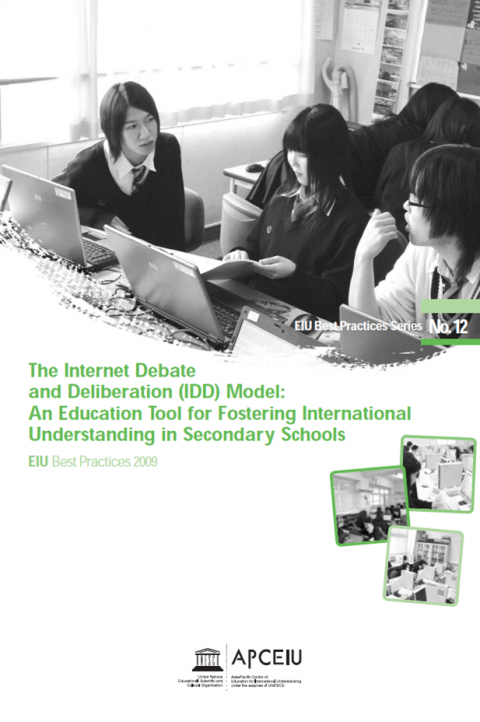 EIU Best Practice Series No. 12: The Internet Debate and Deliberation (IDD) Model: An Education Tool for Fostering International Understanding in Secondary Schools Year of publication: 2009 Author: Rose Sabanal Corporate author: APCEIU This document introduces a case of the internet-based debate and deliberation with an aim to strengthen critical and integrated thinking among high school students from various countries. The case demonstrates that the school in case has been making a devoted effort to develop effective methods of communication among young people with different cultural backgrounds and perspectives, eventually leading to the development of educational content that will enable young learners to critically reflect on highly contending issues of EIU.
 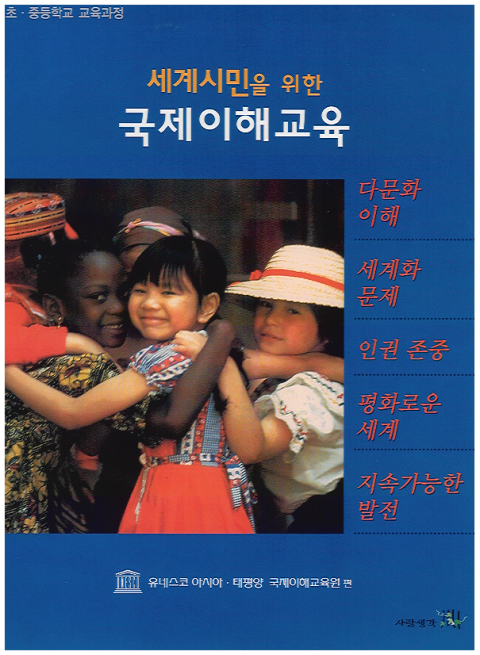 세계시민을 위한 국제이해교육 Year of publication: 2003 Corporate author: APCEIU International Commission on Education for the Twenty-first Century of UNESCO proposed “Learning to Live Together” as the worldwide educational goal at the twenty-first century. Also, as many countries have become multiethnic or multicultural societies due to increasing interdependences, globalization and ICT, the necessity and importance of Education for International Understanding (EIU) on how to live in harmony with others is growing. In Korea, EIU was included as a selective subject for creative experience activities in the seventh national curriculum and the number of schools teaching EIU on the ground has been increasing since 2000. However, in many cases what to teach was left up to teachers’ discretion owing to the lack of clear guidelines or materials. This book is comprised of systematized educational goals and contents in accordance with primary and secondary school curricula, and was developed by Asia-Pacific Centre for Education for International Understanding (APCIEU) under the auspices of UNESCO for its first three years since its establishment in 2000. EIU as a school subject aims to provide students with knowledge, values and ethical attitudes needed for the people of global society to move beyond the borders of ethnicity, culture and religion into a life of peaceful coexistence. Within the frame of EIU, students learn about cultural relativity and universal values. Based on holistic perspective, this book is designed with the following five units - multicultural understanding, issues of globalization, respect for human rights, a peaceful world, and sustainable development - to be utilized for learning at the level of primary and secondary level students.
 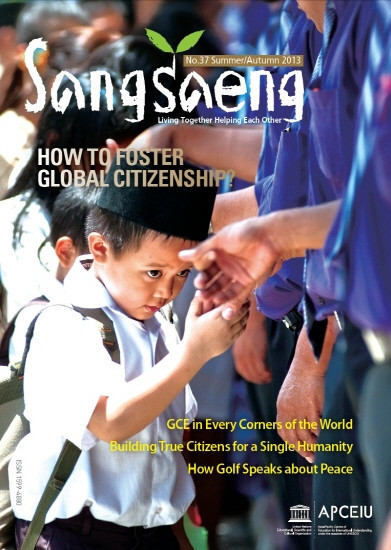 Building a global community out of the ashes of poverty (SangSaeng no. 37 summer autumn 2013) Year of publication: 2013 Corporate author: APCEIU SangSaeng No. 37- How to Foster Global Citizenship? has been published. In order to help our readers better grasp the concept of global citizenship and provide useful information and new ideas, this issue deals with various aspects of global citizenship education.3 Director’s Message4 Special ColumnBuilding True Citizens for a Single Humanity8 Focus: How to Foster Global Citizenship?8 Eliminating World Challenges through Global Citizenship Education 13 Developing Global Citizens with a Global Perspective18 Living in a New World Starts with Education23 GCE in Every Corners of the World28 Best Practices28 Hands-on Hand Print for Environmental Sustainability32 Bhutan Teachers Learn New Models of Education35 Comic Relief: Song of the City36 Special ReportPaving the Way Together for Global Citizenship Education40 InterviewBuilding a Global Community out of the Ashes of Poverty42 LetterCapturing Moments of Living in Harmony44 Peace in My MemoryHow Golf Speaks about Peace47 Understanding the Asia-Pacific RegionDiscovering Locks beyond the Function of Opening and Closing50 APCEIU in Action
 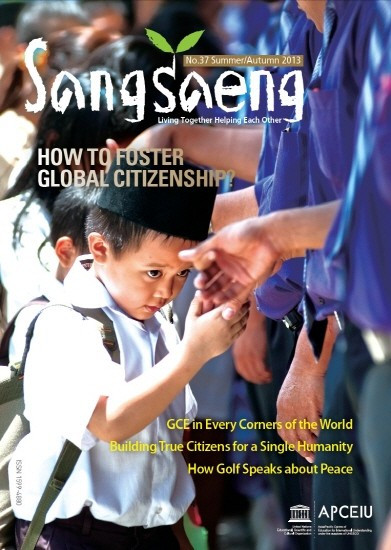 Paving the way together for global citizenship education (SangSaeng no. 37 summer autumn 2013) Year of publication: 2013 Corporate author: APCEIU SangSaeng No. 37- How to Foster Global Citizenship? has been published. In order to help our readers better grasp the concept of global citizenship and provide useful information and new ideas, this issue deals with various aspects of global citizenship education.3 Director’s Message4 Special ColumnBuilding True Citizens for a Single Humanity8 Focus: How to Foster Global Citizenship?8 Eliminating World Challenges through Global Citizenship Education 13 Developing Global Citizens with a Global Perspective18 Living in a New World Starts with Education23 GCE in Every Corners of the World28 Best Practices28 Hands-on Hand Print for Environmental Sustainability32 Bhutan Teachers Learn New Models of Education35 Comic Relief: Song of the City36 Special ReportPaving the Way Together for Global Citizenship Education40 InterviewBuilding a Global Community out of the Ashes of Poverty42 LetterCapturing Moments of Living in Harmony44 Peace in My MemoryHow Golf Speaks about Peace47 Understanding the Asia-Pacific RegionDiscovering Locks beyond the Function of Opening and Closing50 APCEIU in Action
 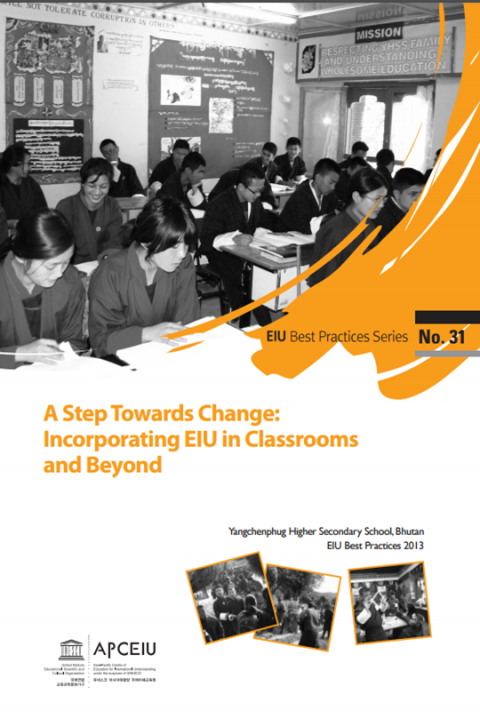 EIU Best Practices Series No.31: A Step towards Change: Incorporating EIU in Classrooms and Beyond Year of publication: 2013 Corporate author: APCEIU This monograph is one of APCEIU's EIU Best Practices Series, which aims to encourage educators, scholars, and activists to implement and share local initiatives on EIU. The Series No.31 introduces a case study in which Bhutanese school carried out activities and curriculum development to successfully promote EIU and ESD for students and teachers. While the school’s curriculum already embodies a degree of EIU, the school strived to be more creative in upholding the existing content by exploring newer issues of media ethics, human rights, culture, and environmental conservation for fruitful engagement. This in turn allowed the target audience to learn the values of EIU/ESD for a culture of peace.
 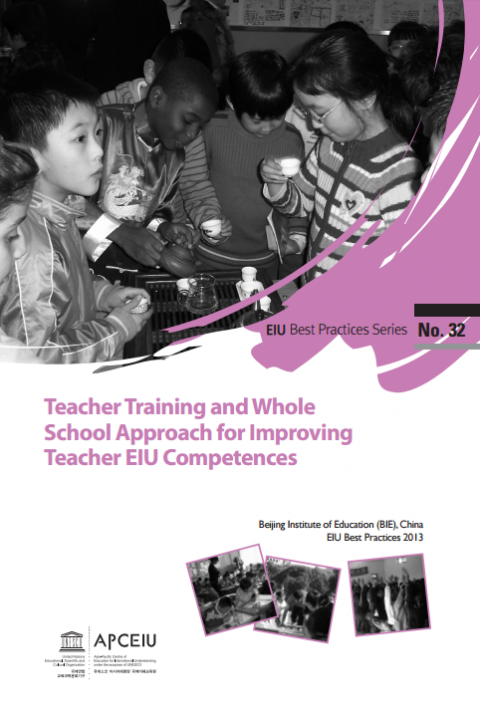 EIU Best Practices Series No.32: Teacher Training and Whole School Approach for Improving Teacher EIU Competences Year of publication: 2013 Corporate author: APCEIU This monograph is one of APCEIU's EIU Best Practices Series, which aims to encourage educators, scholars, and activists to implement and share local initiatives on EIU. The Series No.32 introduces two cases in which primary and secondary school teachers in Beijing were trained to promote EIU in respective communities. As teachers developed their EIU competence and awareness, students learned to be more open-minded, respectful, and tolerant. The issue highlights the important role educators have in instilling EIU values and shaping perception.
 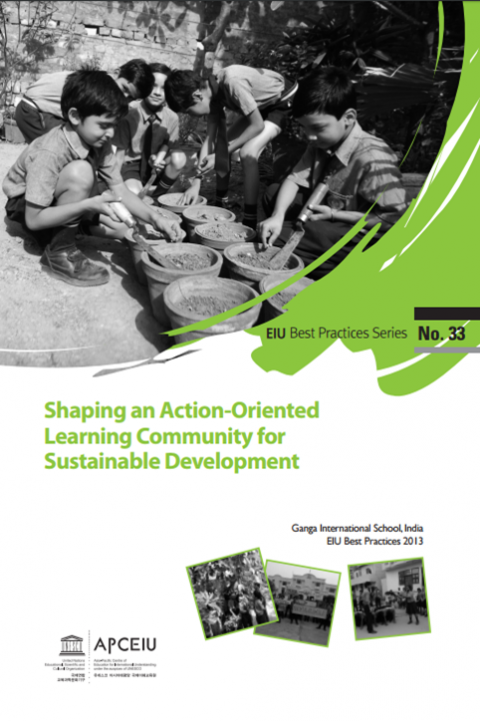 EIU Best Practices Series No.33: Shaping an Action-Oriented Learning Community for Sustainable Development Year of publication: 2013 Corporate author: 유네스코 아시아태평양 국제이해교육원 This monograph is one of APCEIU's EIU Best Practices Series, which aims to encourage educators, scholars, and activists to implement and share local initiatives on EIU. The Series No.33 introduces a program implemented at the Ganga International School in India to promote eco-friendly and multicultural society. Teachers, students, and local community members engaged in awareness raising events such as Recycled Paper Art exhibition, Tree Plantation Drive, and Anti-Malaria Project, allowing everyone to absorb the meaning of EIU and sustainable development. Furthermore, students partook in seed exchange program and video conferences to discuss environmental issues with students of partner schools, which amplified impact at local and global levels.
 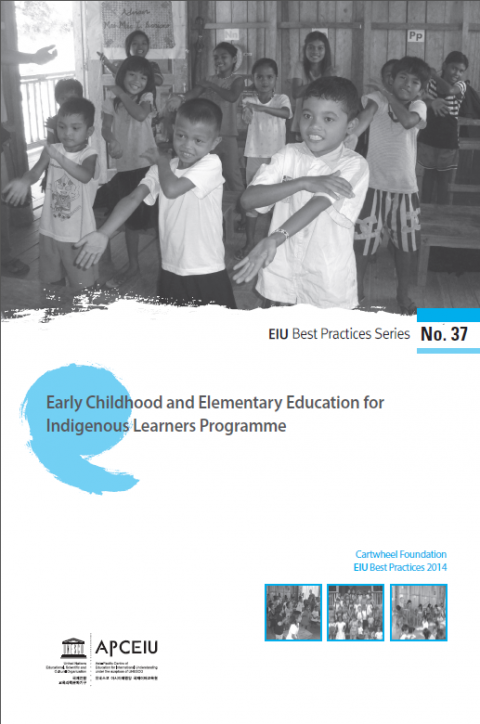 EIU Best Practices Series No.37: Early Childhood and Elementary Education for Indigenous Learners Programme Year of publication: 2014 Corporate author: APCEIU This monograph is one of APCEIU's EIU Best Practices Series, which aims to encourage educators, scholars, and activists to implement and share local initiatives on EIU. The Series No.37 introduces the Early Childhood and Elementary Education (ECEE) for Indigenous Learners Programme initiated in the Philippines. The indigenous peoples (IP) reside in the mountainous regions, away from basic social services and struggling with poverty, malnutrition, and lack of proper education. The aim of ECEE is to facilitate access to quality and culturally-relevant early childhood and elementary education for the Higaonon indigenous children. To achieve this, activities such as curriculum indigenization and teacher training are provided in collaboration with the community members. As the program creates learning process for all through openness, sharing, and collaboration, this is an exemplary case of EIU/GCED pedagogical approach.
  The Recommendation on Education for Peace, Human Rights and Sustainable Development: An Explainer Year of publication: 2024 Corporate author: UNESCO This is an explainer brochure of the new UNESCO Recommendation on Education for Peace and Human Rights, International Understanding, Cooperation, Fundamental Freedoms, Global Citizenship and Sustainable Development, which is commonly referred to as the Recommendation on Education for Peace, Human Rights and Sustainable Development, about its purpose, history, content and potential to bring about necessary change.