
Resources
Explore a wide range of valuable resources on GCED to deepen your understanding and enhance your research, advocacy, teaching, and learning.
249 Results found
 Address by Irina Bokova, Director-General of UNESCO on the occasion of the opening of the PGA High-Level SDG Action Event on Education SDG4 Year of publication: 2017 Corporate author: UNESCO. Director-General, 2009-2017 (Bokova, I.G.) This address was given by Irina Bokova, Director-General of UNESCO on the occasion of the opening of the PGA High-Level SDG Action Event on Education SDG4. Education for sustainable development country guidelines for changing the climate of teacher education to address sustainability: putting transformative education into practice Year of publication: 2011 Corporate author: UNESCO Jakarta This document on ESD Country Guidelines for TEIs is the result of the Regional Training Workshop Programme, titled “Developing Capacities of Teacher Education Institutions (TEIs) of Brunei Darussalam, Indonesia, Malaysia, Philippines and Timor-Leste in Reorienting Teacher Education to Address Sustainability” and has been developed by the five cluster countries of the UNESCO Office, Jakarta. The developed guidelines ultimately aim to reorient each country's curriculum, policies, standard practices and programmes to address sustainability and implement it in a tangible way. Although many idealistic descriptions of sustainability and sustainability education exist, faculties of education must decide which themes should receive particular focus and create their own guidelines and design criteria on this specific area. Therefore, these ESD Country Guidelines are significant initial steps to ensuring teacher education programmes fit the environmental, social, cultural and economic conditions and goals of each country's communities, regions and nations.
  Good practices in education for sustainable development: teacher education institutions Year of publication: 2007 Author: Rosalyn McKeown Corporate author: UNESCO Chair in Reorienting Teacher Education towards Sustainability | International Network of Teacher Education Institutions The case studies in this document reflect individual and institutional efforts to reorient curriculum, programs, practices, and policies to address sustainability at institutions of teacher education. The studies come from Africa, Asia, the Caribbean, Europe, and North America. The case studies deal with professional development for in-service teachers, curriculum revision at the pre-service level, research with students in a local school, greening of a building and its garden, creating a network of universities, starting a journal, and creating new undergraduate and graduate programs. The diversity of efforts is broad; the impact is deep. The dedication of teacher educators around the world is evident on every page of this document.
 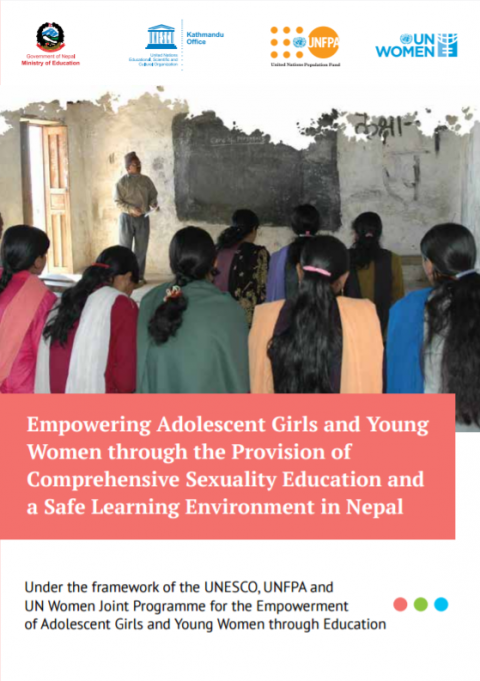 Empowering Adolescent Girls and Young Women through the Provision of Comprehensive Sexuality Education and a Safe Learning Environment in Nepal Year of publication: 2016 Corporate author: UNESCO Kathmandu | United Nations Entity for Gender Equality and the Empowerment of Women (UN Women) | United Nations Population Fund (UNFPA) There are many challenges for adolescent girls and young women in Nepal in terms of access, participation, and completion of good quality education. Child marriage and early pregnancy, gender-based violence, lack of knowledge or provision of proper hygiene facilities such as WASH (water, sanitation and hygiene) are factors preventing adolescent girls and young women from accessing education. This publication is a project plan for empowering adolescent girls and young women in Nepal.
  Addressed by Irina Bokova, Director-General of UNESCO on the Occasion of Launch of the Joint Programme in Nepal Empowering Adolescent Girls and Young Women through Education; Kathmandu, 18 April 2016 Year of publication: 2016 Corporate author: UNESCO. Director-General, 2009-2017 (Bokova, I.G.)
 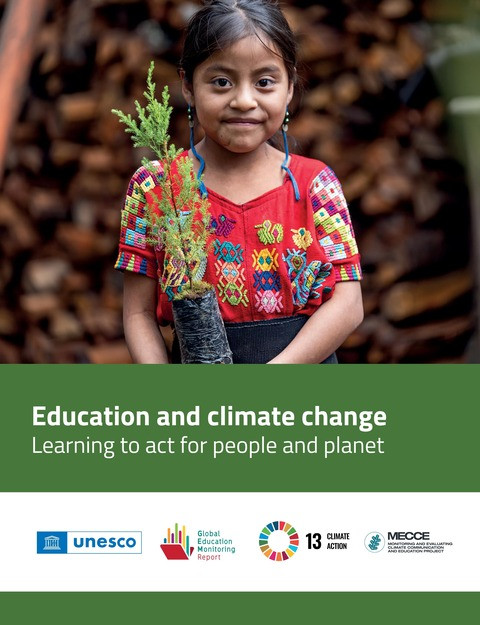 Education and Climate Change: Learning to Act for People and Planet Year of publication: 2024 Corporate author: Global Education Monitoring Report Team | Monitoring and Evaluating Climate Communication and Education Project (MECCE) | University of Sakatchewan How can education lead to climate change action?Despite strong evidence on the impact of education on other development outcomes and the role it plays in developing professional capacity for sustainable development transitions, education is often absent from other sectors’ strategic, policy, planning and financing considerations. The Global Education Monitoring Report is introducing a new series to advance dialogue on the interrelationship of education with the other Sustainable Development Goals.The first paper in the series focuses on climate change. It starts by reviewing the growing impact of climate change on education before turning to the role of education in climate action. Education has a somewhat underappreciated contribution to developing professional capacities for the transition to a green economy. Formal, non-formal and informal learning are also commonly believed to be playing a critical role in motivating actions on climate change mitigation and adaptation.Yet a positive association between education attainment and unsustainable consumption levels, as well as inconclusiveness of much research on the direct impact of education on climate change adaptation and mitigation actions has in part contributed to education receiving low priority in global and national climate change agendas.This paper argues that climate change education needs to adapt to fulfil its potential. The education paradigm cannot rely solely on knowledge transfer but needs to focus on social and emotional, and action-oriented learning.Much of the research has focused on the impact of education attainment and cognitive learning. More research is therefore needed to assess other drivers through which education can influence behaviours and motivate climate change action. Such research is needed to formulate viable education reform packages that improve the curriculum, strengthen climate-readiness of schools and education systems, engage learners and prepare educators accordingly. 国連持続可能な開発のための教育の10年中間年レビューESDの文脈と構造 Year of publication: 2009 Corporate author: UNESCO This document suggests key findings and ways forward in review of the contexts and strctures of education for sustainable development. Review of contexts and structures for education for sustainable development 2009: key findings & ways forward Year of publication: 2009 Corporate author: UNESCO This document suggests key findings and ways forward in review of the contexts and strctures of education for sustainable development. Education for sustainable development: shaping the future Year of publication: 2009 Corporate author: UNESCO This poster portrays the importance of education for sustainable development in terms of shaping the future. Education for Arctic sustainable development Year of publication: 2009 Author: Lars Kullerud Corporate author: UNESCO Education is an essential component of sustainable development. However, for the Arctic there is a history of education systems that tried to force central school models on local people, including different degrees of suppression of local language. This has been improved today to various degrees in the Arctic states. However, lack of skilled teachers with local roots is a circumpolar challenge. Arctic higher educational institutions also face many challenges when attempting to be innovative and competitive due to their small size and geographic isolation. The model of the University of the Arctic allows for a dynamic development of shared education systems through mutual cooperation. This network can be a very efficient tool to for delivering a relevant curriculum for a changing North.