
Resources
Explore a wide range of valuable resources on GCED to deepen your understanding and enhance your research, advocacy, teaching, and learning.
249 Results found
 Good practices in education for sustainable development: using the Earth Charter Year of publication: 2007 Corporate author: UNESCO | Earth Charter International Secretariat This publication has been envisioned to offer stories – case studies from around the world – that highlight how groups and individuals are using the Earth Charter as a tool for education for sustainable development. These stories come from non-formal and formal educational settings and describe a variety of experiences, including the development of guidebooks for primary school teachers, the inclusion of sustainability values in universities’ departments of education, law, engineering and general studies; the reshaping of local, regional and national curricula; and, the creation of vital and engaging programs and workshops for children and youth. Shaping the education of tomorrow: 2012 report on the UN decade of education for sustainable development, abridged Year of publication: 2012 Corporate author: UNESCO As the lead agency for the UN Decade of Education for Sustainable Development (DESD, 2005 – 2014), UNESCO is responsible for monitoring and evaluating progress during the DESD. UNESCO is publishing three reports during the DESD – in 2009, 2012 and 2014. This second report focuses specifically on processes and learning in the context of Education for Sustainable Development (ESD). What kinds of learning processes have emerged in the course of the DESD? What is the role of ESD in supporting them? What changes in ESD have occurred since the early years of the Decade? The report is informed by a broad consultation process that includes input from hundreds of policy makers, scholars and practitioners engaged in ESD around the world. Education for sustainable development good practices in early childhood Year of publication: 2012 Corporate author: UNESCO To support the growing interest in early childhood issues and ESD, UNESCO is publishing this volume containing 12 examples of programmes addressing ESD in early childhood settings and practices. These good practices and shared experiences, which were provided by a range of different stakeholders, are concrete examples of successful implementation of ESD in different fields and sectors, from the political to the school level, and including formal, nonformal and informal learning situations.
  UNESCO Roadmap for Implementing the Global Action Programme on Education for Sustainable Development Year of publication: 2014 Corporate author: UNESCO To create a world that is more just, peaceful and sustainable, all individuals and societies must be equipped with and empowered by knowledge, skills and values as well as be instilled with a heightened awareness to drive such change. There is now a growing international recognition of Education for Sustainable Development (ESD) as an integral element of quality education and a key enabler for sustainabledevelopment. Both the Muscat Agreement adopted at the Global Education For All Meeting in 2014 (GEM) and the proposal for Sustainable Development Goals (SDGs) developed by the Open Working Group of the UN General Assembly on SDGs (OWG) include ESD in the proposed targets for the post-2015 agenda.In 2013, the 37th session of the General Conference of UNESCO endorsed the Global Action Programme (GAP) on ESD as the follow-up to the UN Decade of ESD (2005-2014). Building on the achievements of the Decade, the GAP aims to generate and scale up concrete actions in ESD. The present Roadmap communicates the GAP endorsed by UNESCO Member States (37 C/Resolution 12) to decision-makers, stakeholders and actors, and provides suggestions for the implementation of the GAP, as well as details on UNESCO’s role. Shaping the education of tomorrow: 2012 full length report on the UN Decade of Education for Sustainable Development Year of publication: 2012 Author: Arjen E.J. Wals Corporate author: UNESCO This report represents the second review of the DESD and is conducted in the context of its Global Monitoring and Evaluation Framework (GMEF). It appears twenty years after the Rio Earth Summit, at a time where the challenge of SD is greater than ever. It is all the more timely because there is increased recognition that this challenge cannot be solved solely through technological advances, legislative measures and new policy frameworks. While such responses are necessary, they need to be accompanied by changes in mindsets, values and lifestyles and a strengthening of people’s capacities to bring about change.The report shows that many governments, NGOs, UN agencies and indeed, companies are increasingly emphasizing the importance of learning and capacity-building as they search for solutions to sustainability challenges including climate change, disaster risk management, biodiversity loss and sustainable production and consumption.
 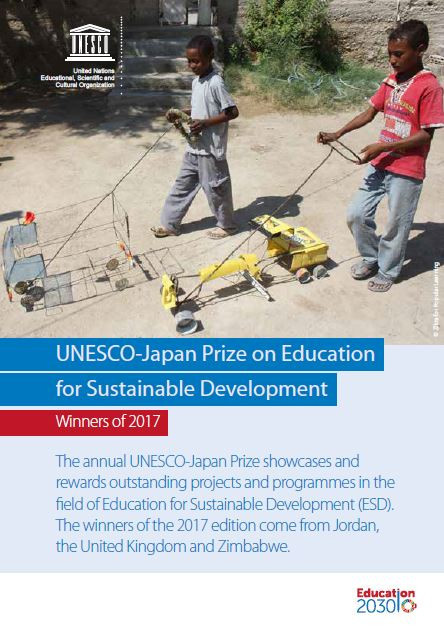 UNESCO-Japan Prize on Education for Sustainable Development: Winners of 2017 Year of publication: 2017 Corporate author: UNESCO The annual UNESCO-Japan Prize showcases and rewards outstanding projects and programmes in the field of Education for Sustainable Development (ESD).The winners of the 2017 edition come from Jordan, the United Kingdom and Zimbabwe.Among this year’s winners are a school, business and a non-profit organization, promoting ESD, respectively, at the local, regional and global level: Sihlengeni Primary School from the Republic of Zimbabwe; the social enterprise Zikra from the Hashemite Kingdom of Jordan; and the Hard Rain Project from the United Kingdom of Great Britain and Northern Ireland. Each of them will receive an award of USD 50,000.The Director-General of UNESCO and the Japanese Minister of Education will award the Prize to the three laureates in a ceremony at UNESCO Headquarters in Paris on 3 November 2017, during the 39th session of the General Conference.
  [Video] The Ten Targets of the Sustainable Development Goal 4...with Elyx Year of publication: 2017 Corporate author: UNESCO This new UNESCO animation explaining the ten targets of the Sustainable Development Goal 4.Together with Elyx, the UN's first digital ambassador, discover how to ensure inclusive and quality education for all and promote lifelong learning.
  Cracking The Code: Girls’ and Women’s Education in Science, Technology, Engineering and Mathematics (STEM) Year of publication: 2017 Corporate author: UNESCO Despite significant improvements in recent decades, education is not universally available and gender inequalities persist. A major concern in many countriesis not only limited numbers of girls going to school, but also limited educational pathways for those that step into the classroom. This includes, more specifically,how to address the lower participation and learning achievement of girls in science, technology, engineering and mathematics (STEM) education. STEM underpins the 2030 Agenda for Sustainable Development, and STEM education can provide learners with the knowledge, skills, attitudes and behavioursrequired for inclusive and sustainable societies. Leaving out girls and women in STEM education and careers is a loss for all. This report aims to ‘crack the code’, or to decipher the factors that hinder or facilitate girls’ and women’s participation, achievement and continuation in STEMeducation, and what can be done by the education sector to promote girls’ and women’s interest in, and engagement with, STEM.
  UNESCO at COP23: Climate Change Education Year of publication: 2017 Corporate author: UNESCO This brochure contains information about UNESCO's role of education in climate change through ESD(Education for Sustainable Development). Education for Sustainable Development (ESD) is increasingly recognized around the world as an effective enabler for a more sustainable future. Building climate change awareness and building capacities for adaptation and mitigation are critical dimensions of ESD. The critical role of education in climate change responses was clearly recognized at the Paris Climate Conference (COP21) in December 2015. COP22 in Marrakesh and COP23 in Bonn reiterate the importance of climate change education in achieving the global agendas.
  Survey on Privacy in Media and Information Literacy with Youth Perspectives Year of publication: 2017 Author: Sherri Hope Culver | Alton Grizzle Corporate author: UNESCO Media and information literate individuals are more empowered to make informed decisions about their privacy online and offline, among other things. Accordingly, governments and policy-makers who are committed to ensuring that the privacy of citizens is respected should also be committed to media and information literacy (MIL) for all. If they are not, then their efforts will be less sustainable. Equally, private and public enterprises that genuinely want to respect the privacy of citizens should purposefully contribute to MIL awareness among users qua citizens. Two research surveys are referenced in this report. The first investigated youth attitudes towards MIL and social and democratic discourses. One of the seven themes addressed in the context of social and democratic discourses was privacy. The research was carried out by UNESCO. The second survey studied privacy in MIL courses globally and was conducted for UNESCO by the UNESCO-UNAOC University Network on Media and Information Literacy and Intercultural dialogue (MILID Network), and members of the Global Alliance for Partnerships in Media and Information Literacy (GAPMIL). The report responds to UNESCO’s efforts to stimulate global research into privacy in MIL. Ultimately, this report aims to provide conceptual, development and policy recommendations to foster privacy in MIL, while enabling the critical engagement of people, including young women and men, in an environment conducive to sustainable development and to freedom of expression online and offline. It seeks to provide clarity on the complex issue of how MIL and privacy intersect.