
Resources
Explore a wide range of valuable resources on GCED to deepen your understanding and enhance your research, advocacy, teaching, and learning.
249 Results found
 Education for Sustainable Development: Partners in Action Year of publication: 2017 Corporate author: UNESCO This brochure illustrates key findings and achievements from a monitoring exercise conducted by UNESCO at the halfway point of the initial phase of the GAP. Key partners reported on their progress as of 2016 for 10 indicators -- two in each Priority Action Area -- and toward their target for 2019 which was set as part of their initial commitment.The data summarised here show remarkable progress and suggest that GAP Key Partners and other stakeholders are acting as catalysts for a wide range of ESD efforts. A clear learning agenda has emerged that will inform the second part of the programme and help ensure that ESD evolves, stays relevant and adds value to the full spectrum of Sustainable Development Goals.
  CCREAD: Inspiring sustainability education project improves lives in Cameroon (CAMEROON) Year of publication: 2017 Author: Shifu Ngalla Corporate author: UNESCO In Cameroon, 36% of young women and men who graduate from the eight state universities and from over 50 private institutions every year find themselves unemployed. Some describe themselves as the “lost generation”. But one young graduate, who experienced hardship as a child, is using Education for Sustainable Development (ESD) to provide capacity, sense of focus and hope to the socially and economically challenged.
  Repensar l'educacio: vers un bé comú mundial? Year of publication: 2015 Corporate author: UNESCO The changes in the world today are characterized by new levels of complexity and contradiction. These changes generate tensions for which education is expected to prepare individuals and communities by giving them the capability to adapt and to respond. This publication contributes to rethinking education and learning in this context. It builds on one of UNESCO’s main tasks as a global observatory of social transformation with the objective of stimulating public policy debate. It is a call for dialogue among all stakeholders. It is inspired by a humanistic vision of education and development, based on respect for life and human dignity, equal rights, social justice, cultural diversity, international solidarity, and shared responsibility for a sustainable future. These are the fundamentals of our common humanity. This book enhances the vision provided by the two landmark UNESCO publications: Learning to Be: The world of education today and tomorrow (1972), the ‘Faure Report’, and Learning: The treasure within (1996), the ‘Delors Report’. Shaping the future we want: UN decade of education for sustainable development; final report Year of publication: 2014 Author: Carolee Buckler | Heather Creech Corporate author: UNESCO The United Nations Decade of Education for Sustainable Development (2005 –2014) (DESD) aimed at integrating the principles and practices of sustainable development into all aspects of education and learning, to encourage changes in knowledge, values and attitudes with the vision of enabling a more sustainable and just society for all. The mandate of the DESD has energized a vast number of stakeholders – across Member States, UN agencies, the education sector, the private sector and civil society – to work in partnership to reorient education systems towards sustainable development. This final DESD Global Monitoring and Evaluation Report (GME) provides an assessment of progress towards embedding Education for Sustainable Development (ESD) into education systems and into sustainable development efforts. Building on the findings of the past two DESD GME reports, and based upon Member States’ and other stakeholders’ assessments of the current state of ESD, this report maps the achievements and challenges of a decade of progress and action on ESD at the global, regional, national and local levels – and within all areas and levels of education.
  First Meeting of the SDG-Education 2030 Steering Committee: report Year of publication: 2016 Corporate author: UNESCO The present report provides the first SDG-education 2030 Steering Committee meeting programme, a short summary of key outcomes and decisions, as well as a second part including a more detailed summary of deliberations reflecting the themes, issues and understandings emerging from the discussions.
  UNESCO moving forward the 2030 Agenda for Sustainable Development Year of publication: 2017 Corporate author: UNESCO The United Nations 2030 Agenda for Sustainable Development, with its 17 Sustainable Development Goals, sets forth a bold new framework for development cooperation over the next 15 years. This agenda aspires to ensure prosperity and well-being for all women and men, while protecting our planet and strengthening the foundations for peace.
  Education Transforms Lives Year of publication: 2017 Corporate author: UNESCO This brochure explores UNESCO’s role in leading and coordinating the Education 2030 Agenda, which is part of a global movement to eradicate poverty through 17 Sustainable Development Goals by 2030. Education, essential to achieve all of these goals, has its own dedicated Goal 4, which aims to “ensure inclusive and equitable quality education and promote lifelong learning opportunities for all”. UNESCO is the United Nations’ specialized agency for education and the Education Sector provides global and regional leadership in education and responds to contemporary global challenges through education with a special focus on gender equality and Africa.
  Second SDG-Education 2030 Steering Committee: meeting report Year of publication: 2016 Corporate author: UNESCO The present report provides the SDG-Education 2030 SC meeting programme, a short summary of key outcomes and decisions, as well as a second part including a more detailed summary of deliberations reflecting the themes, issues and understandings emerging from the discussions.
  [Summary] Accountability in Education: Meeting Our Commitments: Global Education Monitoring Report Summary, 2017/8 Year of publication: 2017 Corporate author: UNESCO This summary of the 2017/8 GEM Report shows the entire array of approaches to accountability in education. It ranges from countries unused to the concept, where violations of the right to education go unchallenged, to countries where accountability has become an end in itself instead of a means to inclusive, equitable and high-quality education and lifelong learning for all.The report emphasizes that education is a shared responsibility. While governments have primary responsibility, all actors – schools, teachers, parents, students, international organizations, private sector providers, civil society and the media – have a role in improving education systems. The report emphasizes the importance of transparency and availability of information but urges caution in how data are used. It makes the case for avoiding accountability systems with a disproportionate focus on narrowly defined results and punitive sanctions. In an era of multiple accountability tools, the report provides clear evidence on those that are working and those that are not.
 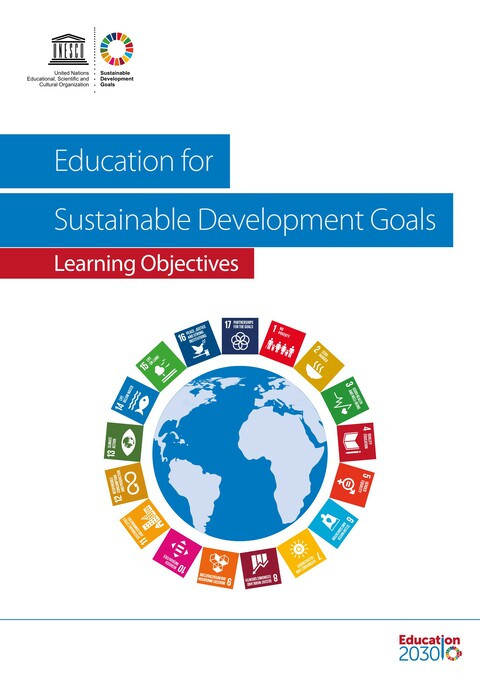 Education for Sustainable Development Goals: Learning Objectives Year of publication: 2017 Corporate author: UNESCO UNESCO has been promoting Education for Sustainable Development (ESD) since 1992. It led the UN Decade for ESD from 2005 to 2014 and is now spearheading its follow-up, the Global Action Programme (GAP) on ESD. The momentum for ESD has never been stronger. Global issues – such as climate change – urgently require a shift in our lifestyles and a transformation of the way we think and act. To achieve this change, we need new skills, values and attitudes that lead to more sustainable societies. Education systems must respond to this pressing need by defining relevant learning objectives and learning contents, introducing pedagogies that empower learners, and urging their institutions to include sustainability principles in their management structures. The new 2030 Agenda for Sustainable Development clearly reflects this vision of the importance of an appropriate educational response. Education is explicitly formulated as a stand-alone goal – Sustainable Development Goal 4. Numerous educationrelated targets and indicators are also contained within other Sustainable Development Goals (SDGs). Education is both a goal in itself and a means for attaining all the other SDGs. It is not only an integral part of sustainable development, but also a key enabler for it. That is why education represents an essential strategy in the pursuit of the SDGs. This publication is designed as a guide for education professionals on the use of ESD in learning for the SDGs, and consequently to contribute to achieving the SDGs. The guide identifies indicative learning objectives and suggests topics and learning activities for each SDG. It also presents implementation methods at different levels, from course design to national strategies. The guide does not aim to be prescriptive in any way, but to provide guidance and suggestions that educators can select and adapt to fit concrete learning contexts