
Resources
Explore a wide range of valuable resources on GCED to deepen your understanding and enhance your research, advocacy, teaching, and learning.
249 Results found
 Education for Sustainable Development: Children speak up! Year of publication: 2017 Corporate author: UNESCO Children from around the world share their message on sustainability.
 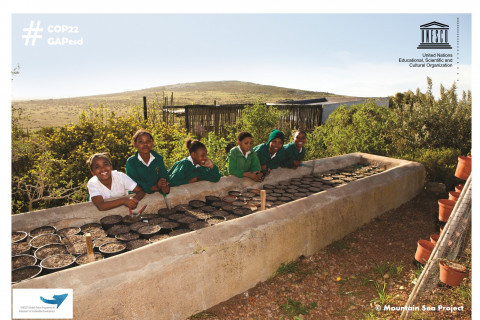 ESD Zoom Newsletters: COP22 Climate Action Year of publication: 2016 Corporate author: UNESCO ESD Zoom Newsletter COP22: Climate Action- COP22 advocates central role for education in international response to climate change- Education is key for green future says UNESCO Director-General at COP22- UNESCO launches two new publications International Events- First UNESCO Symposium on the Future of ESD held in Japanese town- ESD Prize 2016 awarded by UNESCO's Director-General in Paris- "Future of Education and Skills" meeting discusses conceptual learning framework and competencies On the Ground- In Ecuador, UNESCO launches Spanish version of "Tanah", a free game app to respond to earthquakes and tsunamis- Local communities in Tanzania learn to mitigate climate change- Promoting ESD through Community Learning Centres in Viet Nam GAP Key Partners- New app to discover the SDGs and share sustainable actions- OMEP launches Resource Bank on Early Childhood Education and ESD- Beijing International Forum on ESD gathers more than 300 experts- ESD guidelines for schools developed by Japan now availiable in English- Listen to Hilary Ewang Ngide speak about the commitment to the GAP of his organization CCREAD-Cameroon, following the winning of the UNESCO-Japan Prize on ESD- "Empowering the teacher of tomorrow" at LTN Conference in Tallinn
 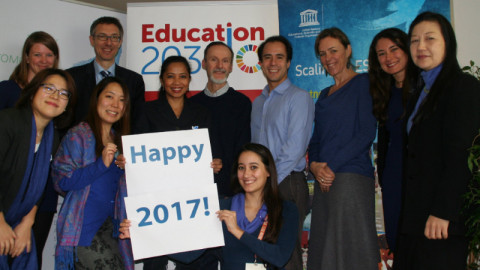 ESD Zoom Newsletters (January 2017) Year of publication: 2017 Corporate author: UNESCO ESD Zoom Newsletter Highlight- UNESCO opens nominations for UNESCO-Japan Prize on ESD 2017 International Events- Call for youth: Join online discussion to participate in UNESCO Week in Canada- Asia-Pacific Network for SDG4 launched at regional meeting on Education 2030- UNESCO ASPnet trains teachers to address climate change- ESD at heart of new Mediterranean Action Plan GAP Key Partners- GAP regional meeting: The role of cities in living sustainably- GAP key partner from Peru wins prestigious Rolex Award for Enterprise- Japan holds eighth National UNESCO ASPnet Conference- Video message by Okayama Youth- Winners of International Essay Contest for Young People awards- "Green Impact": The numbers speak for themselves
 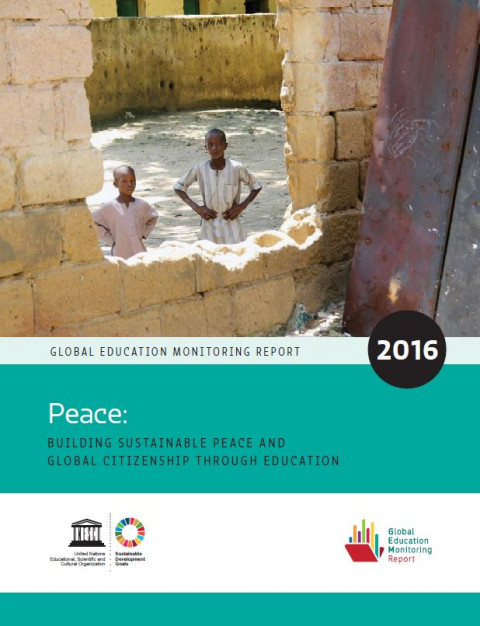 Peace: building sustainable peace and global citizenship through education;Global education monitoring report summary 2016 Year of publication: 2017 Corporate author: UNESCO The 2016 GEM Report, the first of a new 15-year series, shows that education will not deliver its full potential to catapult the world forward unless rates of improvement dramatically shift, and education systems consider sustainable development in the way services are delivered. This Peace: Building sustainable peace and global citizenship through education publication is a select extract from the full 2016 Global Education Monitoring (GEM) Report: Education for people and planet: Creating sustainable futures for all. It contains two chapters from that full Report – one on peace, political participation and access to justice and the other on education for global citizenship and sustainable development — , along with the associated policy recommendations and a short section of a recent GEM Report Policy Paper Textbooks pave the way to sustainable development.
 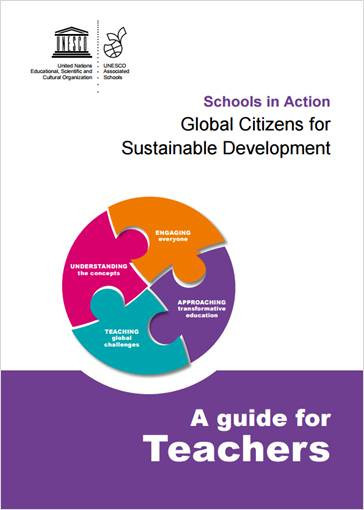 Schools in Action: Global Citizens for Sustainable Development: A Guide for Teachers Year of publication: 2016 Corporate author: UNESCO The Global Citizens for Sustainable Development Teachers’ guide aims to introduce teachers to Global Citizenship Education (GCED) and Education for Sustainable Development (ESD). It provides secondary school teachers with ideas and activities to help students become global citizens and sustainable development actors. The Teachers’ guide draws on the discussions and activities of almost 1,100 participants from 104 countries, including ASPnet National Coordinators, school principals, teachers, students and experts who contributed to the Online Collaborative Platform ASPnet in Action: Global Citizens Connected for Sustainable Development in 2014 and 2015 [http://en.unesco. org/aspnet/globalcitizens] with associated activities and initiatives. The Teachers’ guide provides: An overview of what it means for learners to become global citizens and of how learners can contribute to sustainable development. Ideas for classroom activities that can help secondary school students to develop knowledge, skills, values, attitudes and behaviours that promote GCED and ESD. Selected activities on GCED and ESD from ASPnet schools around the world.
 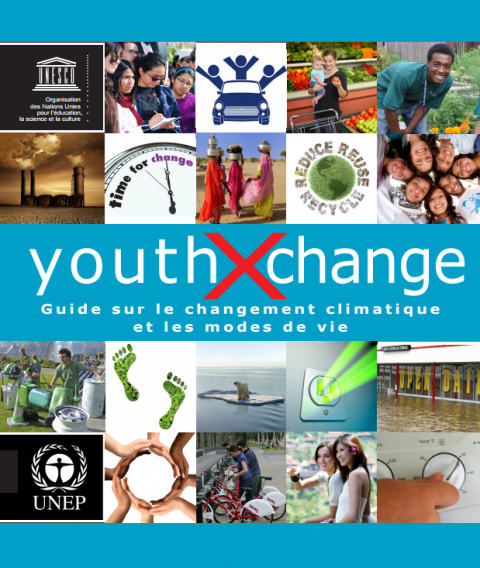 YouthXchange: guide sur le changement climatique et les modes de vie Year of publication: 2015 Author: Adam Cade | Rob Bowden Corporate author: UNESCO | United Nations Environment Programme (UNEP) Climate Change and Lifestyles is the first in a series of guidebooks supporting the UNESCO/ UNEP YouthXchange (YXC) Initiative, which was created in 2001 to promote sustainable lifestyles among youth (15-24 years) through education, dialogue, awareness raising and capacity building. The series is being produced for young people and people working with youth, such as educators, teachers, trainers and youth leaders in both developed and developing countries. Almost half of the world’s population is under the age of 25, and nearly 90 per cent of them live in developing countries. Youth is a critical stakeholder in the global economy and will be the main actor and motor for change in the near future. Thus, the energy, motivation and creativity of youth are essential assets to stimulating change. Aims of the YXC Guidebook on Climate Change and Lifestyles:• Explore the links between lifestyles and climate change; • Help young people consider the actions they should take towards more sustainable lifestyles;• Support courses and actions that promote greater understanding of climate change and lifestyles among youth. The guidebook:• Considers the causes and effects of climate change and its human impacts and responses, while connecting them to lifestyle choices and the technical and social infrastructures of a society;• Provides scientific, political, economic, social, ethical and cultural perspectives on climate change;• Explains complex issues in accessible language supported by facts, graphics, images, examples and web links;• Develops the critical skills young people need to make personal choices to address the challenges of climate change.
 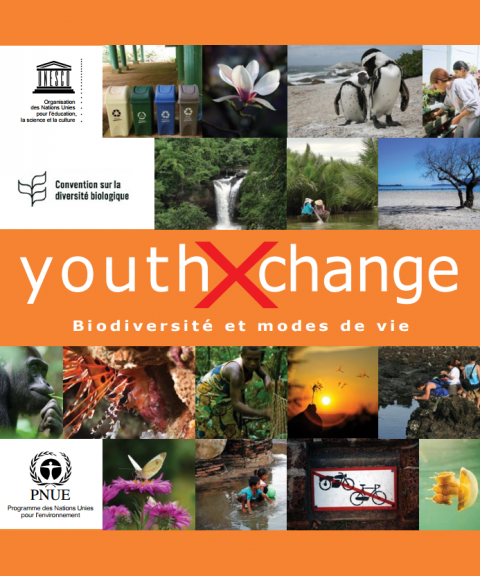 Série de guides youthXchange: biodiversité et modes de vie Year of publication: 2015 Corporate author: UNESCO | United Nations Environment Programme (UNEP) The YouthXchange Biodiversity and LifestylesGuidebook is designed to help young people familiarize themselves with the dimensions of global biological and cultural diversity, as well as help them to develop essential skills whileengaging with biodiversity.The guidebook aims to:• Explore the interactions between biodiversity and lifestyle choices by explaining the interrelatedness of food, consumption, culture and biodiversity conservation;• Help young people familiarize themselves with the dimensions of global biological and cultural diversity, as well as help them to develop essential skills while engaging with biodiversity; and• Help young people consider how they can preserve biodiversity though responsible lifestyle choices, engagement and action.
  Analysis of Determinants of a Measure of Sustainability Literacy Year of publication: 2017 Author: Aurélien Decamps Corporate author: UNESCO This paper highlights the contribution of the Sulitest to analyse the determinants of sustainability literacy in higher education. Sulitest is an open online training and assessment tool designed to assess and improve sustainability literacy. It is a multi-stakeholder initiative supported by several UN agencies and academic networks. Based on collaboration through the volunteer contribution of an international community, this tool aims to be internationally recognized and locally relevant by addressing global as well as local issues. With a growing community of more than 500 higher education institutions and other organizations from more than 50 countries, Sulitest begins to be recognized as a standard to assess and improve sustainability literacy. As the use of the tool is expanding, the data collected provides tangible indicators to map the current level of sustainability literacy and to monitor progress over time.
  Teacher Training for Multicultural Education in Favour of Democracy and Sustainable Development: the Territorial Approach Year of publication: 1995 Author: Raúl Galiardi | Paula Bernadini Mosconi Corporate author: UNESCO This publication is part of the book Teacher Training and Multiculturalism: National Studies. This book presents the outcomes concerning the initial training systems of teachers in eight countries at different levels of development in different regions of the world but who are faced with a common challenge to educate for cultural diversity. Both the conclusions of each particular study and the general outcomes demonstrate the complexity of the problems and the benefits of comparative analysis. Overcoming prejudices and stereotypes is not an easy task nor likely to be achieved in the short term. Mentalities change far more slowly than knowledge and, because of this, educational strategies need to be applied in the long term. This study also shows that it is necessary to improve the exchange of experiences as well as contacts between people and institutions who are confronted with the same problems in different contexts. The publication of the initial outcomes of this project is intended to enrich the quality of discussions between specialists and institutions who, in different parts of the world, are concerned by multicultural education as an instrument to promote understanding, respect and dialogue between cultures.
  Non-formal and Informal Programs and Activities that Promote the Acquisition of Knowledge and Skills in Areas of Global Citizenship Education (GCED) and Education for Sustainable Development (ESD) Year of publication: 2016 Author: Ashley Stepanek Lockhart Corporate author: UNESCO This study will examine the nature of, and how, non-formal and informal programs and activities contribute to the acquisition of knowledge and skills for children, adolescents, youth and adults in precise areas of Target 4.7. This will be done by highlighting different definitions, conceptual approaches and history, along with policies of GCED and ESD and non-formal education and informal learning, comparing attempts to operationalize GCED and ESD to indicators for measurement and monitoring and challenges therein, and by identifying relevant sample programs and activities from around the world to analyze and consider using as data sources. How non-formal and informal provision related to GCED and ESD links to formal education will be considered, along with its connection to the larger notion of lifelong learning.