
Resources
Explore a wide range of valuable resources on GCED to deepen your understanding and enhance your research, advocacy, teaching, and learning.
249 Results found
 Towards the development of an international module for assessing learning in Global Citizenship Education (GCE) and Education for Sustainable Development (ESD): a critical review of current measurement strategies Year of publication: 2016 Author: Bryony Hoskins Corporate author: UNESCO The aim of the study is to support the development of an indicator for target 4.7 of the UN sustainable development goals (STG). The study provides a conceptual framework for measuring the competences from global citizenship education (GCE) and education for sustainable development (ESD) from a review of the literature and then an audit of the different aspects of these competences. The study establishes the extent that these competences can be measured using existing data. The results of this analysis show that most dimensions of GCE can to some extent be measured by the existing IEA ICCS 2009 and 2016 datasets and an outline of how this data can be used to develop an initial indicator or set of indicators for target 4.7 is given. However, in contrast, the study finds that existing data is much more limited on measuring ESD and the existing data does not provide enough coverage for indicator development at the moment. The study recommends that in order to provide a more comprehensive measure of both these competences it would be necessary to develop a new module on GCE and ESD. After considering the options, it is concluded that the most realistic option is for this module to be attached to the existing IEA ICCS survey. The study concludes that an indicator of all citizens across the whole world is probably unrealistic considering the challenges faced, but what could be achievable is an indicator covering some countries from each region from around the world. To make this a reality considerable political effort and search for funding would be required to engage new regions to the ICCS survey, for example, from Africa and the Middle East
  Developing a Monitoring Instrument to Measure Extracurricular and Non-formal Activities which Promote Global Citizenship Education (GCED) and Education for Sustainable Development (ESD) Year of publication: 2016 Author: Bassel Akar Corporate author: UNESCO The goal on Education is 1 of 17 Sustainable Development Goals that comprises a target to ensure all learners around the world have an opportunity to develop the competencies to promote sustainable approaches to living, including appreciating of cultural diversity, non-violence, and gender equality. Extracurricular activities and non-formal education (ENA) provides a non-traditional space for learning global citizenship and sustainable development. Around the world, communities have organized education programs and activities for youth outside school to learn the values and practices of being global citizens. Research shows, however, that most efforts to review and improve ENA for global citizenship and sustainable development have focused on summative evaluations with little attention to formative approaches of monitoring. Drawing on basic principles of action research, sustainable professional development, and education quality enhancement, a monitoring framework emerges to support organizations around the world in measuring progress towards education for global citizenship and sustainable development. This framework also suggests (1) inclusive monitoring spaces like internal reviews and online social networking platforms, (2) roles of stakeholders like donor agencies in institutionalizing monitoring practices, (3) instruments and measurable scales to facilitate dialogues that review program objectives and action plans, and (4) challenges in inclusive and sustainable monitoring tools and approaches.
  Education for Global Citizenship Education & Sustainable Development: Content in Social Science Textbooks Year of publication: 2016 Author: Patrica Bromley | Julia Lerch | Jeremy Jimenez Corporate author: UNESCO In times of violence and egregious destruction of human lives and the natural world, our recognition of the need for education that promotes peace and justice becomes particularly pressing. This background report reviews the state of existing research and data on relevant sustainable development content in social science education in countries around the world. Specifically, it examines the extent to which textbook content could help learners acquire the knowledge, skills, and values needed to meet goal 4.7 of the United Nation’s Sustainable Development Goals: “By 2030, ensure that all learners acquire the knowledge and skills needed to promote sustainable development, including, among others, through education for sustainable development and sustainable lifestyles, human rights, gender equality, promotion of a culture of peace and non-violence, global citizenship and appreciation of cultural diversity and of culture’s contribution to sustainable development.” It reviews relevant literature and analyzes three cross-national, longitudinal databases containing information coded from textbook content to assess the current state of knowledge. The paper concludes by indicating where future research efforts are most needed, identifying geographic and substantive needs, and considering monitoring mechanisms that could encourage on-going evaluation and monitoring of textbook content.
  UNESCO's Role and Responsibilities in Implementing Global Citizenship Education and Promoting Peace and Human Rights Eudcation and Education for Sustainable Development Year of publication: 2015 Corporate author: UNESCO This document is an addendum to document 196 EX/32. This item was included in the provisional agenda of the 196th session of the Executive Board at the request of Austria and Italy
  Empowering Adolescent Girls and Young Women through Education: Information for Funding Partners Year of publication: 2016 Corporate author: UNESCO | United Nations Population Fund (UNFPA) | United Nations Entity for Gender Equality and the Empowerment of Women (UN Women) Empowering Adolescent Girls and Young Women through Education: Information for Funding Partners
 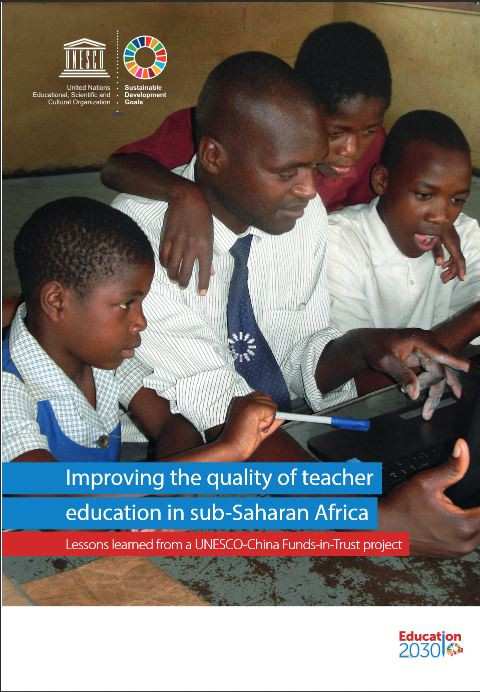 Improving the quality of teacher education in Sub-Saharan Africa: lessons learned from a UNESCO-China Funds-in-Trust project Year of publication: 2018 Corporate author: UNESCO The booklet describes how the project started, the choice of beneficiary countries, the implementation strategies and its achievements. The different sections numbered one to four describe particular aspects of the project, using country cases to illustrate how the success of the project was due to strong country ownership and leadership. UNESCO, in partnership with the Government of the People’s Republic of China, initiated the project to enhance the institutional capacity and the professional development of teacher educators through ICT-supported learning, teaching and research. This technology aided the transformation of capacity teacher training through digitalization of instructional materials.
  Mainstreaming SDG4-Education 2030 in sector-wide policy and planning: technical guidelines for UNESCO field offices Year of publication: 2016 Corporate author: UNESCO Mainstreaming SDG4-Education 2030 in sector-wide policy and planning offers technical guidelines for UNESCO field offices to ensure adequate technical support to national authorities. The guidelines take into account the different profiles of countries’ need and capacities, thus avoiding a one-size-fits-all approach. The document contains resources and pointers that can be combined and tailored to fit the particular context of each country. In all cases, UNESCO is expected to ensure that all the relevant information about SDG4-Education 2030 is properly disseminated in these guidelines. Field staff will adapt the guidelines provided here to the country they are serving to ensure that UNESCO plays its role as the leading United Nations agency in the field.
  Framework for a DESD communication strategy in support of the UN decade of education for sustainable development Year of publication: 2007 Corporate author: UNESCO The following framework for a DESD Communication Strategy seeks to provide guidelines for different stakeholders to come together and work on a joint harmonious communication strategy, dedicated to furthering the exchange of information on ESD issues in order to: • share ESD information and resources between and among partners; • promote better cooperation among partners doing ESD work and create synergies; • reduce duplication of efforts in programme planning, design, and ESD advocacy; • strengthen individual partner's ability to help create a viable future by working together with others, with each partner contributing its own "piece of the puzzle". Minimum elements of a DESD communication strategy include an appropriate emphasis on: • dissemination of basic ESD information to all partners; • dissemination of available information sources pertinent to partners’ needs in ESD; • sharing prototype training materials, experiences of demonstration activities and related resources for testing, adapting and translating them to other cultural contexts; • dissemination of information about the experiences of project participants, emphasizing openness and clarity about problems encountered, in order to allow others to benefit from the lessons learned in practice.
  Education for sustainable development; good practices in addressing biodiversity Year of publication: 2012 Corporate author: UNESCO To support the growing interest in biodiversity issues and ESD, UNESCO is publishing this volume containing 24 examples of programmes addressing biodiversity in ESD settings and practices. These good practices and shared experiences, which were provided by a range of different stakeholders, are concrete examples of successful implementation of ESD in different fields and sectors, from the political to the school level, and including formal, non-formal and informal learning situations. Education for sustainable development and climate change Year of publication: 2009 Corporate author: UNESCO The Intergovernmental Panel on Climate Change (IPCC), in its 2007 report, stated unequivocally that humans are contributing to climate change. People’s actions are intensifying the climate’s natural variability, and the Earth’s temperature is rising. Scientists make a distinction between climate variability (where climatic variations are attributable to natural causes) and climate change (where human activities are altering the atmospheric composition). Human induced (or anthropogenic) climate change is caused by increased production of greenhouse gases, including carbon dioxide (CO2), methane and nitrous oxide. Carbon dioxide, the main contributor, is produced primarily by the burning of fossil fuels — oil, gas and coal. Although methane occurs in smaller quantities than CO2, it has higher warming effects. Increased methane production is linked to increased levels of livestock farming for meat production. Warming of permafrost areas in Siberia and Canada may also contribute significantly to an increase of methane emissions, since permafrost lakes store methane gases. Increases in greenhouse gas production are directly linked to the post-1750 period of industrialisation in Western countries. These gases now far exceed the natural rate of greenhouse gas production as measured in pre-industrial era ice cores spanning many thousands of years. The IPCC projects that global average temperatures are likely to rise by 1.8 - 4 degrees Celsius by 2100. This might sound small, but the difference between today’s temperatures and the last Ice Age is around 4-5%. A small temperature rise is likely to have a substantial impact. It may also take many years for the real impact of current rises in temperature to show. Even if people substantially reduced CO2 emissions tomorrow, the atmosphere would go on warming for a long time to come. Changes in temperature will impact on the whole of the Earth’s system, and on human activities everywhere. Projected impacts include warming of the oceans, melting of the icecaps, sea level rise, unpredictable weather patterns, increased flooding and droughts, loss of biodiversity, changes in agricultural productivity, increased health risks, massive human migration and economic decline. Scientists are worried that change will be faster than expected due to ‘positive feedback’, which is a process where the warming fuels itself, causing accelerated temperature increase. The acceleration of climate change needs to be reduced urgently, and everyone everywhere needs to be involved.