
Resources
Explore a wide range of valuable resources on GCED to deepen your understanding and enhance your research, advocacy, teaching, and learning.
249 Results found
 Sandwatch: adaptar-se à mudança climática e educar para o desenvolvimento sustentável Year of publication: 2012 Author: Gillian Cambers | Paul Diamond Corporate author: UNESCO Sandwatch provides a framework for children, youth and adults, with the help of teachers and local communities, to work together to critically evaluate the problems and conflicts facing their beach environments, and to develop sustainable approaches to address these issues. It also helps beaches become more resilient to climate change. The preliminary chapters of this publication focus on how to get started with Sandwatch activities and examine ways to address climate change impacts. The principle aim of this publication is to document the Sandwatch methodology: monitoring, analysing, sharing and taking action. An activities-orientated approach is used to provide step-by-step instructions to cover monitoring methods and data analysis, including observation and recording, erosion and accretion, beach composition, human activities, beach debris, water quality, waves, longshore currents, plants and animals. The activities are related to (a) sustainable development issues, including: beach ownership, mining beaches for construction material, conflict resolution between different beach users, pollution, conservation of endangered species, and (b) climate change adaptation issues: sea level rise, rising temperatures, ocean acidification and increased extreme events. Ways to share findings and create a Sandwatch network are detailed including methods such as the use of local media, websites, social networking and video production. Finally, ways are discussed to design, plan and implement a Sandwatch project to fulfill one or all of the following criteria: (a) addressing a particular beach-related issue, (b) enhancing the beach, and (c) promoting climate change adaptation. Sandwatch stands as an example of Education for Sustainable Development in action, and is being targeted as one of several flagship projects for the United Nations Decade of Education for Sustainable Development (2005–2014). As the world confronts the growing threat of climate change, Sandwatch presents an opportunity to help people and ecosystems respond to present and future changes in a practical manner. Beaches are among the ecosystems most at risk from climate change as they face rising sea levels and increased more intense storms. By contributing to ecosystem health and resilience, Sandwatch can help people from all walks of life learn about climate change and how their actions can contribute to the adaptation process. Education for sustainable development: building a better, fairer world for the 21st century Year of publication: 2012 Corporate author: UNESCO Education for Sustainable Development allows every human being to acquire the knowledge, skills, attitudes and values necessary to shape a sustainable future. Education for Sustainable Development means including key sustainable development issues into teaching and learning; for example, climate change, disaster risk reduction, biodiversity, poverty reduction, and sustainable consumption. It also requires participatory teaching and learning methods that motivate and empower learners to change their behaviour and take action for sustainable development. Education for Sustainable Development consequently promotes competencies like critical thinking, imagining future scenarios and making decisions in a collaborative way. Education for Sustainable Development requires far-reaching changes in the way education is often practised today. UNESCO is the lead agency for the UN Decade of Education for Sustainable Development (2005-2014). Climate change education for sustainable development in small island developing states: report and recommendations Year of publication: 2012 Corporate author: UNESCO This report summarizes the key outcomes of a three-day meeting of around one hundred climate change education (CCE) experts, primarily from Small Island Developing States (SIDS) in the Caribbean, the Pacific Ocean and the Indian Ocean, representing a multi-disciplinary and diverse group of stakeholders. The meeting discussed and reflected on the challenges that climate change poses to education systems in SIDS, and on the role that education must play in adaptation to climate change. It was held from 21 to 23 September 2011 in Nassau, with the support of the Commonwealth of the Bahamas, the Government of Denmark and the Government of Japan. SIDS in the Caribbean Sea, the Indian Ocean and the Pacific Ocean are among the most vulnerable countries with regard to climate change. SIDS are already confronted with the effects of climate change, including rising sea levels and changes in weather and climate extremes such as droughts, floods and tropical cyclones/hurricanes. With current and future impacts of climate change representing a real danger to SIDS communities and livelihoods – whether based on agriculture, fisheries, forestry, tourism or trade – the need for SIDS to reduce their vulnerability to climate change by strengthening their adaptive capacity is a matter of urgency. Moving further along the path to sustainable development and achieving sustainable development objectives will depend on the ability of SIDS to strengthen this adaptive capacity. Adaptation to climate change requires individuals to be aware of potential changes in the climate and to understand the implications of changes for their lives. It requires them to assess the risks such changes hold for their identity and future, and to make informed decisions on how to adapt their livelihoods, homes and communities. Education plays an essential role in increasing the adaptative capacity of communities and nations by enabling individuals to make informed decisions. In particular, the education of girls and women has proven to have a significant impact on the capacity of communities to adapt to climate change and develop sustainably. Quality education designed for the purpose of empowering people to address climate change and live sustainably improves the adaptation capacity at the community level. This implies educational programmes that explicitly prepare communities for natural disasters. Climate change education for sustainable development (CCESD) needs also to incorporate indigenous knowledge, and promote sustainable lifestyles in which the importance of heritage is recognised as an integral part of community identity and a key asset that can help build resilience. Finally, CCESD should stress the unique cultural and natural heritage of SIDS, which plays a major role in the building of community resilience.
  UNESCO Global Action Programme on Education for Sustainable Development: information folder Year of publication: 2017 Corporate author: UNESCO This is a comprehensive folder containing 13 information sheets on different aspects of the Global Action Programme on ESD (GAP) and its key actors and partners. It aims to familiarize educators, learners and the general public with the GAP and advise them on how to spread the word.
  Evaluation of UNESCO's Capacity Development for Education for All (CapEFA) Programme Year of publication: 2016 Corporate author: UNESCO The main purpose of this evaluation is to determine the relevance and effectiveness of the Capacity Development for Education for All (CapEFA) programme’s overall contribution to progress towards the realization of the Education for All (EFA) goals in its target countries, and to provide actionable and timely recommendations to the United Nations Educational, Scientific and Cultural Organization (UNESCO) on the positioning of the Programme to meet future needs and challenges related to the adoption of the Sustainable Development Goals (SDG) in September 2015, and more specifically to the SDG 4 to ‘Ensure inclusive and equitable quality education and promote lifelong learning opportunities for all’. The focus of this evaluation is on assessing the CapEFA programme’s relevance, effectiveness, efficiency, and sustainability. This evaluation does not focus on how the programme impacts on the EFA goals, due to the challenge in assessing the causality between the programme’s goals and the EFA indicators. The focus of the assessment is on whether the right conditions at the systemic and institutional levels are created to have an impact on these EFA macro-indicators.
 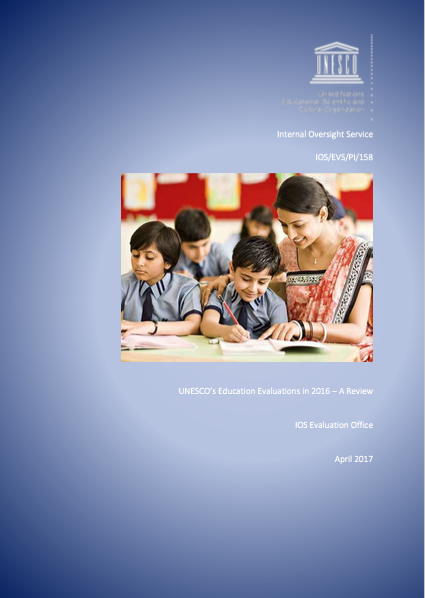 UNESCO's Education Evaluation in 2016: A Review Year of publication: 2017 Corporate author: UNESCO UNESCO completed 12 education related evaluations in 2016. Part A of this review presents the key insights and lessons learned from those evaluations. These learnings are designed to help enhance UNESCO’s leadership and coordination of the SDG 4 – Education 2030 Agenda. Part B of the review provides an assessment of the quality and usefulness of these evaluations based on the UNEG and OECD quality standards for evaluation reports.
  UNESCO and Education Year of publication: 2017 Corporate author: UNESCO Education is a fundamental human right and
a public good and, as such, has been at the core of UNESCO’s work since its inception.Education is also the path to sustainability – to poverty alleviation, better health, environmental protection and gender equality.As the only United Nations agency with a mandate to cover all aspects of education, UNESCO was entrusted in 2015 to lead the coordination and monitoring of Sustainable Development Goal 4, as part of the new Global Education 2030 Agenda.Goal 4 aims to “ensure inclusive and equitable quality education and promote lifelong learning opportunities for all,” and renewed UNESCO’s and Member States’ commitment to a vision of education that is holistic, inspirational and which leaves no one behind.This commitment is reflected in the size and scope of the Education Sector, the largest in UNESCO, with staff working at its Paris Headquarters and spread across a global network of field offices and specialized institutes and centres. With its close links with education ministries and other partners, UNESCO is strongly placed to press for action and change.UNESCO’s Education Sector supports Member States in developing education systems that foster high-quality and inclusive lifelong learning for all, empowering learners to be creative and responsible global citizens while leading the debate to help shape the future international education agenda.There is no stronger, no more lasting, investment a country can make than educating its citizens. The Education Sector exists to further this collective vision worldwide by transforming lives one by one.
UNESCO and Education Year of publication: 2017 Corporate author: UNESCO Education is a fundamental human right and
a public good and, as such, has been at the core of UNESCO’s work since its inception.Education is also the path to sustainability – to poverty alleviation, better health, environmental protection and gender equality.As the only United Nations agency with a mandate to cover all aspects of education, UNESCO was entrusted in 2015 to lead the coordination and monitoring of Sustainable Development Goal 4, as part of the new Global Education 2030 Agenda.Goal 4 aims to “ensure inclusive and equitable quality education and promote lifelong learning opportunities for all,” and renewed UNESCO’s and Member States’ commitment to a vision of education that is holistic, inspirational and which leaves no one behind.This commitment is reflected in the size and scope of the Education Sector, the largest in UNESCO, with staff working at its Paris Headquarters and spread across a global network of field offices and specialized institutes and centres. With its close links with education ministries and other partners, UNESCO is strongly placed to press for action and change.UNESCO’s Education Sector supports Member States in developing education systems that foster high-quality and inclusive lifelong learning for all, empowering learners to be creative and responsible global citizens while leading the debate to help shape the future international education agenda.There is no stronger, no more lasting, investment a country can make than educating its citizens. The Education Sector exists to further this collective vision worldwide by transforming lives one by one. 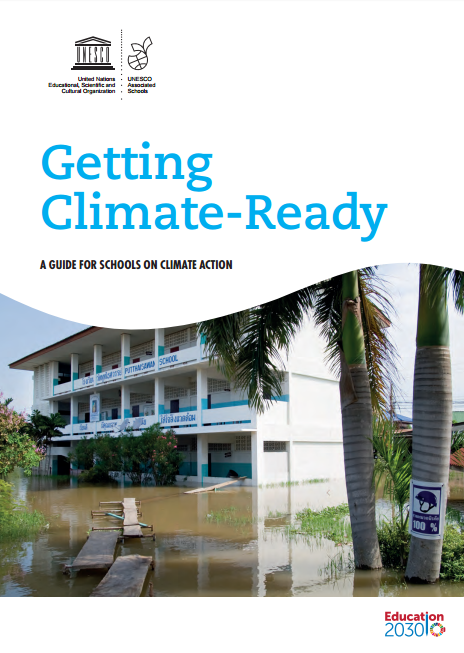 Getting climate ready: a guide for schools on climate action and the whole-school approach Year of publication: 2016 Corporate author: UNESCO Do you want to help create a healthier, fairer, more environmentally sustainable society? Do you want to empower children and young people to do the same? Do you want to make your school more climate-friendly? If so, this guide is for you! The guidelines and examples are based on a survey looking at climate action projects at 55 schools in 12 countries. All schools in the survey are part of UNESCO’s Associated Schools Project Network (ASPnet). In addition, this guide draws on examples and research published in peer-reviewed journals, books, national and international guidelines and frameworks and programme websites.
 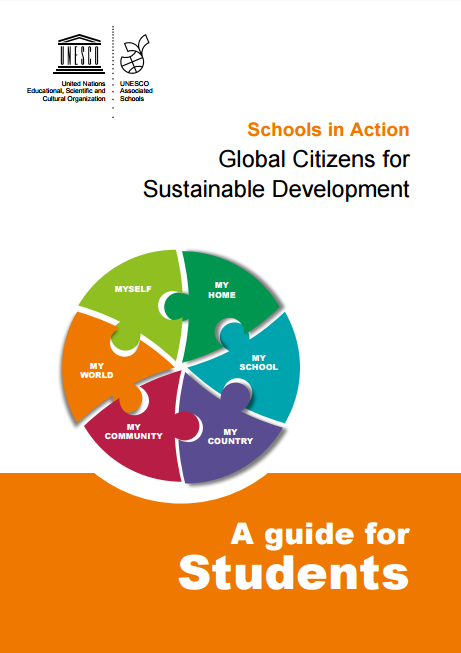 Schools in action, global citizens for sustainable development: a guide for students Year of publication: 2016 Corporate author: UNESCO The UNESCO Associated Schools Project Network (ASPnet) in Action: Global Citizens for Sustainable Development student guide aims to introduce secondary school students to Global Citizenship Education (GCED) and Education for Sustainable Development (ESD) and provide them with ideas and activities to contribute proactively to a more peaceful and sustainable world. The guide draws on the discussions and activities of almost 1,100 participants from 104 countries, including ASPnet National Coordinators, school principals, teachers, students and experts who contributed to the ASPnet Online Collaborative Platform: Global Citizens Connected for Sustainable Development in 2014 and 2015 [http://en.unesco.org/aspnet/globalcitizens]. You will find in this student guide: An overview of what it means to be a global citizen and of how you can contribute to sustainable development. Ideas for getting active yourself, as part of your home, school, community, country and globally. Selected activities on GCED and ESD from ASPnet schools around the world.
 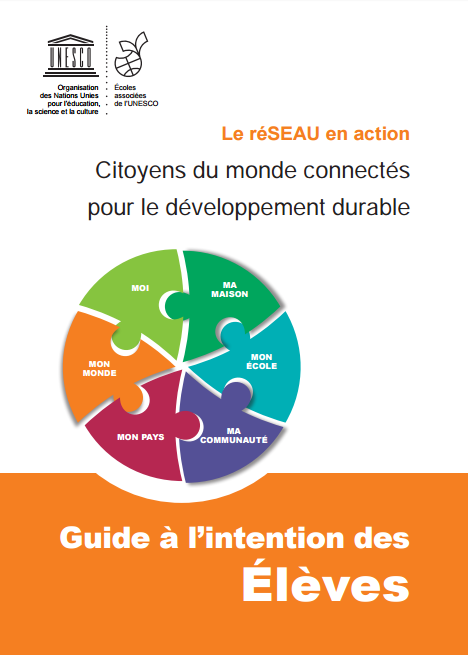 Le réSEAU en action: citoyens du monde connectés pour le développement durable: guide à l'intention des élèves Year of publication: 2017 Corporate author: UNESCO Le guide « Le réSEAU en action : Citoyens du monde connectés pour le développement durable » à l’intention des élèves a pour but d’initier les élèves du secondaire à l’éducation à la citoyenneté mondiale (ECM) et à l’éducation en vue du développement durable (EDD), et de leur proposer des idées et des activités pour qu’ils contribuent activement à la construction d’un monde plus pacifique et durable. Le guide s’appuie sur les discussions et les activités de près de 1 100 participants originaires de 104 pays, notamment des coordinnateurs nationaux du réSEAU, des chefs d’établissement, des enseignants, des élèves et des experts qui ont contribué à la plateforme collaborative en ligne « Le réSEAU en action : Citoyens du monde connectés pour le développement durable » en 2014 et 2015 [http://fr.unesco.org/aspnet/globalcitizens/]. Le guide à l’intention des élèves : donne une idée de ce que signifie « être un citoyen du monde » ainsi que des suggestions pour contribuer au développement durable ; propose des idées pour agir vous-mêmes dans votre foyer, dans votre école, dans votre communauté, dans votre pays et dans le monde ; présente une sélection d’activités sur l’ECM et l’EDD mises en œuvre par des écoles du réSEAU du monde entier.