
Resources
Explore a wide range of valuable resources on GCED to deepen your understanding and enhance your research, advocacy, teaching, and learning.
249 Results found
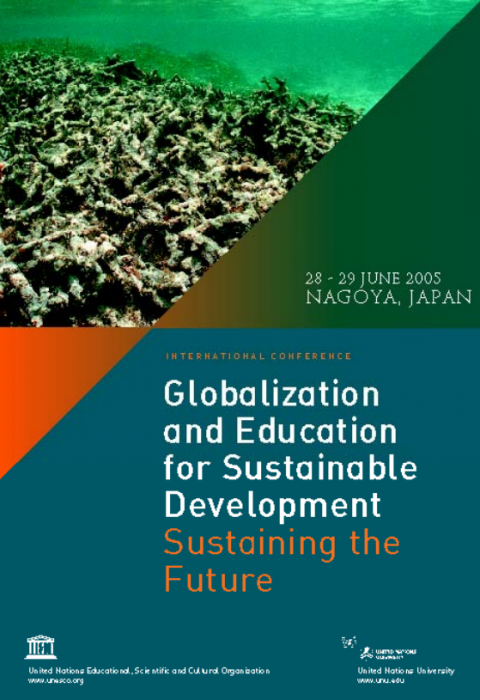 Globalization and education for sustainable development: sustaining the future Year of publication: 2006 Author: Laura Wong Corporate author: United Nations University This publication presents the contributions and outcomes of the stimulating two day gathering in Nagoya, where representatives of governments, academia and civil society gathered to share their experiences and develop their ideas about how to ensure ESD within the context of globalizing societies.
  Envisioning education beyond 2015: Asia-Pacific regional perspectives; final report Year of publication: 2014 Corporate author: UNESCO Bangkok This report provides a thorough account of the discussions and deliberations that led to the construction of the Asia-Pacific Statement on Education Beyond 2015 (Bangkok Statement), the outcome document of this historic event. Participants reviewed in fine detail EFA progress across the Asia-Pacific region and debated key thematic areas of basic education, skills and competencies, global citizenship education, education for sustainable development, teachers, governance and finance. Participants also looked into implementation strategies, and education ministers from across the region shared their views on remaining challenges, future priorities and strategies for education beyond 2015. Promoting sub-regional education for sustainable development in South-East Asia Year of publication: 2011 Corporate author: UNESCO Jakarta UNESCO Office, Jakarta, focuses on five cluster countries, helping their governments to plan and manage the education sector by enhancing national capacities to integrate sustainable development issues and practices into all types and levels of education. Country reports on education for sustainable development: centred on the five cluster countries of UNESCO office, Jakarta Year of publication: 2011 Author: Meeyoung Choi | Robert J. Didham Corporate author: UNESCO Jakarta As the cluster office, UNESCO Office, Jakarta covers the implementation of all major programmes and mandates by UNESCO in these five countries as well as disseminates and shares information and knowledge in the fields of education, science, culture and communication in the Asia and Pacific region.
  Learning with Intangible Heritage for a Sustainable Future: Guidelines for Educators in the Asia-Pacific Region Year of publication: 2015 Corporate author: UNESCO Bangkok The guide provides teacher educators and teachers with an understanding of the concept of intangible cultural heritage (ICH) and explains why ICH should be integrated into the curriculum in tandem with the principles and perspectives of Education for Sustainable Development (ESD). This guide explains how the strategic incorporation of ICH elements and ESD principles into the curriculum can enable learners to gain the knowledge and skills that are necessary for ensuring sustainable development in the future.
 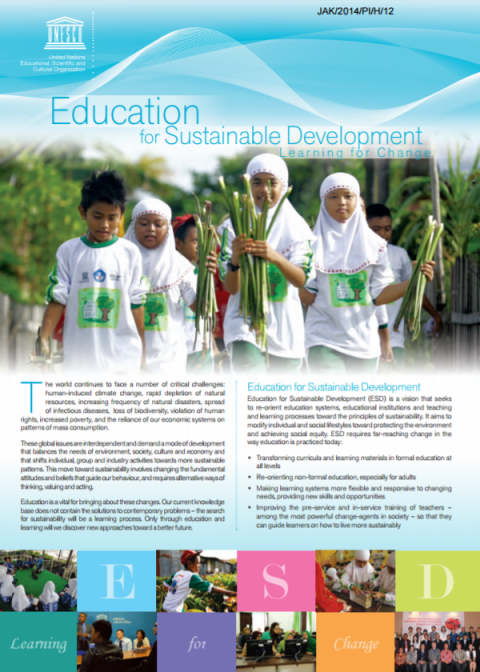 Education for Sustainable Development: Leaning for Change Year of publication: 2014 Corporate author: UNESCO Jakarta Education for Sustainable Development: Leaning for Change Education and Lifelong Learning for Sustainable Development: Asia-Pacific Regional Consultation; 12 - 13 February, 2015, Vientiane, Lao PDR Year of publication: 2015 Author: Heribert Hinzen | Ounpheng Khammang | Somsy Southivong | Timote Masima Vaioleti The book contains all the texts which were transformed from the presentations during the consultations into written manuscripts.
  Address by Irina Bokova, Director-General of UNESCO, at the Global Education and Skills Forum: debate on the rise of populism, Dubai, 19 March 2017 Year of publication: 2017 Corporate author: UNESCO. Director-General, 2009-2017 (Bokova, I.G.) This address was presented by Irina Bokova, Director-General of UNESCO at the Global Education and Skills Forum. She debates on the Rise of Populism.
 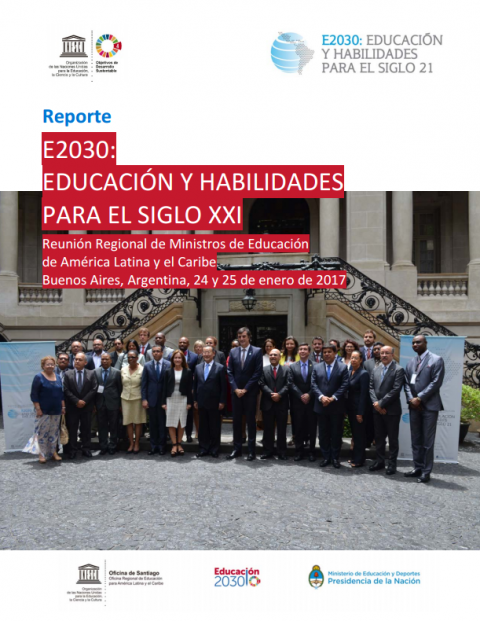 E2030: education and skills for the 21st century: Regional Meeting Year of publication: 2017 Corporate author: UNESCO Santiago This report provides a systematization of the discussions at the Regional Meeting of Ministers of Education of Latin America and the Caribbean “E2030: Education and skills for the 21st century” held 24‐25 January 2017 in Buenos Aires, Argentina. The objectives of the meeting were to: • adopt a Ministerial Declaration on a joint approach to achieve the SDG4-E2030 Agenda in the region, including means of implementation, technical instruments of support and follow-up mechanisms. • agree on a roadmap for the implementation of E2030, including a contextualized followup mechanism that responds to the region’s educational challenges and expectations.
 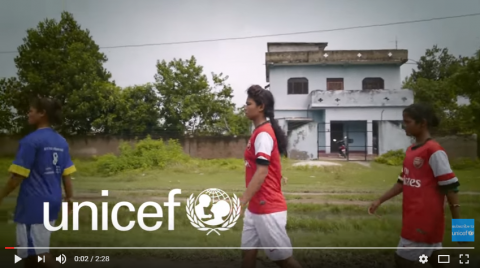 From the football field to the classrooms of Nepal Year of publication: 2015 Corporate author: United Nations Children's Fund (UNICEF) “Before, we didn’t know how to study. We were not motivated. I am transformed because of sports. And my studies have also improved,” Kalita says. In Solakhpur, Nepal, football is improving the life of 16-year-old Kalita and those of other adolescent girls through a sports programme meant to get more children into school and boost their academic success.