
Resources
Explore a wide range of valuable resources on GCED to deepen your understanding and enhance your research, advocacy, teaching, and learning.
249 Results found
 YouthXchange guidebook series: climate change and lifestyles Year of publication: 2011 Author: Adam Cade | Rob Bowden Corporate author: UNESCO | United Nations Environment Programme (UNEP) Climate Change and Lifestyles is the first in a series of guidebooks supporting the UNESCO/ UNEP YouthXchange (YXC) Initiative, which was created in 2001 to promote sustainable lifestyles among youth (15-24 years) through education, dialogue, awareness raising and capacity building. The series is being produced for young people and people working with youth, such as educators, teachers, trainers and youth leaders in both developed and developing countries. Almost half of the world’s population is under the age of 25, and nearly 90 per cent of them live in developing countries. Youth is a critical stakeholder in the global economy and will be the main actor and motor for change in the near future. Thus, the energy, motivation and creativity of youth are essential assets to stimulating change. Aims of the YXC Guidebook on Climate Change and Lifestyles: • Explore the links between lifestyles and climate change; • Help young people consider the actions they should take towards more sustainable lifestyles; • Support courses and actions that promote greater understanding of climate change and lifestyles among youth. The guidebook: • Considers the causes and effects of climate change and its human impacts and responses, while connecting them to lifestyle choices and the technical and social infrastructures of a society; • Provides scientific, political, economic, social, ethical and cultural perspectives on climate change; • Explains complex issues in accessible language supported by facts, graphics, images, examples and web links; • Develops the critical skills young people need to make personal choices to address the challenges of climate change.
  Climate Change Education for Sustainable Development: the UNESCO Climate Change Initiative Year of publication: 2010 Corporate author: UNESCO The UNESCO Climate Change Initiative was launched by Director-General Irina Bokova in Copenhagen during the 15th Conference of the Parties to the UN Framework Convention on Climate Change (UNFCCC COP15). It seeks to reinforce the scientific, mitigation and adaptation capacities of countries and communities that are most vulnerable to the effects of climate change. It focuses on a select number of strategic issues in line with The UN System Delivering as One on Climate Change action plan and The UNESCO Strategy for Action on Climate Change. The Initiative is based on four thematic areas: scientific, educational, environmental and ethical. Key objectives will be achieved through intersectoral and interdisciplinary cooperation, coordinated field activities, and networking. Special attention is given to UNESCO’s two global priorities, Africa and gender equality, as well as to the increased vulnerability of Small Island Developing States (SIDS).The UN System “Delivering as One” on Climate Change During the 13th session of the Conference of Parties to the UNFCCC in Bali, Indonesia, UN Secretary General Ban Ki-Moon presented an unprecedented coordination effort to bring together all the diverse perspectives, expertise and strengths of the UN system so as to deliver as one in the critical area of climate change. The initiative brings together expertise and ongoing work in diverse areas ranging from science and technology to agriculture, transport, forestry and disaster risk reduction, to address both mitigation and adaptation. It brings together the normative, standard setting and knowledge sharing capacities of the system with its operational reach in order to support the most vulnerable. The overall objective is to maximize existing synergies, eliminate duplication and overlap, and optimize the impact of the collective effort of the UN system.To ensure better coordination, convening responsibilities were assigned to UN system entities with a large volume of activities in the five focus areas and four cross-cutting areas. Focus areas ㆍAdaptation – High-Level Committee on Programmes collectively ㆍ Technology transfer – UNIDO, UN-DESA ㆍReduction of emissions from deforestation and degradation (REDD) – UNDP, FAO, UNEP ㆍ Financing mitigation and adaptation action – UNDP, World Bank Group ㆍCapacity building – UNDP, UNEP Cross-cutting areas ㆍClimate knowledge: science, assessment, monitoring and early warning – WMO, UNESCO ㆍSupporting global, regional and national action – UN-DESA, UN Regional Commissions, UNDP ㆍClimate-neutral UN – UNEP ㆍPublic awareness – UNCG, UNEP.
  Aichi-Nagoya Declaration on Education for Sustainable Development Year of publication: 2014 Corporate author: UNESCO We, the participants of the UNESCO World Conference on Education for Sustainable Development held in AichiNagoya, Japan, from 10 to 12 November 2014, adopt this Declaration and call for urgent action to further strengthen and scale up Education for Sustainable Development (ESD), in order to enable current generations to meet their needs while allowing future generations to meet their own, with a balanced and integrated approach regarding the economic, social and environmental dimensions of sustainable development. This Declaration recognises that people are at the centre of sustainable development and builds on the achievements of the United Nations (UN) Decade of ESD (2005-2014); the deliberations of the UNESCO World Conference on ESD in Aichi-Nagoya; and the Stakeholder Meetings held in Okayama, Japan, from 4 to 8 November 2014, namely, UNESCO ASPnet International ESD events, the UNESCO ESD Youth Conference, the Global Regional Centres of Expertise Conference, and other relevant events and consultation processes, including regional ministerial meetings. We express our sincere gratitude to the Government of Japan for hosting the UNESCO World Conference on ESD.
  Two concepts, one goal: education for international understanding and education for sustainable development Year of publication: 2007 Corporate author: APCEIU | UNESCO Bangkok EIU and ESD are not dogmas but evolving concepts that can contribute to social learning and transformation. EIU and ESD share many common issues, supporting each other’s scope of work and focus. This series of information sheets has been prepared to highlight key complementary areas and synergies.
  EIU Best Practice Series No. 5: Peace and human rights education through education for sustainable development: lessons from four case studies in the Philippines Year of publication: 2007 Corporate author: APCEIU The four case studies showed that EIU through peace and human rights education in the context of education for sustainable development can build a critical mass of Filipinos who will reject wars and promote social security. Education can play a role to direct the children, youth, and adults toward peace building and better understanding of cultural differences. It should also be noted that when institutions adopt a peace culture, establishing local and international organizations and putting up resources for various peace-building initiatives become possible. Educational intervention can effect changes in the minds of men and build a lasting and substantive foundation for peace based on justice and respect for human rights.
  Global Citizenship Concepts in the Curricula of Four Countries Year of publication: 2017 Author: Natalie Browes Corporate author: UNESCO International Bureau of Education (IBE) | APCEIU This report details the presence of Global Citizenship Education (GCED) concepts in the education systems of four countries: Cambodia, Colombia, Mongolia and Uganda. It highlights the main findings of eight reports: four expert reports, which predominately analyse curriculum content, and four situational analysis reports, which take a broader view and detail some of the country-specific challenges and opportunities with regard to GCED. Findings reveal the presence of GCED concepts across the curricula of the four countries. In addition to cognitive content related to GCED, competency-based content is also found present within the curricula of these countries. However, the majority of this content can only be indirectly linked to GCED, and it is better interpreted as part of the more traditional civics or citizenship education approach. As such, it generally lacks a global perspective and does not engage with all key themes of GCED. Furthermore, this content is often concentrated at the lower and upper secondary levels, instead of being equally distributed across all grade levels. This is particularly true in the case of behaviour-based competencies. Findings also reveal challenges beyond the curriculum. These include lack of teacher training and lack of support to implement GCED, which are concerns expressed by stakeholders in all four countries. A lack of GCED content in textbooks and lack of supplementary materials were also found to be issues. The report concludes with recommendations regarding the effective implementation of GCED within curricula. Among others, the report suggests the transversal integration of GCED - across the curriculum at all grade levels, while at the same time, actors from all levels of the education system, ranging from central government to teachers, should be engaged to ensure the use of complementary learning materials, pedagogies and assessment techniques.
  Peace Education in Northeast Asia: A Situational Analysis Year of publication: 2021 Author: Soonwon Kang | Cheng Liu | Ketei Matsui | Batbaatar Monkhooroi | Boyoung Park | Muyu Huang | Oyuntsetseg Dugarsuren Corporate author: APCEIU Being central to education for international understanding and global citizenship, peace education has always been an important theme in UNESCO. For effective delivery of peace education, it is critical to examine and understand the relevance of peace education and its key issues and approaches at a given juncture. With this in mind, in 2020, APCEIU conducted a study on peace education in South Korea to review its current state and suggest some policy recommendations. Following up on this study, APCEIU initiated in 2021 a research project on peace education in Northeast Asia in order to identify how peace education is interpreted and practised in the countries of the region and explore possibilities of cooperation among peace educators, researchers, and practitioners in the region. Building on this research, APCEIU hopes to develop and carry out joint projects for peace education in the region.
  EIU Best Practices Series No. 19: Culture-Based Education Programme for Indigenous Children & Youth in the Philippines Year of publication: 2010 Author: Benjamin David Abadiano Corporate author: APCEIU This monograph is one of APCEIU's EIU Best Practices Series, which aims to encourage educators, scholars, and activists to implement and share local initiatives on EIU. The Series No.19 introduces the Pumulaan program, a successful culture-based education programme for indigenous children and youth in the Philippines. The program is similar to that of Tugdaan, a widely recognized education program that promote learning for the Indigenous people. The Pumulaan program focuses on providing culturally sensitive, appropriate, and relevant education to students in Mangyan Tribe in Mindoro and the Matigsalog Tribe in Mindanao, incorporating values of peace, harmony, and diversity within the education programs.
 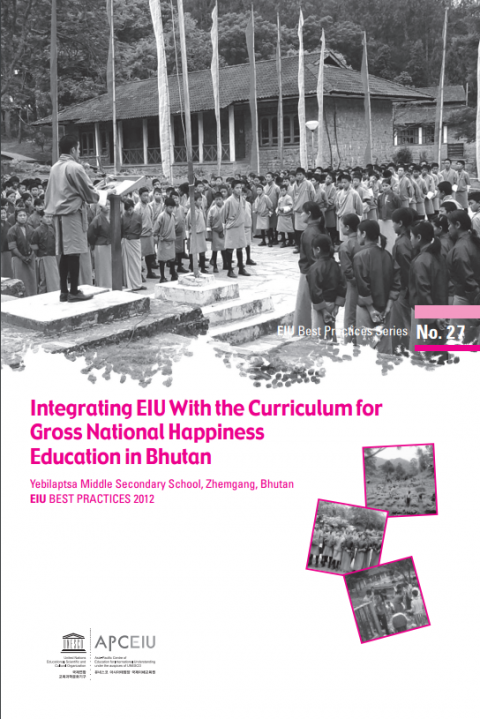 EIU Best Practices Series No. 27: Integrating EIU with the Curriculum for Gross National Happiness Education in Bhutan Year of publication: 2012 Author: Udhim Subba Corporate author: APCEIU This monograph is one of APCEIU's EIU Best Practices Series, which aims to encourage educators, scholars, and activists to implement and share local initiatives on EIU. The Series No.27 introduces Bhutan’s Yebilaptsa Middle Secondary School, in its effort to promote values of EIU as a complementary component of the Gross National Happiness Education efforts. Activities such as UNESCO club community activities, environmental learning, EIU cultural night, international exchange altogether exemplify effective ways to integrate EIU practices in the curriculum and extracurricular programs of schools.
 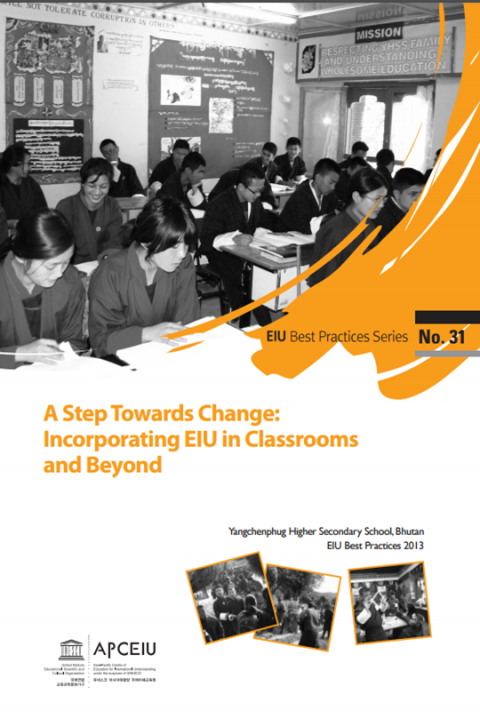 EIU Best Practices Series No.31: A Step towards Change: Incorporating EIU in Classrooms and Beyond Year of publication: 2013 Corporate author: APCEIU This monograph is one of APCEIU's EIU Best Practices Series, which aims to encourage educators, scholars, and activists to implement and share local initiatives on EIU. The Series No.31 introduces a case study in which Bhutanese school carried out activities and curriculum development to successfully promote EIU and ESD for students and teachers. While the school’s curriculum already embodies a degree of EIU, the school strived to be more creative in upholding the existing content by exploring newer issues of media ethics, human rights, culture, and environmental conservation for fruitful engagement. This in turn allowed the target audience to learn the values of EIU/ESD for a culture of peace.