
Resources
Explore a wide range of valuable resources on GCED to deepen your understanding and enhance your research, advocacy, teaching, and learning.
249 Results found
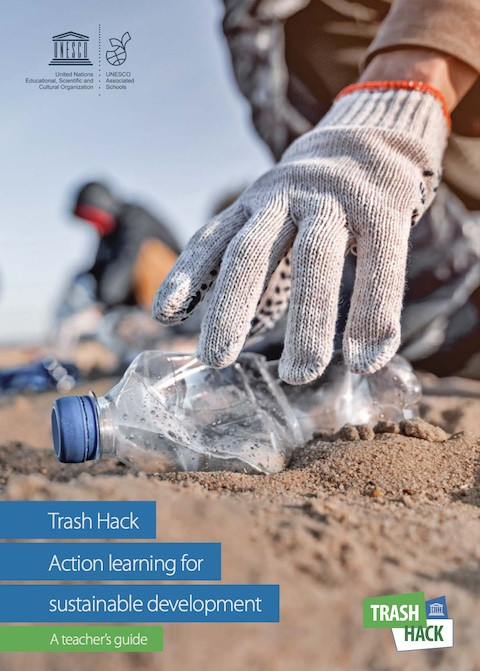 Trash Hack Action Learning for Sustainable Development: A Teacher's Guide Year of publication: 2021 Corporate author: UNESCO Education for Sustainable Development (ESD) gives people the tools to tackle the problems of the present and future, to fight the climate crisis, change the world and achieve the SDGs. ESD rethinks what we learn, where we learn and how we learn. It is about lifelong learning, which lets people develop the knowledge, skills, values and attitudes that enable them to make informed decisions and actions on global problems.The action-based activities in this guide intend to contribute to fostering the three dimensions of learning (cognitive, socio-emotional andbehavioural) and thereby promoting cross-cutting competencies for the SDGs, such as systems thinking, anticipatory competency, collaboration, critical thinking and integrated problem-solving.
 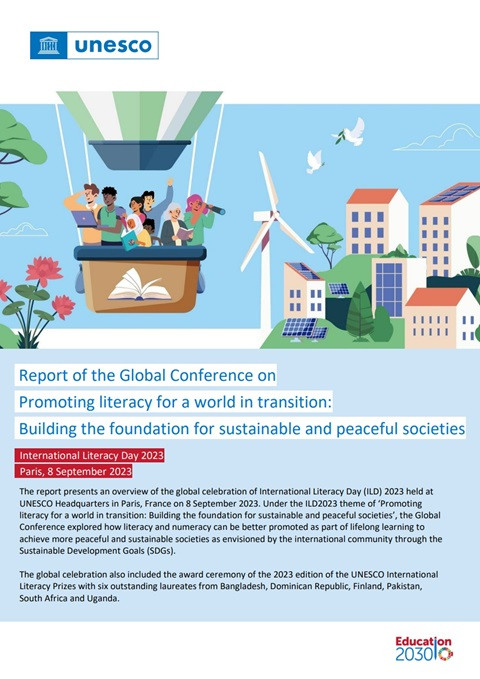 Report of the Global Conference on Promoting Literacy for a World in Transition: Building the Foundation for Sustainable and Peaceful Societies Year of publication: 2024 Corporate author: UNESCO The report presents an overview of the global celebration of International Literacy Day (ILD) 2023 held at UNESCO Headquarters in Paris, France on 8 September 2023. Under the ILD 2023 theme of ‘Promoting literacy for a world in transition: Building the foundation for sustainable and peaceful societies’, the Global Conference explored how literacy and numeracy can be better promoted as part of lifelong learning to achieve more peaceful and sustainable societies as envisioned by the international community through the Sustainable Development Goals (SDGs). The global celebration also included the award ceremony of the 2023 edition of the UNESCO International Literacy Prizes with six outstanding laureates from Bangladesh, Dominican Republic, Finland, Pakistan, South Africa and Uganda.
  Berlin Declaration on Education for Sustainable Development; Learn for Our Planet: Act for Sustainability Year of publication: 2022 Corporate author: UNESCO From 17 May to 19 May 2021 around 2800 people – politicians, business people, youth leaders, scientists, Non-governmental organizations, and many more - from 160 countries came together virtually at the UNESCO World Conference on Education for Sustainable Development (ESD) 2021. During the conference, they expressed their commitment to use the transformative power of education in order to address the global challenges we face. The Berlin Declaration was the main result of the conference.The Berlin Declaration on Education for Sustainable Development is an important document that emphasizes the significance of ESD for each and every one of us. It identifies concrete challenges the global community is facing and calls for changes that are urgently needed in order to fully integrate and strengthen ESD in all educational contexts.
  Climate Change and Sustainability in Science and Social Science Secondary School Curricula Year of publication: 2024 Author: Marcia McKenzie | Aaron Benavot Corporate author: UNESCO There is an urgent need to transform the way climate change and sustainability are taught in classrooms and at schools. Learners must grasp the environmental impacts of climate change, how climate change relates to their own context and what actions can be undertaken and contribute to making societies more sustainable, equitable, just and climate-resilient. The findings presented in this publication indicate that accelerated efforts are needed. In a study of over 530 Grade 9 science and social science curricula from 85 countries worldwide, we found that 69 per cent of curricula contained no references to climate change, while 66 per cent had no references to sustainability. Furthermore, while 69 per cent of surveyed teachers from eight of the countries studied reported that environment, sustainability and climate change topics were included in the science and social science curricula in their schools only 50 per cent included them in their teaching. While there is a notable inclusion of environment, sustainability and climate change in science and social science curricula across countries, the depth of focus of this inclusion varies widely. Cognitive learning prevails over social and emotional or action-oriented learning. Climate change and sustainability in school practices must be strengthened, with teachers playing a key role in enhancing integration through teaching methods and materials.
  Green School Quality Standard: Greening Every Learning Environment Year of publication: 2024 Corporate author: UNESCO Climate change threatens our planet and future. Schools and other learning institutions are central places for accelerating climate action among learners and local communities. By empowering teachers and students to understand climate change in their own context contribute to making societies more sustainable and climate resilient. This publication provides for the first time ever a quality standard for greening schools and other learning environments. It outlines four core areas for integrating sustainability principles and climate action: 1) school governance, 2) facilities and operation, 3) teaching and learning, and 4) community engagement. Through the Greening Education Partnership, this standard establishes a common language for all stakeholders to jointly reach the global target of greening at least 50% of schools in all countries by 2030. Policy-makers and ministries in charge of education accreditation schemes, as well as educators, learners and communities are encouraged to use the green school quality standard and join the climate-ready school movement to ensure that every learner is equipped to address climate challenges.
  Greening Curriculum Guidance: Teaching and Learning for Climate Action Year of publication: 2024 Corporate author: UNESCO This Guidance responds to the calls from young people for a holistic approach to climate change and sustainability in the curriculum. It outlines a common language on how quality climate change and sustainability can be reflected in the curriculum by setting expected learning outcomes per age group (from 5-year olds and up to 18+ age group, including a lifelong learning approach).This is crucial for accelerating country-level action and ensuring joint monitoring of progress. The objective is to have 90 per cent of all countries include climate change in their curricula by 2030, as established by the Greening Education Partnership.This Guidance aims to support countries, schools or individual practitioners in reassessing their ongoing practices to adopt a more action-oriented, holistic, scientifically accurate, justice-driven and lifelong learning approach to climate change.
 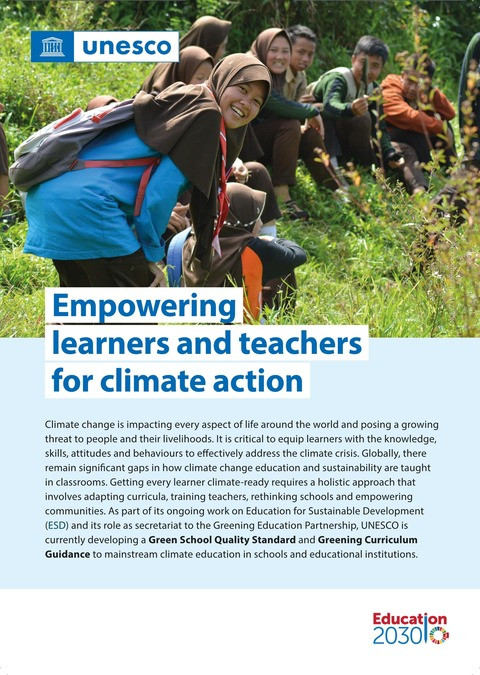 Empowering Learners and Teachers for Climate Action Year of publication: 2023 Corporate author: UNESCO Climate change is impacting every aspect of life around the world and posing a growing threat to people and their livelihoods. It is critical to equip learners with the knowledge, skills, attitudes and behaviours to effectively address the climate crisis. Globally, there remain significant gaps in how climate change education and sustainability are taught in classrooms. Getting every learner climate-ready requires a holistic approach that involves adapting curricula, training teachers, rethinking schools and empowering communities. As part of its ongoing work on Education for Sustainable Development (ESD) and its role as secretariat to the Greening Education Partnership, UNESCO is currently developing a Green School Quality Standard and Greening Curriculum Guidance to mainstream climate education in schools and educational institutions.
  Humanistic Futures of Learning: Perspectives from UNESCO Chairs and UNITWIN Networks Year of publication: 2020 Corporate author: UNESCO UNESCO’s Futures of Education initiative aims to rethink education and shape the future. The initiative is catalyzing a global debate on how knowledge, education and learning need to be reimagined in a world of increasing complexity, uncertainty and precarity. This publication presents the first curated input to the Futures of Education initiative from the UNITWIN/UNESCO Chairs Programme, which now represents an extensive global network of more than 800 higher education institutions in over 115 countries. It features think pieces that highlight key dimensions to be considered in re-visioning and re-purposing education for the future of humanity and the planet. The collection of the pieces calls for greater focus on a number of critical areas such as: The role of culture in strengthening social and environmental sustainability; the values and attitudes that are needed to shape future generations; the importance of both robust public education, as well as of other learning spaces; the need to strengthen human creativity and capability in the digital era, as well as the role of higher education in generating the knowledge and driving the innovation required to transform our world.
  Non-Formal Education, Sustainable Development and the Education 2030 Agenda: Study of Civil Society Practices in Latin America and the Caribbean Year of publication: 2020 Corporate author: UNESCO Santiago | UNESCO Mexico This publication shows 27 civil society initiatives from various countries in Latin America and the Caribbean that work to promote actions and programs to comply with Target 4.7 within non-formal education. The study seeks that these organizations show their work, the challenges they face as regards the implementation of their programs and their greatest achievements.