
Resources
Explore a wide range of valuable resources on GCED to deepen your understanding and enhance your research, advocacy, teaching, and learning.
526 Results found
 Education pour le développement durable: construire un monde meilleur et plus juste pour le 21e siècle Year of publication: 2012 Corporate author: UNESCO Education for Sustainable Development allows every human being to acquire the knowledge, skills, attitudes and values necessary to shape a sustainable future. Education for Sustainable Development means including key sustainable development issues into teaching and learning; for example, climate change, disaster risk reduction, biodiversity, poverty reduction, and sustainable consumption. It also requires participatory teaching and learning methods that motivate and empower learners to change their behaviour and take action for sustainable development. Education for Sustainable Development consequently promotes competencies like critical thinking, imagining future scenarios and making decisions in a collaborative way. Education for Sustainable Development requires far-reaching changes in the way education is often practised today. UNESCO is the lead agency for the UN Decade of Education for Sustainable Development (2005-2014). Educación para el desarrollo sostenible: edificar un mundo mejor y más justo para el siglo XXI Year of publication: 2012 Corporate author: UNESCO Education for Sustainable Development allows every human being to acquire the knowledge, skills, attitudes and values necessary to shape a sustainable future. Education for Sustainable Development means including key sustainable development issues into teaching and learning; for example, climate change, disaster risk reduction, biodiversity, poverty reduction, and sustainable consumption. It also requires participatory teaching and learning methods that motivate and empower learners to change their behaviour and take action for sustainable development. Education for Sustainable Development consequently promotes competencies like critical thinking, imagining future scenarios and making decisions in a collaborative way. Education for Sustainable Development requires far-reaching changes in the way education is often practised today. UNESCO is the lead agency for the UN Decade of Education for Sustainable Development (2005-2014).
  Global Citizenship Concepts in the Curricula of Four Countries Year of publication: 2017 Author: Natalie Browes Corporate author: UNESCO International Bureau of Education (IBE) | APCEIU This report details the presence of Global Citizenship Education (GCED) concepts in the education systems of four countries: Cambodia, Colombia, Mongolia and Uganda. It highlights the main findings of eight reports: four expert reports, which predominately analyse curriculum content, and four situational analysis reports, which take a broader view and detail some of the country-specific challenges and opportunities with regard to GCED. Findings reveal the presence of GCED concepts across the curricula of the four countries. In addition to cognitive content related to GCED, competency-based content is also found present within the curricula of these countries. However, the majority of this content can only be indirectly linked to GCED, and it is better interpreted as part of the more traditional civics or citizenship education approach. As such, it generally lacks a global perspective and does not engage with all key themes of GCED. Furthermore, this content is often concentrated at the lower and upper secondary levels, instead of being equally distributed across all grade levels. This is particularly true in the case of behaviour-based competencies. Findings also reveal challenges beyond the curriculum. These include lack of teacher training and lack of support to implement GCED, which are concerns expressed by stakeholders in all four countries. A lack of GCED content in textbooks and lack of supplementary materials were also found to be issues. The report concludes with recommendations regarding the effective implementation of GCED within curricula. Among others, the report suggests the transversal integration of GCED - across the curriculum at all grade levels, while at the same time, actors from all levels of the education system, ranging from central government to teachers, should be engaged to ensure the use of complementary learning materials, pedagogies and assessment techniques.
  Europe and North America Regional Workshop on the Global Action Programme on Education for Sustainable Development and Cities Year of publication: 2017 Corporate author: UNESCO UNESCO promotes Education for Sustainable Development (ESD) through the Global Action Programme (GAP), the official follow-up to the UN Decade of ESD. The Europe and North America region was the first to officially adopt a regional strategy for the United Nations Decade of Education for Sustainable Development (DESD, 2005-2014), which seeks to promote a better quality of life for populations and human settlements. Learning to live in a sustainable way and securing people’s involvement and participation in community and urban life are key factors in ensuring sustainable economic, social and environmental development. It is in this context that UNESCO, the UNESCO Global Network of Learning Cities, with its secretariat in the UNESCO Institute for Lifelong Learning (UIL) in Hamburg, and the Free and Hanseatic City of Hamburg, organized the regional workshop for Europe and North America on the role of cities in accelerating sustainable solutions at local level through education. More than 50 experts and city representatives from Europe and North America participated in the regional workshop in Hamburg, Germany, from 12 to 14 December 2016. The workshop examined how education and learning beyond the formal system can be used to support the implementation of the five Ps (Planet, People, Peace, Prosperity and Partnership) of the 2030 Agenda to achieve the Sustainable Development Goals (SDGs). Experts shared their views on ESD, with cities providing insight into their good practices and enriching discussions on the challenges of promoting the various SDGs through education and lifelong learning at city level. These discussions helped to promote awareness on integrating ESD in their cities’ development and education agendas. Programme d'action global pour l'Education en vue du développement durable et les villes: atelier régional pour l'Europe et l'Amérique du Nord Year of publication: 2017 Corporate author: UNESCO L’UNESCO oeuvre pour l’éducation au développement durable (EDD) dans le cadre du Programme d’action global, suivi officiel de la Décennie des Nations Unies pour l'éducation au service du développement durable (DEDD, 2005-2014). La région Europe et Amérique du Nord a été la première à adopter formellement une stratégie régionale pour la Décennie visant à promouvoir une meilleure qualité de vie pour les populations et les établissements humains. L’apprentissage d’un mode de vie durable et la participation des individus à la vie de la communauté et de la ville sont des conditions essentielles d’un développement économique, social et environnemental durable. C’est dans ce contexte que l’UNESCO, son Réseau mondial des villes apprenantes, dont le secrétariat est hébergé par l’Institut de l'UNESCO pour l'apprentissage tout au long de la vie (UIL) à Hambourg, et les autorités de la Ville libre et hanséatique de Hambourg ont organisé l’atelier régional pour l’Europe et l’Amérique du Nord sur le rôle des villes dans la mise en place accélérée de solutions locales durables, par l’éducation. Plus de 50 experts et représentants de villes d’Europe et d’Amérique du Nord ont participé à l’atelier régional, qui s’est tenu à Hambourg (Allemagne) du 12 au 14 décembre 2016. Ils ont réfléchi à la manière de s’appuyer sur l’éducation et l’apprentissage, au-delà du cadre formel, pour faciliter la mise en oeuvre des « cinq P » – planète, population (humanité), paix, prospérité et partenariats – du Programme 2030 et réaliser les Objectifs de développement durable (ODD). Les experts ont partagé leurs vues sur l’EDD, et les municipalités ont présenté leurs bonnes pratiques et enrichi les discussions sur les défis que représentait la promotion des différents ODD par l’éducation et l’apprentissage tout au long de la vie, au niveau des villes. Ces discussions ont aidé les villes à mieux comprendre comment intégrer l’EDD dans leurs programmes de développement et d’éducation.
  Meeting on Learning to Live Sustainably in Cities in Latin America and the Caribbean, Villa María, Argentina (26-28 April 2017): Meeting Report Year of publication: 2017 Corporate author: UNESCO Villa Maríia, the first Argentinian city to join the UNESCO Global Network of Learning Cities (GNLC), co-hosted the first GNLC meeting in the region, titled ‘Learning to live sustainably in cities in Latin America and the Caribbean’. This three-day event was a joint effort of the City of Villa Maríia, the UNESCO Institute for Lifelong Learning (UIL), UNESCO Headquarters, and the UNESCO Regional Bureau for Education in Latin America and the Caribbean (OREALC/UNESCO Santiago). Participants explored new ways to implement sustainable solutions at the local level, as well as increase awareness and training related to Education for Sustainable Development (ESD). More than 170 city representatives from over 40 cities and 20 countries (including mayors and deputy mayors, experts, authorities and practitioners) were welcomed by the host city. The first day of the meeting was composed of plenary sessions; the second day consisted of two parallel workshop sessions: (1) a regional workshop on the Global Action Programme (GAP) on ESD and Cities, and (2) a regional workshop on learning cities. Aprender a Vivir de Manera Sostenible en Ciudades de América Latina y el Caribe, Villa María (Argentina), 26-28 de abril de 2017: informe de la reunión Year of publication: 2017 Corporate author: UNESCO Villa Maríia, la primera ciudad argentina que entróo a formar parte de la Red Mundial de Ciudades del Aprendizaje de la UNESCO, fue una de las organizadoras de la primera reunióon de esta Red en la regióon, titulada “Aprender a vivir de manera sostenible en ciudades en Améerica Latina y el Caribe”. Este acto, de tres díias de duracióon, fue una iniciativa conjunta de la ciudad de Villa Maríia, el Instituto de la UNESCO para el Aprendizaje a lo Largo de Toda la Vida (IUAL), la Sede de la UNESCO y la Oficina Regional de Educacióon de la UNESCO para Améerica Latina y el Caribe (OREALC/UNESCO Santiago). Los participantes estudiaron nuevas formas de poner en práactica soluciones sostenibles a escala local, asíi como de fomentar una mayor sensibilizacióon y formacióon en materia de educacióon para el desarrollo sostenible (EDS). Villa Maríia acogióo a máas de 170 representantes de máas de 40 ciudades y 20 paíises, entre los que se encontraban alcaldes y tenientes de alcalde, expertos, autoridades y profesionales. Durante la primera jornada de la reunióon tuvieron lugar reuniones plenarias y la segunda jornada se dividióo en dos sesiones paralelas de talleres: 1) un taller regional sobre el Programa de Accióon Mundial de EDS y las ciudades, y 2) un taller regional sobre las ciudades del aprendizaje.
 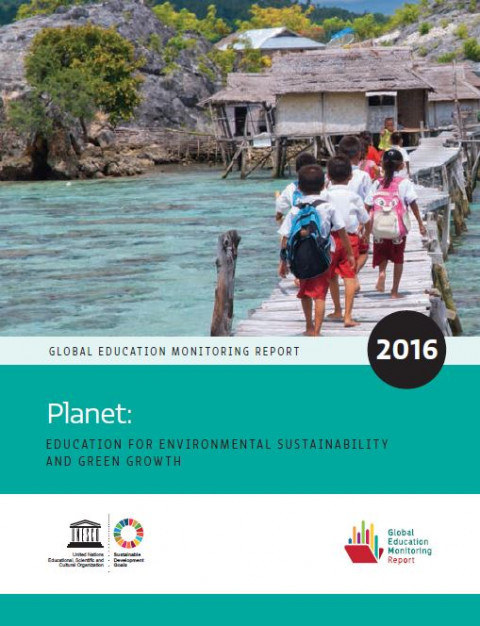 Global Education Monitoring Report, 2016: Planet: Education for Environmental Sustainability and Green Growth Year of publication: 2016 Corporate author: UNESCO PLANET: Education for environmental sustainability and green growth, a publication taken from the full 2016 Global Education Monitoring Report, explores the knowledge and skills needed for sustainable and inclusive economic growth that does not damage our planet.This publication demonstrates how education can help people understand and respond to environmental issues and climate change. Environmental education can increase green knowledge and build sustainability practices. The publication warns that while education contributes to economic growth, education systems must be careful not to encourage unsustainable lifestyles and all learners must acquire the knowledge and skills needed to promote sustainable development.It also argues that we must continue to learn throughout our lives in order to make production and consumption sustainable, and to provide green skills for green industries. Creating green industries relies on high-skill workers with specific training, yet by 2020 there could be 40 million too few workers with tertiary education relative to demand. Higher education and research should also be oriented towards green innovation and growth; innovation depends on cooperation in higher education and investment in research and development to transform production in vast swaths of the economy.It also recognises that education must change in order to keep up with the changing face of work. Green and transferable skills should be taught in both school and the workplace. The greening of industries requires not only the production of more high-skill workers, but the continued training and education for low and medium skill workers, often on the job. “To ensure the Sustainable Development Goals are implemented, everyone involved needs to think, to work, to organise, to communicate and to report in ways that are completely different from what has been done up till now. Education truly is key to a wide appreciation not just of the SDGs but the new ways of thinking and working that are going to be necessary to fulfil them. So the challenge to all of us is to re-learn, and that does not just apply to educators, but it applies to all of us.” Programa temático propuesto sobre la educación relativa al agua en el marco del Decenio de las Naciones Unidas de la Educación para el Desarrollo Sostenible (2005-2014) Year of publication: 2006 Corporate author: International Hydrological Programme (IHP) Water education is a very important component of UNESCO’s overall effort in water, including within the International Hydrological Programme. The UNESCO Executive Board has called for a UNESCO-wide strategy for water education at all levels. This document reviews the evolution of water education within UNESCO, and draws attention to the Draft Action Plan for the UN Decade on Education for Sustainable Development (DESD), which includes 12 Thematic Programmes one of which would be devoted to “Education for Sustainable Water Management”. The IHP would be expected to play an important role in such a UNESCO-wide effort for water education. Le rôle de l'UNESCO pour la décennie des Nations Unies pour l'éducation au service du développement durable (2005-2014): visions et défis Year of publication: 2006 Corporate author: UNESCO This document elaborates on UNESCO's role in guiding the Decade of Education for Sustainable Development (DESD), its vision and challenges for the DESD.