
Resources
Explore a wide range of valuable resources on GCED to deepen your understanding and enhance your research, advocacy, teaching, and learning.
526 Results found
 L'UNESCO et l'éducation Year of publication: 2017 Corporate author: UNESCO Education is a fundamental human right and
a public good and, as such, has been at the core of UNESCO’s work since its inception.Education is also the path to sustainability – to poverty alleviation, better health, environmental protection and gender equality.As the only United Nations agency with a mandate to cover all aspects of education, UNESCO was entrusted in 2015 to lead the coordination and monitoring of Sustainable Development Goal 4, as part of the new Global Education 2030 Agenda.Goal 4 aims to “ensure inclusive and equitable quality education and promote lifelong learning opportunities for all,” and renewed UNESCO’s and Member States’ commitment to a vision of education that is holistic, inspirational and which leaves no one behind.This commitment is reflected in the size and scope of the Education Sector, the largest in UNESCO, with staff working at its Paris Headquarters and spread across a global network of field offices and specialized institutes and centres. With its close links with education ministries and other partners, UNESCO is strongly placed to press for action and change.UNESCO’s Education Sector supports Member States in developing education systems that foster high-quality and inclusive lifelong learning for all, empowering learners to be creative and responsible global citizens while leading the debate to help shape the future international education agenda.There is no stronger, no more lasting, investment a country can make than educating its citizens. The Education Sector exists to further this collective vision worldwide by transforming lives one by one.
L'UNESCO et l'éducation Year of publication: 2017 Corporate author: UNESCO Education is a fundamental human right and
a public good and, as such, has been at the core of UNESCO’s work since its inception.Education is also the path to sustainability – to poverty alleviation, better health, environmental protection and gender equality.As the only United Nations agency with a mandate to cover all aspects of education, UNESCO was entrusted in 2015 to lead the coordination and monitoring of Sustainable Development Goal 4, as part of the new Global Education 2030 Agenda.Goal 4 aims to “ensure inclusive and equitable quality education and promote lifelong learning opportunities for all,” and renewed UNESCO’s and Member States’ commitment to a vision of education that is holistic, inspirational and which leaves no one behind.This commitment is reflected in the size and scope of the Education Sector, the largest in UNESCO, with staff working at its Paris Headquarters and spread across a global network of field offices and specialized institutes and centres. With its close links with education ministries and other partners, UNESCO is strongly placed to press for action and change.UNESCO’s Education Sector supports Member States in developing education systems that foster high-quality and inclusive lifelong learning for all, empowering learners to be creative and responsible global citizens while leading the debate to help shape the future international education agenda.There is no stronger, no more lasting, investment a country can make than educating its citizens. The Education Sector exists to further this collective vision worldwide by transforming lives one by one. 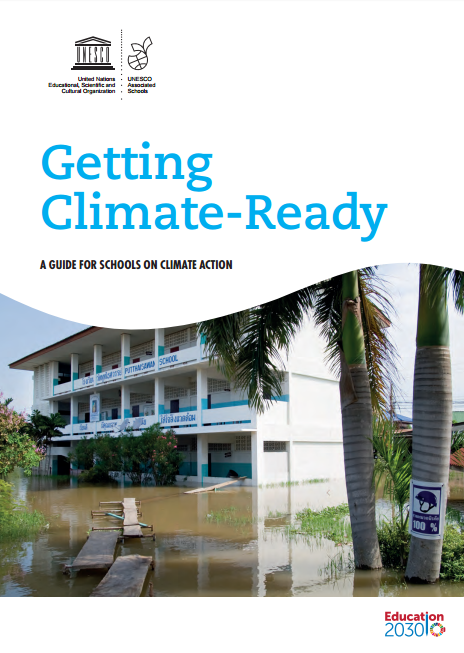 Getting climate ready: a guide for schools on climate action and the whole-school approach Year of publication: 2016 Corporate author: UNESCO Do you want to help create a healthier, fairer, more environmentally sustainable society? Do you want to empower children and young people to do the same? Do you want to make your school more climate-friendly? If so, this guide is for you! The guidelines and examples are based on a survey looking at climate action projects at 55 schools in 12 countries. All schools in the survey are part of UNESCO’s Associated Schools Project Network (ASPnet). In addition, this guide draws on examples and research published in peer-reviewed journals, books, national and international guidelines and frameworks and programme websites. Faire face au changement climatique: guide sur l'action climat destiné aux établissements scolaires Year of publication: 2016 Corporate author: UNESCO Do you want to help create a healthier, fairer, more environmentally sustainable society? Do you want to empower children and young people to do the same? Do you want to make your school more climate-friendly? If so, this guide is for you! The guidelines and examples are based on a survey looking at climate action projects at 55 schools in 12 countries. All schools in the survey are part of UNESCO’s Associated Schools Project Network (ASPnet). In addition, this guide draws on examples and research published in peer-reviewed journals, books, national and international guidelines and frameworks and programme websites.
  Asia-Pacific guidelines for the development of national ESD indicators Year of publication: 2007 Author: Daniella Tilbury | Sonja Janousek | Derek Elias | Joel Bacha Corporate author: UNESCO Bangkok UNESCO Bangkok, with assistance from the Commission on Education and Communication (CEC) of the World Conservation Union (IUCN) in conjunction with Macquarie University in Australia, implemented a project to assist with the important task of monitoring and assessing progress during the UN Decade of Education for Sustainable Development (DESD). This process has been funded by the generous contribution of the Ministry of Education, Culture, Sports, Science and Technology under the Japanese Funds-In-Trust for Education for Sustainable Development (ESD). The DESD provides an important opportunity to enhance the profile of ESD in both formal and informal learning spaces which in turn assists UNESCO Member States with the transformation into sustainable societies. Efforts to promote and integrate ESD at all levels will be key to advancing the reach of the Decade.Responding to the DESD International Implementation Scheme’s (IIS) recommendation to develop indicators (see Appendix 1), the Asia-Pacific DESD Indicators Project commenced in March 2006. The first stage of the project has resulted in the publication of this Guidelines document which assists UNESCO Member States in the Asia-Pacific region with the development of ESD indicators and monitoring systems at the national level.The document is intended to provide an important practical resource for UNESCO National Commissions, in addition to other stakeholders, in the area of ESD indicator development. By outlining how to develop national ESD indicators, the Guidelines offers an effective way of building knowledge and increasing ownership of the Decade among stakeholders. Rather than deliver a pre-packaged set of ESD indicators, this document provides countries with a foundation for developing indicators that are relevant to their national contexts.The objectives of the Guidelines are:• To assist with understanding the nature of ESD indicators and the different approaches for their use;• To identify the different types of ESD indicators and what they may reveal about progress;• To identify important sources, methods and planning tools for both data collection and reporting;• To encourage UNESCO Member States in the Asia-Pacific region to work collaboratively, share experiences and learn about meaningful monitoring and assessment during and beyond the DESD; and• To build national capacity to develop ESD indicators and ESD data collection mechanisms at the national level Orientations Asie-Pacifique pour l'élaboration d'indicateurs nationaux Year of publication: 2007 Author: Daniella Tilbury | Sonja Janousek | Derek Elias | Joel Bacha Corporate author: UNESCO Bangkok L'UNESCO Bangkok, avec l'aide de la Commission de l'Éducation et de la Communication (CEC) de l'Union mondiale pour la nature (UICN) en collaboration avec l'Université Macquarie en Australie, a mis en œuvre un projet pour aider à la tâche importante de suivi et d'évaluation des progrès de la Décennie des Nations Unies. Éducation pour le développement durable (DEDD). Ce processus a été financé par la contribution généreuse du ministère de l'Éducation, de la Culture, des Sports, des Sciences et de la Technologie au Fonds fiduciaire japonais pour l'éducation pour le développement durable. Le DEDD offre une occasion importante de rehausser le profil de l'EDD dans les espaces d'apprentissage formels et informels, ce qui aide les États membres de l'UNESCO à se transformer en sociétés durables. Les efforts déployés pour promouvoir et intégrer l'EDD à tous les niveaux seront essentiels pour faire progresser la portée de la Décennie.Répondant à la recommandation du DEDD International Implementation Scheme (IIS) pour l'élaboration d'indicateurs (voir Annexe 1), le Projet d'Indicateurs DEDD de l'Asie-Pacifique a débuté en mars 2006. La première étape du projet a abouti à la publication du présent document qui aide l'UNESCO Les États membres de la région Asie-Pacifique, avec l'élaboration d'indicateurs et de systèmes de suivi au niveau national.Le document est destiné à fournir une ressource pratique importante aux Commissions nationales de l'UNESCO, en plus des autres parties prenantes, dans le domaine de l'élaboration d'indicateurs de développement durable. En définissant la manière d'élaborer des indicateurs nationaux de développement économique durable, les Lignes directrices offrent un moyen efficace de renforcer les connaissances et d'accroître l'appropriation de la Décennie par les parties prenantes. Plutôt que de fournir un ensemble pré-emballé d'indicateurs EDD, ce document fournit aux pays une base pour développer des indicateurs qui sont pertinents à leur contexte national.Les objectifs des lignes directrices sont les suivants:• Aider à comprendre la nature des indicateurs EDD et les différentes approches pour leur utilisation;• Identifier les différents types d'indicateurs EDD et ce qu'ils peuvent révéler sur les progrès;• Identifier les sources, les méthodes et les outils de planification importants pour la collecte et le compte rendu des données;• Encourager les États membres de l'UNESCO de la région Asie-Pacifique à travailler en collaboration, à échanger leurs expériences et à en apprendre davantage sur le suivi et l'évaluation significatifs pendant et après le DEDD; et• Renforcer la capacité nationale d'élaborer des indicateurs EDD et des mécanismes de collecte de données EDD au niveau national
 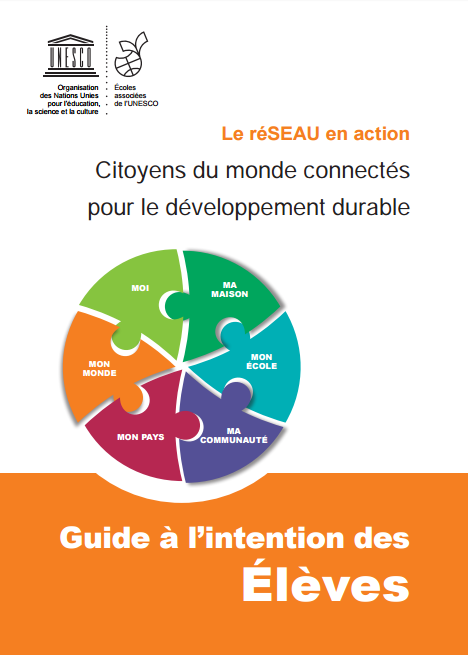 Le réSEAU en action: citoyens du monde connectés pour le développement durable: guide à l'intention des élèves Year of publication: 2017 Corporate author: UNESCO Le guide « Le réSEAU en action : Citoyens du monde connectés pour le développement durable » à l’intention des élèves a pour but d’initier les élèves du secondaire à l’éducation à la citoyenneté mondiale (ECM) et à l’éducation en vue du développement durable (EDD), et de leur proposer des idées et des activités pour qu’ils contribuent activement à la construction d’un monde plus pacifique et durable. Le guide s’appuie sur les discussions et les activités de près de 1 100 participants originaires de 104 pays, notamment des coordinnateurs nationaux du réSEAU, des chefs d’établissement, des enseignants, des élèves et des experts qui ont contribué à la plateforme collaborative en ligne « Le réSEAU en action : Citoyens du monde connectés pour le développement durable » en 2014 et 2015 [http://fr.unesco.org/aspnet/globalcitizens/]. Le guide à l’intention des élèves : donne une idée de ce que signifie « être un citoyen du monde » ainsi que des suggestions pour contribuer au développement durable ; propose des idées pour agir vous-mêmes dans votre foyer, dans votre école, dans votre communauté, dans votre pays et dans le monde ; présente une sélection d’activités sur l’ECM et l’EDD mises en œuvre par des écoles du réSEAU du monde entier.
  Address by Irina Bokova, Director-General of UNESCO, on the occasion of the Global Citizen Forum; Monaco, 8 October 2015 Corporate author: UNESCO. Director-General, 2009-2017 (Bokova, I.G.) This address was delivered by Irina Bokova, Director-General of UNESCO, on the occasion of the Global Citizen Forum.
  Green impact: the numbers speak for themselves Year of publication: 2015 Author: Christopher Slaney Corporate author: UNESCO ESD Success Stories are showcasing compelling stories with a personal/human dimension from all five UNESCO regions (Africa, Arab States, Asia and Pacific, Europe & North America and Latin America & the Caribbean). The stories illustrate the wide diversity of ESD approaches and initiatives taking place in different parts of the world. They show how involvement with ESD has changed the lives of specific individual persons and how they have become more active in their community. Each story centers on one individual or a group of individuals.The National Union of Students (NUS) UK enables, accredits and awards university departments for sustainability efforts through its "Green Impact" scheme. Green impact: las cifras hablan por sí solas Year of publication: 2015 Author: Christopher Slaney Corporate author: UNESCO ESD Success Stories are showcasing compelling stories with a personal/human dimension from all five UNESCO regions (Africa, Arab States, Asia and Pacific, Europe & North America and Latin America & the Caribbean). The stories illustrate the wide diversity of ESD approaches and initiatives taking place in different parts of the world. They show how involvement with ESD has changed the lives of specific individual persons and how they have become more active in their community. Each story centers on one individual or a group of individuals.The National Union of Students (NUS) UK enables, accredits and awards university departments for sustainability efforts through its "Green Impact" scheme. Green impact: des chiffres éloquents Year of publication: 2015 Author: Christopher Slaney Corporate author: UNESCO ESD Success Stories are showcasing compelling stories with a personal/human dimension from all five UNESCO regions (Africa, Arab States, Asia and Pacific, Europe & North America and Latin America & the Caribbean). The stories illustrate the wide diversity of ESD approaches and initiatives taking place in different parts of the world. They show how involvement with ESD has changed the lives of specific individual persons and how they have become more active in their community. Each story centers on one individual or a group of individuals.The National Union of Students (NUS) UK enables, accredits and awards university departments for sustainability efforts through its "Green Impact" scheme.