
Resources
Explore a wide range of valuable resources on GCED to deepen your understanding and enhance your research, advocacy, teaching, and learning.
249 Results found
 Address by Irina Bokova, Director-General of UNESCO, on the occasion of the Opening of the International Conference on Higher Education for Sustainable Development: Higher Education Beyond 2014; Nagoya University, Aichi, Japan, 9 November 2014 Year of publication: 2014 Corporate author: UNESCO. Director-General, 2009-2017 (Bokova, I.G.) This address had been made by Irina Bokova, Director-General of UNESCO, on the occasion of the opening of the International Conference on Higher Education for Sustainable Development: Higher Education Beyond 2014.
  Environmental Education and Its Role in Sustainable Development: A Field Study in Intermediate Education Institutions in the City of Biskra Year of publication: 2013 Corporate author: University Mohamed Khider Biskra The file is a doctoral thesis in an Algerian university. The thesis discusses the role of environmental education in achieving sustainable development. The study used the descriptive approach and focused on the city of Biskra.
  So That Nature Lives Year of publication: 2020 Author: Enky Wave Corporate author: National Museum of Natural History | Création Collective In the face of growing environmental collapse, the National History Museum's scientists are speaking out to alert people. The central theme of So that nature lives on is nature: understanding it better to preserve it more effectively. In each 30-minute episode, a researcher shares his or her knowledge and solutions to help us better understand living things and the world around us.
  Greening Technical and Vocational Education and Training: A Practical Guide for Institutions Year of publication: 2017 Corporate author: UNESCO International Centre for Technical and Vocational Education and Training (UNEVOC) This Guide describes the macro need for TVET reform in conformity with the Sustainable Development Goals, the Global Action Programme (GAP) on Education for Sustainable Development (ESD), and other United Nations, UNESCO and national initiatives. The Guide also provides specific practical help for institutional greening transition teams to plan and carry out the changes that are deemed necessary. It is essential that all such greening undertakings have a clear vision, are known to all those concerned, follow a strategic plan, set targets and milestones, and include a monitoring/assessment tool. The concept of shared vision and team reformation combined with the support of senior leaders is evident throughout this Guide. A major goal is that greening will grow into an ongoing process which is eventually infused into the culture of each institution.
  Address by Irina Bokova, Director-General of UNESCO, on the occasion of the conference: Creating Sustainable Society of Peace: A Legacy of King Bhumibol Adulyadej of Thailand Year of publication: 2017 Corporate author: UNESCO. Director-General, 2009-2017 (Bokova, I.G.) This address was delivered by Irina Bokova, Director-General of UNESCO, on the occasion of the conference: Creating Sustainable Society of Peace: A Legacy of King Bhumibol Adulyadej of Thailand; UNESCO, 26 September 2017.
  Artificial intelligence in education: challenges and opportunities for sustainable development Year of publication: 2019 Author: Pedró, Francesc | Subosa, Miguel | Rivas, Axel | Valverde, Paula Artificial Intelligence is a booming technological domain capable of altering every aspect of our social interactions. Ineducation, AI has begun producing new teaching and learning solutions that are now undergoing testing in differentcontexts. This working paper, written for education policymakers, anticipates the extent to which AI affects the education sector to allow for informed and appropriate policy responses. This paper gathers examples of the introduction of AI in education worldwide, particularly in developing countries, discussions in the context of the 2019 Mobile Learning Week and beyond, as part of the multiple ways to accomplish Sustainable Development Goal 4, which strives for equitable, quality education for all. First, this paper analyses how AI can be used to improve learning outcomes, presenting examples of how AI technology can help education systems use data to improve educational equity and quality in the developing world. Next, thepaper explores the different means by which governments and educational institutions are rethinking and reworking educational programmes to prepare learners for the increasing presence of AI in all aspects of human activity. Thepaper then addresses the challenges and policy implications that should be part of the global and local conversations regarding the possibilities and risks of introducing AI in education and preparing students for an AI-powered context. Finally, this paper reflects on future directions for AI in education, ending with an open invitation to create new discussions around the uses, possibilities and risks of AI in education for sustainable development.
 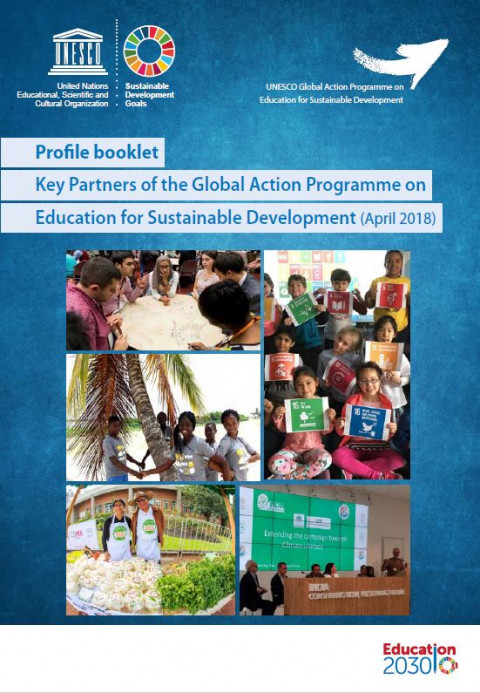 Profile booklet: key partners of the Global Action Programme on Education for Sustainable Development (April 2018) Year of publication: 2018 UNESCO’s Global Action Programme (GAP) was launched at the World Conference on Education for Sustainable Development (ESD) in November 2014 in Aichi-Nagoya, Japan as a follow-up programme to the Decade of ESD (2005-2014). This booklet contains profiles of the current 96 members (also called Key Partners) of the GAP Partner Networks. Each Key Partner is listed in alphabetical order within one of the five Partner Networks. Each profile presents the main objective of their work, their GAP launch commitment and specific activities that contribute to the GAP, as well as related website links and contact information for the organization’s focal point.
  A Review of Education for Sustainable Development and Global Citizenship Education in Teacher Education Year of publication: 2017 Author: Douglas Bourn, Frances Hunt, Phil Bamber Corporate author: University College London. Institute of Education This paper has been produced to inform UNESCO in its preparation for the 2017 Global Education Monitoring Report (GEM) Report. Its purpose is to examine the current preparation of teachers in Education for Sustainable Development (ESD) and Global Citizenship Education (GCED) as outlined in the Sustainable Development Goal (SDG) target 4.7.The literature for this study is based on looking not only at material that makes direct reference to ESD and GCED, but also broader themes that have a potential bearing on these areas such as a sense of global, social and environmental responsibility and a commitment to social justice.In this paper teacher education includes the initial and in-service continuing professional development (CPD) of teachers.
  Education for Sustainable Development Year of publication: 2016 Author: Altayeb Ahmed Corporate author: National Center for Curriculum and Educational Research This paper addresses education for sustainable development. It opens by discussing the concept of education for sustainable development. The author clearly links how education is looking at environment and how we should preserve it.
  Raising a Child for Sustainable Development: Problems and Solution Year of publication: 2019 Author: Fathy Mohamed Corporate author: Assiut University This paper aims to study the problems that hinder raising a child for sustainable development. After discussing the problems, the paper ends with a vision to activate education for sustainable development in kindergarten institutions.