
Resources
Explore a wide range of valuable resources on GCED to deepen your understanding and enhance your research, advocacy, teaching, and learning.
16 Results found
 Regional Consultation Meeting on SDG4-Education 2030: Europe and North America Region, Paris, 24-25 October Year of publication: 2016 Corporate author: UNESCO Réunion de consultation régionale sur l'ODD 4: Education 2030, Etats d'Europe et d'Amérique du Nord, Paris, 24-25 octobre 2016 Year of publication: 2016 Corporate author: UNESCO
 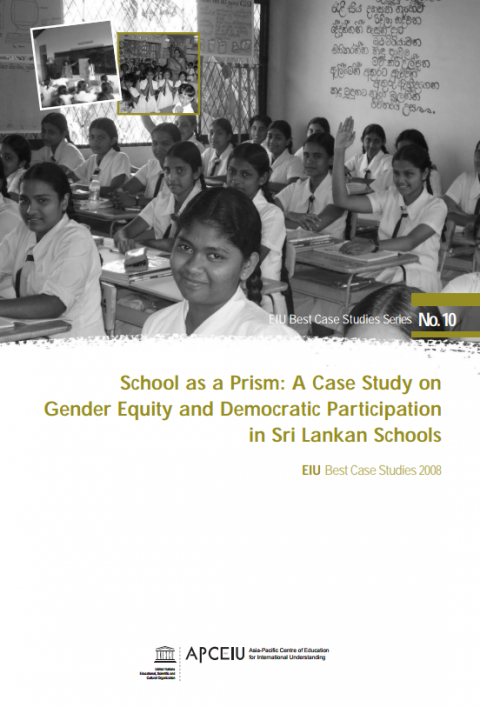 EIU Best Practices Series No. 10: School as a Prism: A Case Study on Gender Equity and Democratic Participation in Sri Lanka Schools Year of publication: 2008 Corporate author: APCEIU This report is one of the APCEIU's EIU Best Practices Series, which aims to encourage educators, scholars, and activists to implement and share local initiatives on EIU. The Series No.10 introduces a study of nine schools in Sri Lanka, which has been conducted to analyze current practices of gender education and provide suggestions for improvement. Upon careful assessment of documentary surveys, interviews, self-reports, and historical data analysis, the result indicates that gender equality and democratic participation are substantially provided and prioritized in Sri Lankan schools, in lieu of EIU theme of social justice. As common challenges still exist, the research notes the need to further examine learning patterns of boys and girls, classroom-specific gender issues, and good practices that promote role of women in democratic participation.
  A Study on Education Indicator Development and Statistical Capacity Building focused on New Southern and Northern Policy (V) Year of publication: 2020 Author: Changhwan Kim | Kijun Lee | Geunyoung Park | Sungho Park | Hoonam Lim | Hyojung Han | Nayoung Kim | Yewon Seo | Joo Heo | Hanseung Lee | Yoseop Oh | Jihye Son | Sangtae Noh | Hyojung Kim Corporate author: Korean Educational Development Institute (KEDI) This study has a purpose to be carried out to develop education statistics capacity of developing countries through establishment a comprehensive consulting plan according to determine current status of education statistics of three Asian countries and conduct a demand survey and statistics survey. 개도국 교육지표 개발·협력 사업(V): 신남·북방국가를 중심으로 Year of publication: 2020 Author: 김창환 | 이기준 | 박근영 | 박성호 | 임후남 | 한효정 | 김나영 | 서예원 | 허주 | 이한승 | 오요섭 | 손지혜 | 노상태 | 김효정 Corporate author: 한국교육개발원 본 연구사업은 정부가 추진 중인 신남ㆍ북방 정책과 밀접한 관련을 맺고 있다. 그동안 한국의 발전은 선진국과 교역하면서 부를 창출하는 방식으로 이루어졌다. 그러나 선진국 시장의 성장이 한계에 도달하면서 새로운 시장 개척이 필요한 상황을 맞고 있다. 더욱이 미ㆍ중 무역전쟁 여파로 탈중국이 현실화 되면서 글로벌 밸류체인이 변하고 있다. 이러한 상황에서 대체시장으로 신남ㆍ북방 국가의 중요성이 부각되고 있는 상황이다. 즉, 미래 한국의 지속가능한 성장을 위해서는 신남ㆍ북방 국가와의 협력이 매우 중요한 것이다.본 연구사업은 정부의 정책에 적극 부응하기 위해 2주기에서 신남ㆍ북방 국가를 중점 협력 국가로 선정하고 사업을 추진하고 있다. 2주기 연구사업이 추진되는 과정 속에서, 연구사업이 종료되었을 때 신남ㆍ북방 국가와의 협력이 더욱 증가하게 될 것으로 전망되고, 이를 통해 국익에도 기여할 것으로 기대되고 있다.본 저작물은 한국교육개발원에서 2020년 작성하여 공공누리 제4유형으로 개방한 ‘개도국 교육지표 개발·협력 사업(V): 신남·북방국가를 중심으로(김창환)’ 를 이용하였으며 해당 저작물은 한국교육개발원 홈페이지(www.kedi.re.kr)에서 무료로 다운받으실 수 있습니다.
 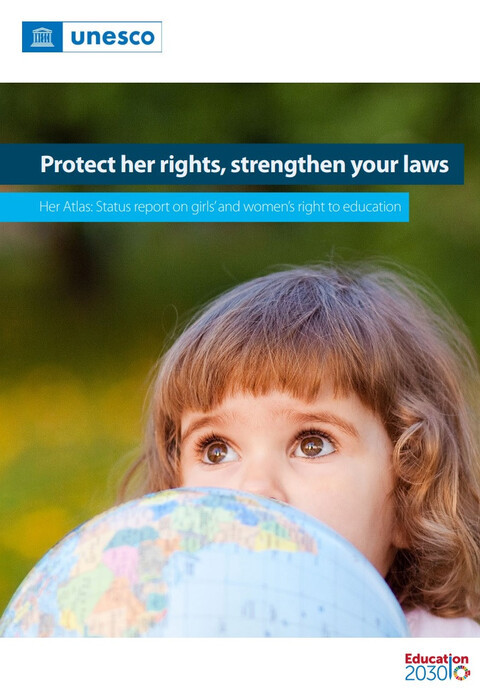 Protect Her Rights, Strengthen Your Laws: Her Atlas; Status Report on Girls’ and Women’s Right to Education Year of publication: 2022 Corporate author: UNESCO UNESCO’s Her Education, our future initiative, Her Atlas was launched in 2019 with the aim to enhance public knowledge and monitor the status of national constitutions, legislation and regulations related to girls’ and women’s education rights in order to encourage countries to take actions to improve their legal frameworks. Three years after its launch, the research phase has been completed: overall, the legal frameworks of 196 countries have been thoroughly analyzed to evaluate the level of protection of girls’ and women’s right to education around the world. In an interactive world map format, Her Atlas uses a color-coded scoring system to monitor 12 indicators of legal progress towards gender equality in the right to education. This report marks the completion of the first research phase and intends to highlight some key trends outlined by the research work, and to emphasize examples of legal provisions regarding some aspects of girls’ and women’s right to education guaranteed by States’ domestic laws.