
Resources
Explore a wide range of valuable resources on GCED to deepen your understanding and enhance your research, advocacy, teaching, and learning.
34 Results found
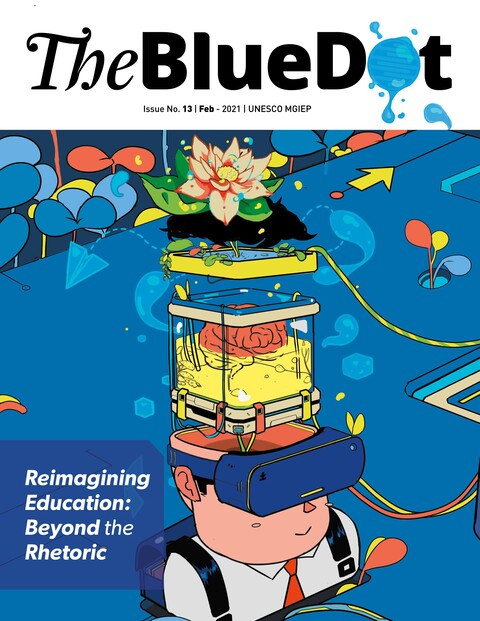 Reimagining Education: Beyond the Rhetoric (The Blue Dot; No.13, 2021) Year of publication: 2021 Corporate author: Mahatma Gandhi Institute of Education for Peace and Sustainable Development (MGIEP) The events of the year 2020, driven predominantly by the COVID-19 pandemic, have forced governments, policymakers, educators and organisations to rethink the purpose, structure and modality of existing education systems. Even while the world is struggling with climate change, decreased empathy, violent extremism, xenophobia and an increase in mental health issues in children, with a recent report by WHO highlighting that 800,000 people between the ages of 15-29 are dying by suicide ever year, globally1 , the COVID-19 virus singlehandedly shut down access to face-to-face school education for roughly half of the world’s student population. These ongoing and unexpected challenges bring to light the urgent need for education systems to be more adaptable, responsive, and resilient to future shocks and disasters. We can work to transform education in many ways, such as by translating our understanding of how the brain learns from the research laboratory to the classroom and leveraging the power of technology to ensure that learning can reach every child who hungers to learn. It is time we reimagine education to ensure learning continues with minimal disruption but also empowers students as compassionate human beings, prepared for an unpredictable future, but also as global citizens seeking a peaceful and kinder world. The purpose of education needs to change from being instrumental (based on human capital) to one that is constitutive (human-flourishing), accessible to all and structured such that learning can happen anytime and anywhere and always.
  Generative AI and the Future of Education Year of publication: 2023 Corporate author: UNESCO. Assistant Director-General for Education, 2018- (Giannini, Stefania) The digital revolution has brought about significant changes in how we live, learn, and interact, with multiple waves of technological advancements. The current AI revolution represents a new and profound shift, particularly through AI's ability to simulate human language and conversation. This development challenges our understanding of language, intelligence, and the role of technology in education and society.As AI begins to generate human-like responses and knowledge, it raises fundamental questions about its impact on education, societal values, and our concept of humanity. Education systems are now grappling with how to integrate and regulate AI, which has been rapidly introduced into classrooms without sufficient oversight. The author emphasizes the importance of carefully considering the risks and ethical implications of AI, particularly in its potential to manipulate and shape knowledge systems. There is a need for balanced development, where AI technology is aligned with human values, and education remains a deeply human-centered process.UNESCO is working with countries to develop strategies for the safe use of AI in education, emphasizing the need for a cautious approach and robust regulatory frameworks. The overarching message is that while AI offers immense possibilities, it must be integrated thoughtfully to ensure it enhances education and society without undermining human agency, equity, or the foundational values of learning. La IA generativa y el futuro de la educació Year of publication: 2023 Corporate author: UNESCO. Assistant Director-General for Education, 2018- (Giannini, Stefania) La revolución digital ha traído cambios significativos en cómo vivimos, aprendemos e interactuamos, con múltiples olas de avances tecnológicos. La actual revolución de la inteligencia artificial representa un cambio nuevo y profundo, particularmente a través de la capacidad de la IA para simular el lenguaje humano y la conversación. Este desarrollo desafía nuestra comprensión del lenguaje, la inteligencia y el papel de la tecnología en la educación y la sociedad. A medida que la IA comienza a generar respuestas y conocimientos similares a los humanos, surgen preguntas fundamentales sobre su impacto en la educación, los valores sociales y nuestro concepto de humanidad. Los sistemas educativos ahora están lidiando con la forma de integrar y regular la IA, que ha sido introducida rápidamente en las aulas sin una supervisión adecuada. El autor enfatiza la importancia de considerar cuidadosamente los riesgos y las implicaciones éticas de la IA, particularmente en su potencial para manipular y moldear los sistemas de conocimiento. Existe una necesidad de un desarrollo equilibrado, donde la tecnología de la IA esté alineada con los valores humanos y la educación siga siendo un proceso profundamente centrado en el ser humano. UNESCO está trabajando con los países para desarrollar estrategias para el uso seguro de la IA en la educación, enfatizando la necesidad de un enfoque cauteloso y marcos regulatorios robustos. El mensaje general es que, si bien la IA ofrece inmensas posibilidades, debe integrarse de manera reflexiva para asegurar que mejore la educación y la sociedad sin socavar la agencia humana, la equidad o los valores fundamentales del aprendizaje. L’IA générative et le futur de l’éducation Year of publication: 2023 Corporate author: UNESCO. Assistant Director-General for Education, 2018- (Giannini, Stefania) La révolution numérique a apporté des changements significatifs dans nos modes de vie, d'apprentissage et d'interaction, avec plusieurs vagues de progrès technologiques. La révolution actuelle de l'IA représente un nouveau tournant profond, notamment grâce à la capacité de l'IA à simuler le langage et la conversation humaine. Ce développement remet en question notre compréhension du langage, de l'intelligence et du rôle de la technologie dans l'éducation et la société.Alors que l'IA commence à générer des réponses et des connaissances semblables à celles des humains, cela soulève des questions fondamentales quant à son impact sur l'éducation, les valeurs sociétales et notre conception de l'humanité. Les systèmes éducatifs se retrouvent désormais face au défi d'intégrer et de réguler l'IA, qui a été introduite rapidement dans les salles de classe sans une supervision suffisante. L'auteur insiste sur l'importance de prendre en compte les risques et les implications éthiques de l'IA, en particulier son potentiel à manipuler et à influencer les systèmes de connaissance. Il est nécessaire d'adopter un développement équilibré, où la technologie de l'IA est en phase avec les valeurs humaines, et où l'éducation reste un processus profondément centré sur l'humain.L'UNESCO travaille avec les pays pour élaborer des stratégies visant à utiliser l'IA en toute sécurité dans l'éducation, en insistant sur la nécessité d'une approche prudente et de cadres réglementaires solides. Le message principal est que, bien que l'IA offre d'immenses possibilités, elle doit être intégrée de manière réfléchie afin de garantir qu'elle améliore l'éducation et la société sans compromettre l'autonomie humaine, l'équité ou les valeurs fondamentales de l'apprentissage.
  Educación para la ciudadanía mundial: temas y objetivos de aprendizaje Year of publication: 2015 Corporate author: UNESCO This publication, titled Global Citizenship Education: Topics and learning objectives, is the first pedagogical guidance from UNESCO on global citizenship education. It is the result of an extensive research and consultation process with experts from different parts of the world. This guidance draws on the UNESCO publication Global Citizenship Education: Preparing learners for the challenges of the 21st century and the outcomes of three key UNESCO events on global citizenship education: the Technical Consultation on Global Citizenship Education (September 2013), as well as the First and Second UNESCO Fora on Global Citizenship Education, organized in December 2013 and January 2015 respectively. Before it was finalized, the guidance was field-tested by education stakeholders in selected countries in all regions to ensure its relevance in different geographical and socio-cultural contexts. Following the foundational work of UNESCO to clarify the conceptual underpinnings of global citizenship education and provide policy and programmatic directions, this document has been developed in response to the needs of Member States for overall guidance on integrating global citizenship education in their education systems. It presents suggestions for translating global citizenship education concepts into practical and age-specific topics and learning objectives in a way that allows for adaptation to local contexts. It is intended as a resource for educators, curriculum developers, trainers as well as policy-makers, but it will also be useful for other education stakeholders working in non-formal and informal settings.
 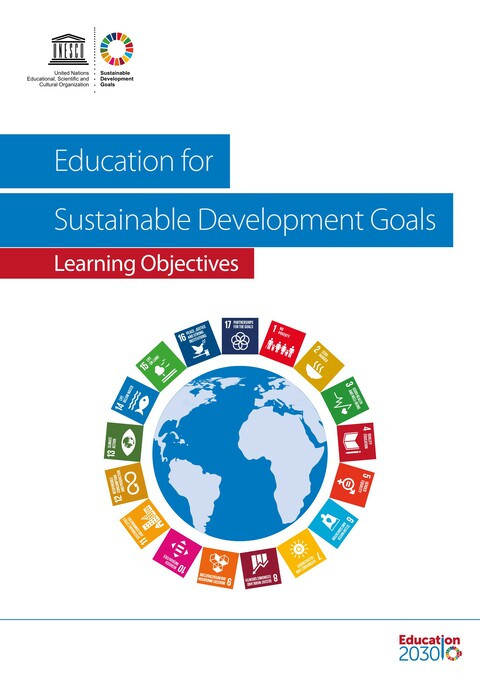 Education for Sustainable Development Goals: Learning Objectives Year of publication: 2017 Corporate author: UNESCO UNESCO has been promoting Education for Sustainable Development (ESD) since 1992. It led the UN Decade for ESD from 2005 to 2014 and is now spearheading its follow-up, the Global Action Programme (GAP) on ESD. The momentum for ESD has never been stronger. Global issues – such as climate change – urgently require a shift in our lifestyles and a transformation of the way we think and act. To achieve this change, we need new skills, values and attitudes that lead to more sustainable societies. Education systems must respond to this pressing need by defining relevant learning objectives and learning contents, introducing pedagogies that empower learners, and urging their institutions to include sustainability principles in their management structures. The new 2030 Agenda for Sustainable Development clearly reflects this vision of the importance of an appropriate educational response. Education is explicitly formulated as a stand-alone goal – Sustainable Development Goal 4. Numerous educationrelated targets and indicators are also contained within other Sustainable Development Goals (SDGs). Education is both a goal in itself and a means for attaining all the other SDGs. It is not only an integral part of sustainable development, but also a key enabler for it. That is why education represents an essential strategy in the pursuit of the SDGs. This publication is designed as a guide for education professionals on the use of ESD in learning for the SDGs, and consequently to contribute to achieving the SDGs. The guide identifies indicative learning objectives and suggests topics and learning activities for each SDG. It also presents implementation methods at different levels, from course design to national strategies. The guide does not aim to be prescriptive in any way, but to provide guidance and suggestions that educators can select and adapt to fit concrete learning contexts L’éducation en vue des objectifs de développement durable: Objectifs d’apprentissage Year of publication: 2017 Corporate author: UNESCO L’UNESCO promeut l’éducation en vue du développement durable (EDD) depuis 1992. Après avoir été le chef de file de la Décennie des Nations Unies pour l’éducation au service du développement durable de 2005 à 2014, elle est maintenant le fer de lance du Programme d’action global pour l’éducation en vue du développement durable qui lui a succédé. La dynamique en faveur de l’EDD n’a jamais été aussi forte. Des enjeux planétaires, tels que le changement climatique, exigent d’urgence un changement de nos modes de vie et une transformation de notre façon de penser et d’agir. Pour y parvenir, nous avons besoin de compétences, de valeurs et d’attitudes nouvelles qui conduisent à des sociétés plus viables. Les systèmes éducatifs doivent répondre à ce besoin urgent en définissant des objectifs et des contenus d’apprentissage pertinents, en proposant des pédagogies qui autonomisent les apprenants et en pressant leurs établissements d’intégrer les principes de la durabilité dans leurs structures de gestion. Le nouveau Programme mondial de développement durable à l’horizon 2030 reflète clairement cette vision de l’importance d’une réponse éducative adaptée. L’éducation est explicitement présentée comme un objectif autonome dans l’Objectif de développement durable 4. De nombreux indicateurs et cibles relatifs à l’éducation sont également intégrés à d’autres Objectifs de développement durable (ODD). L’éducation est à la fois un but en soi et un moyen de réaliser tous les autres ODD ; elle est non seulement un élément à part entière du développement durable, mais elle en est également l’un des principaux moteurs. C’est pourquoi l’éducation représente une stratégie essentielle dans la réalisation des ODD. La présente publication est conçue pour guider les professionnels de l’éducation en leur montrant comment faire de l’EDD un apprentissage au service des ODD et donc contribuer à la réalisation de ces objectifs. Il propose une liste indicative d’objectifs d’apprentissage et suggère des thèmes et des activités d’apprentissage pour chaque ODD. Il présente également des méthodes de mise en œuvre aux différents niveaux de l’enseignement, des plans de cours aux stratégies nationales. Ce guide ne se veut en aucun cas prescriptif ; il vise à offrir des conseils et des suggestions que les éducateurs pourront choisir et adapter à des situations d’apprentissage concrètes. Educación para los Objetivos de Desarrollo Sostenible: Objetivos de aprendizaje Year of publication: 2017 Corporate author: UNESCO Desde 1992, la UNESCO ha promovido la Educación para el Desarrollo Sostenible (EDS). Entre 2005 y 2014, coordinó el Decenio de las Naciones Unidas de la EDS, y ahora está llevando a cabo el programa de seguimiento, el Programa de Acción Mundial sobre la EDS. El impulso de la EDS nunca ha sido más fuerte. Temas mundiales –como el cambio climático- requieren de forma urgente un cambio en nuestros estilos de vida y una transformación en nuestra forma de actuar y pensar. Para lograrlo, necesitamos nuevas competencias, actitudes y conductas que nos conduzcan a sociedades más sostenibles. Los sistemas educativos tienen que responder a esta necesidad a la hora de definir los objetivos y contenidos de aprendizaje pertinentes, introduciendo pedagogías que empoderen a los alumnos e instando a las instituciones a incluir los principios de sostenibilidad en sus estructuras de gestión. La nueva agenda mundial para el desarrollo sostenible 2030 refleja claramente esta visión de la importancia de una respuesta educativa apropiada. La educación está explícitamente formulada como un objetivo independiente en el Objetivo de Desarrollo Sostenible número 4. Metas e indicadores relacionados con la educación también están incluidos en otros ODS. La educación de calidad es tanto una meta en sí misma como un medio para lograr todos los otros ODS, porque es parte integral del desarrollo sostenible y un facilitador clave del mismo. Es por ello que la educación representa una estrategia esencial en la consecución de los ODS. Este documento ha sido diseñado para guiar a los profesionales de la educación en el uso de la EDS en el aprendizaje para los ODS y, en consecuencia, para lograr los ODS. Esta guía identifica objetivos específicos de aprendizaje y sugiere temas y actividades para cada ODS. También presenta métodos de implementación a distintos niveles, desde el diseño de cursos hasta las estrategias nacionales. Este documento no busca de ninguna forma ser prescriptivo, sino servir como una guía y ofrecer sugerencias que los educadores puedan seleccionar y adaptar a contextos específicos de aprendizaje. Цели образования в интересах устойчивого развития: Задачи обучения Year of publication: 2017 Corporate author: UNESCO ЮНЕСКО занимается поощрением образования в интересах устойчивого развития (ОУР) с 1992 г. Организация сыграла ведущую роль в проведении Десятилетия образования в интересах устойчивого развития Организации Объединенных Наций (2005- 2014 гг.), а сегодня возглавляет усилия, связанные с последующей деятельностью по итогам ДОУР и осуществлением Глобальной программы действий (ГПД) по образованию в интересах устойчивого развития. Потребность в ОУР еще никогда не была настолько актуальной. Глобальные проблемы, такие как изменение климата, диктуют необходимость безотлагательной трансформации нашего образа жизни, нашего менталитета и наших привычек. Для того, чтобы эти изменения стали реальностью, нам нужны новые практические навыки, ценностные ориентиры и поведенческие установки, которые обеспечат построение более устойчивых обществ. Системы образования должны реагировать на эту насущную потребность посредством формулирования соответствующих задач и содержания обучения, применения методик, расширяющих возможности учащихся, активного поощрения своих учреждений к внедрению принципов устойчивого развития в структурах управления образовательных учреждений. Такое понимание значимости адекватного реагирования со стороны систем образования получило наглядное отражение в новой Повестке дня в области устойчивого развития на период до 2030 г. В этом документе образование представлено в виде отдельной цели в области устойчивого развития (ЦУР 4). Целый ряд других целей в области устойчивого развития (ЦУР) также включает задачи и целевые показатели, связанные с образованием. Образование – это одновременно самостоятельная цель и средство для достижения всех остальных ЦУР. Оно является не только неотъемлемой частью, но и ключевым фактором устойчивого развития. В связи с этим оно представляет собой важнейшую область с точки зрения реализации ЦУР. Настоящая публикация призвана стать руководством для специалистов в области образования по вопросам применения принципов ОУР в обучении в интересах достижения целей в области устойчивого развития. Таким образом, она призвана содействовать достижению ЦУР. В этом руководстве сформулированы типовые задачи обучения и предложены темы и практические учебные задания по каждой ЦУР. В нем также представлены методы реализации этих задач на различных этапах - от разработки учебных курсов до формулирования национальных стратегий. Руководство не носит директивного характера, а является методологической основой и предлагает решения, которые могут быть использованы специалистами в области образования и адаптированы ими для конкретных условий обучения.
  Воспитание глобальной гражданственности: темы и цели обучения Year of publication: 2015 Corporate author: UNESCO Данная публикация, озаглавленная «Воспитание глобальной гражданственности: темы и цели обучения» является первым, подготовленным ЮНЕСКО, педагогическим руководством в области воспитания глобальной гражданственности. Она является результатом обширных исследований и консультаций с участием экспертов из разных частей мира. Это руководство основывается на публикации ЮНЕСКО «Воспитание глобальной гражданственности: подготовка учащихся к проблемам XXI века» и результатах трех ключевых мероприятий ЮНЕСКО в области воспитания глобальной гражданственности: технической консультации по воспитанию глобальной гражданственности (сентябрь 2013 г.), а также первого и второго форумов ЮНЕСКО по воспитанию глобальной гражданственности, прошедших в декабре 2013 г. и январе 2015 г. До составления окончательного варианта руководства оно было протестировано заинтересованными сторонами в области образования в отдельных странах во всех регионах для обеспечения его актуальности в различных географических и социо-культурных ситуациях.