
Resources
Explore a wide range of valuable resources on GCED to deepen your understanding and enhance your research, advocacy, teaching, and learning.
103 Results found
 Globalization and education for sustainable development: sustaining the future Year of publication: 2006 Author: Laura Wong Corporate author: United Nations University This publication presents the contributions and outcomes of the stimulating two day gathering in Nagoya, where representatives of governments, academia and civil society gathered to share their experiences and develop their ideas about how to ensure ESD within the context of globalizing societies. La mondialisation et l'éducation pour le développement durable: le maintien de l'avenir Year of publication: 2006 Author: Laura Wong Corporate author: United Nations University Cette publication présente les contributions et les résultats de la stimulation de la collecte de deux jours à Nagoya, où les représentants des gouvernements, des universités et de la société civile se sont réunis pour partager leurs expériences et de développer leurs idées sur la façon d'assurer l'EDD dans le contexte des sociétés de mondialisation.
 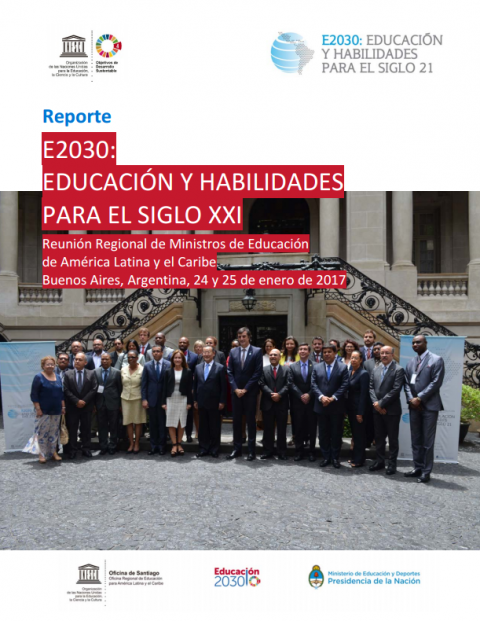 E2030: education and skills for the 21st century: Regional Meeting Year of publication: 2017 Corporate author: UNESCO Santiago This report provides a systematization of the discussions at the Regional Meeting of Ministers of Education of Latin America and the Caribbean “E2030: Education and skills for the 21st century” held 24‐25 January 2017 in Buenos Aires, Argentina. The objectives of the meeting were to: • adopt a Ministerial Declaration on a joint approach to achieve the SDG4-E2030 Agenda in the region, including means of implementation, technical instruments of support and follow-up mechanisms. • agree on a roadmap for the implementation of E2030, including a contextualized followup mechanism that responds to the region’s educational challenges and expectations. Reporte: Educación y habilidades para el siglo XXI; Reunión Regional de Ministros de Educación de América Latina y el Caribe, Buenos Aires, Argentina, 24 y 25 de enero 2017 Year of publication: 2017 Corporate author: UNESCO Santiago This report provides a systematization of the discussions at the Regional Meeting of Ministers of Education of Latin America and the Caribbean “E2030: Education and skills for the 21st century” held 24‐25 January 2017 in Buenos Aires, Argentina. The objectives of the meeting were to: • adopt a Ministerial Declaration on a joint approach to achieve the SDG4-E2030 Agenda in the region, including means of implementation, technical instruments of support and follow-up mechanisms. • agree on a roadmap for the implementation of E2030, including a contextualized followup mechanism that responds to the region’s educational challenges and expectations.
  Présentation de l'assurance de la qualité de l'éducation à la citoyenneté démocratique dans les écoles - étude comparative de 10 pays Year of publication: 2009 Corporate author: Conseil de l'Europe (Recommandation Rec (2002) 12). Selon cette recommandation, les gouvernements européens ont reconnu leur responsabilité de veiller à la base culturelle de la démocratie par l'éducation. Cependant, la politique est pas si simple que les recommandations supranationales sont immédiatement traduites en politique dans les Etats nationaux. Cet écart entre les politiques convenues et réalisés a été appelé un «écart de conformité». Une des raisons les plus logiques pour la non-conformité provient d'un manque de sensibilisation ou de compétences. Par conséquent, le Conseil de l'Europe concentrée sur la production de matériaux qui pourraient aider à sensibiliser et développer les compétences. Les principaux produits résultant de cet effort ont été collectées comme un «ECD / EDH Pack » depuis 2005. Cette collection couvre les domaines de l'élaboration des politiques, la gouvernance démocratique des établissements d'enseignement, la formation des enseignants et l'assurance qualité. Le «Outil pour l'assurance qualité de l'éducation à la citoyenneté démocratique dans les écoles» (Bîrzea et al., 2005), qui est l'un de ces matériaux, constitue le document de référence pour cette étude. Cette étude analyse les conditions pertinentes et les activités possibles en ce qui concerne la mise en œuvre de l'outil dans 10 systèmes éducatifs nationaux. Comme les conditions pertinentes, l'étude considère les tentatives existantes pour offrir une qualité d'enseignement au sein des pays, ainsi que les programmes de formation des enseignants qui accompagnent ces tentatives. Comme les activités possibles, les adaptations nationales de l'outil, et diverses façons de travailler avec différents groupes cibles, sont également pris en compte. Les sections suivantes fournissent des informations de base concernant le projet. Cela aidera le lecteur à comprendre pourquoi l'outil doit être adapté dans des circonstances différentes. La section 2 présente des points de référence qui ouvrent des perspectives théoriques sur le travail présenté. Section 3 fournit une justification pour la sélection des pays participants et donne et décrit la méthodologie utilisée lors de la réalisation de cette étude. Enfin, la section 4 donne un aperçu du reste du contenu de ce livre.
  Tool for quality assuarance of education for democratic citizenship in schools Year of publication: 2005 Corporate author: Council of Europe This Tool for Quality Assurance of Education for Democratic Citizenship (EDC) in Schools was prepared as a response to the compliance gap between policies and practices of EDC in various countries. While EDC policies are well developed, EDC practices in schools present significant weaknesses. The Tool was also prepared as part of the current interest and implementation of quality assurance in education. This Tool is designed as a reference document. It focuses on education for democratic citizenship and applies the principles and processes of quality assurance to EDC. Astrolabe: a guide to education for sustainable development coordination in Asia and the Pacific Year of publication: 2011 Corporate author: UNESCO Bangkok An astrolabe is an ancient instrument used to measure the position of the sun and stars. In the past it was used for a number of purposes, such as determining the time of day or night and measuring one’s current position in relation to the north and south poles. A mariner’s astrolabe was used to determine the latitude of a ship at sea and guide its direction. Similar to the mariner’s astrolabe, the Asia-Pacific Education for Sustainable Development (ESD) Astrolabe aims to assist UNESCO Member States in determining the current position of ESD in their country and guiding education and learning in a desired direction, so as to support the advancement of sustainable development in the national context. The ESD Astrolabe is also intended to complement ongoing efforts to enhance the quality of education throughout the Asia-Pacific region. Astrolabe: un guide de l'éducation pour la coordination du développement durable en Asie et dans le Pacifique Year of publication: 2011 Corporate author: UNESCO Bangkok Un astrolabe est un instrument ancien utilisé pour mesurer la position du soleil et des étoiles. Dans le passé, il a été utilisé pour un certain nombre de buts, tels que la détermination de l'heure du jour ou de nuit et la mesure de sa position actuelle par rapport aux pôles nord et sud. Un astrolabe de marin a été utilisé pour déterminer la latitude d'un navire en mer et de guider sa direction. Similaire à l'astrolabe du marins, l'Astrolabe de l'Asie-Pacifique pour le développement durable (EDD) vise à aider les États membres de l'UNESCO à déterminer la position actuelle de l'EDD dans leur pays et à orienter l'éducation et l'apprentissage dans une direction souhaitée, Développement durable dans le contexte national. L'EDD Astrolabe est également destiné à compléter les efforts en cours pour améliorer la qualité de l'éducation dans toute la région Asie-Pacifique. Quality Adult Education Benchmarks for Indigeneous Education Year of publication: 2011 Author: Sandra L. Morrison | Timote Vaioleti Corporate author: Asia South Pacific Association for Basic and Adult Education (ASPBAE) In November 2010, in Indonesia, Asia South Pacific Association for Basic and Adult Education(ASPBAE) brought together a number of educators from across its region to discuss benchmarking quality adult education for indigenous peoples. Educators came from across the ASPBAE region including the Philippines, India, Nepal, New Zealand, Australia, Thailand, Indonesia and Uzbekistan to share experiences and to build a collective understanding of what constitutes a good quality adult education program for indigenous peoples. Discussions were informed by a broader ASPBAE Quality Adult Education Framework, which had its origins in discussions held in 2009. The Core of the Framework is grounded on ASPBAE’s commitment to education as a right, adult education for transformation, and adult and basic education as integral and inter‐connected components of the vision of lifelong learning (Guevara, 2010). Other frameworks promoted by ASPBAE for education to be empowering, pro‐poor, gender just and sustainable were also important considerations. The 2010 gathering served as a nodal point to discuss the ASPBAE framework more deeply and to reaffirm or create a set of benchmarks for indigenous education which can be validated through a subsequent national and regional consultation process. Introducing quality assurance of education for democratic citizenship in schools - comparative study of 10 countries Year of publication: 2009 Corporate author: Council of Europe For over a decade the Council of Europe has been working on policies in the field of education for democratic citizenship (EDC). One result has been that the Committee of Ministers of the Council of Europe agreed on a recommendation stating that EDC is central to educational politics, and that it is a “factor for innovation in terms of organising and managing overall education systems, as well as curricula and teaching methods” (Recommendation Rec(2002)12). According to this recommendation, European governments acknowledged their responsibility for ensuring the cultural basis of democracy through education. However, politics is not so simple that supranational recommendations are immediately translated into policy in national states. This gap between agreed and realised policies has been termed a “compliance gap”. One of the most logical reasons for noncompliance comes from a lack of awareness or competences. Therefore the Council of Europe concentrated on producing materials that could help raise awareness and develop competences. Key products resulting from this effort have been collected as an “EDC/HRE Pack” since 2005.This collection covers the areas of policy making, democratic governance of educational institutions, teacher training and quality assurance. The “Tool for Quality Assurance of Education for Democratic Citizenship in Schools” (Bîrzea et al., 2005), which is one of these materials, forms the reference document for this study.This study analyses relevant conditions and possible activities with regard to implementing the tool in 10 national educational systems. As relevant conditions, the study considers the existing attempts to deliver educational quality within countries, together with the teacher training programmes that accompany these attempts. As possible activities, national adaptations of the tool, and various ways of working with different target groups, are also taken into account.The following sections provide background information concerning the project. This will help the reader understand why the tool needs to be adapted in different circumstances. Section 2 presents points of reference that open theoretical perspectives on the work presented. Section 3 provides a rationale for the selection of participating countries and gives and describes the methodology used when conducting this study. Finally, Section 4 provides an overview of the remaining contents of this book.