
Resources
Explore a wide range of valuable resources on GCED to deepen your understanding and enhance your research, advocacy, teaching, and learning.
103 Results found
 Citizenship, identity and education: examining the public purposes of schools in an age of globalization Year of publication: 2006 Author: Fernando Reimers Corporate author: UNESCO International Bureau of Education (IBE) Educational institutions exist to achieve public purposes. One of those purposes is to develop citizenship. In the 21st century, citizenship includes global citizenship. In an era of globalization effective citizenship includes the knowledge, ability and disposition to engage peacefully and constructively across cultural differences for purposes of addressing personal and collective needs and of achieving sustainable human–environmental interactions, this requires internalizing global values. Addressing these challenges of globalization will require making citizenship education and the development of global values an explicit objective of efforts to improve quality throughout the world, critically examining theories and evidence about the effectiveness of various approaches to developing citizenship and global citizenship and supporting activities aligned with this public purpose. This public purpose should support the development of a political culture that fosters the rule of national and international law and respect of human rights, the development of understanding to support trade and economic and peaceful bilateral and international diplomacy as the preferred means to solve international disputes, the development of the capability to understand and address the serious environmental challenges facing humanity and to collaborate across national boundaries in the creation of sustainable forms of human–environmental interactions and in the development of the skills to promote rationality in deliberation and action, and to advance science and technology as means to improve human health and well-being. At present, however, many education systems and reforms are insufficiently focused on quality, or focus instead on a very narrow and self-referenced definition of quality. It is possible to educate people to understand and appreciate cultural differences and to understand and accept human rights in a framework of global values that includes compassion and caring, concern for others, respect and reciprocity. These values, dispositions, knowledge and skills can be developed in a range of institutions that societies have to pass on what they value to the young, and to re-create culture: families, religious institutions, the media, workplaces, political institutions and also schools. While there is no reason to assume that schools can be more effective in this task than any of these other institutions, they have greater potential to be aligned with transnational efforts to promote global civility. They are a public space, and consequently also a globally public space, in ways in which families and religious institutions are not. If schools actively engage in teaching hatred or intolerance, or if they fail to prepare students adequately for global civility, these failures can be noted by international institutions that can potentially mobilize resources to support national and local efforts to prepare students for global citizenship. There is not a similar network linking national and transnational institutions, public and private, governmental and non-governmental, that attends to the dynamics of families and other ‘‘private’’ spaces. Citoyenneté, identité et de l'éducation: l'examen des fins publiques des écoles à l'ère de la mondialisation Year of publication: 2006 Author: Fernando Reimers Corporate author: UNESCO International Bureau of Education (IBE) Les établissements d'enseignement existent pour parvenir à des fins publiques. L'un de ces objectifs est de développer la citoyenneté. Au 21e siècle, la citoyenneté comprend la citoyenneté mondiale. Dans une ère de mondialisation citoyenneté effective comprend les connaissances, la capacité et la disposition à engager pacifique et constructive entre les différences culturelles aux fins de répondre aux besoins personnels et collectifs et de réaliser des interactions humaines-environnementales durables, ce qui nécessite l'intériorisation des valeurs globales. Pour relever ces défis de la mondialisation, il faudra faire de l'éducation à la citoyenneté et le développement des valeurs mondiales un objectif explicite des efforts pour améliorer la qualité dans le monde entier, l'examen critique des théories et des preuves sur l'efficacité des différentes approches pour développer la citoyenneté et la citoyenneté mondiale et soutenir les activités alignées cet effet public. Cet objectif public devrait soutenir le développement d'une culture politique qui favorise la primauté du droit national et international et le respect des droits de l'homme, le développement de la compréhension pour soutenir le commerce et la diplomatie bilatérale et internationale économique et pacifique comme le moyen privilégié pour résoudre les conflits internationaux, le développement de la capacité à comprendre et à relever les défis environnementaux humanité face à de graves et de collaborer à travers les frontières nationales dans la création de formes durables d'interactions homme-environnement et dans le développement des compétences pour promouvoir la rationalité dans la délibération et de l'action, et de faire avancer la science et la technologie comme moyen d'améliorer la santé humaine et le bien-être. À l'heure actuelle, cependant, de nombreux systèmes d'éducation et les réformes ne sont pas suffisamment axées sur la qualité, ou se concentrent plutôt sur une définition très étroite et auto-référencé de la qualité. Il est possible d'éduquer les gens à comprendre et à apprécier les différences culturelles et à comprendre et à acept droits de l'homme dans un cadre de valeurs globales qui comprend la compassion et la compassion, le souci des autres, le respect et la réciprocité. Ces valeurs, les dispositions, les connaissances et les compétences peuvent être développées dans un éventail d'institutions que les sociétés doivent passer sur ce qu'ils apprécient le jeune, et de recréer la culture: les familles, les institutions religieuses, les médias, les milieux de travail, les institutions politiques et aussi écoles. Bien qu'il n'y ait aucune raison de supposer que les écoles peuvent être plus efficaces dans cette tâche que l'une de ces autres institutions, ils ont un plus grand potentiel pour être aligné avec les efforts transnationaux visant à promouvoir la civilité mondiale. Ils sont un espace public, et par conséquent aussi un espace public à l'échelle mondiale, dans les façons dont les familles et les institutions religieuses ne sont pas. Si les écoles participent activement à l'enseignement à la haine ou l'intolérance, ou si elles ne parviennent pas à préparer les étudiants de manière adéquate pour la civilité mondiale, ces échecs peuvent être notées par les institutions internationales qui peuvent potentiellement mobiliser des ressources pour soutenir les efforts nationaux et locaux pour préparer les élèves à la citoyenneté mondiale. Il n'y a pas un réseau similaire reliant les institutions nationales et transnationales, publiques et privées, gouvernementales et non-gouvernementales, qui assiste à la dynamique des familles et d'autres «espaces» «privés».
 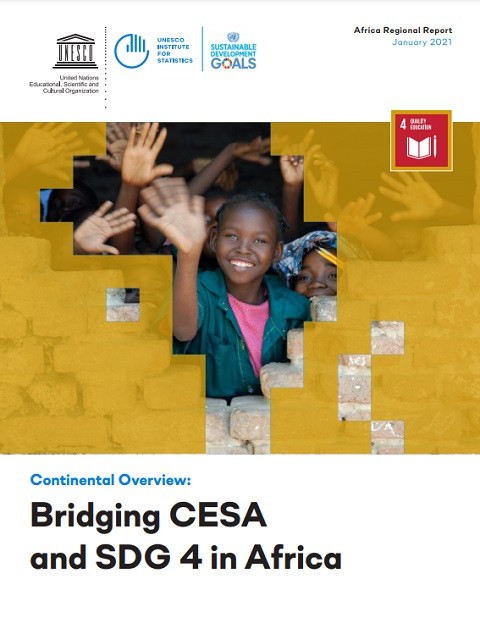 Continental Overview: Bridging CESA and SDG 4 in Africa; Africa Regional Report Year of publication: 2021 Corporate author: UNESCO Institute for Statistics (UIS) Monitoring progress toward Sustainable Development Goal 4 for education (SDG 4) is crucial to ensuring that children around the world have access to a quality education where they can learn and gain the skills they need to meet their full potential. SDG 4 indicators are organized with a view to global, thematic, regional and national targets.This report by the UNESCO Institute for Statistics (UIS) is the first in a series intended to bring a regional focus to SDG 4 monitoring, highlight the work being done in the regions and compare SDG 4 targets with those established by regional bodies.This new series of regional reports serve two purposes. Firstly, to map regional and SDG 4 targets to provide an overview of the symmetries between the two. Continental Overview: Bridging CESA and SDG 4 in Africa looks at how the strategic objectives of the Continental Education Strategy for Africa (CESA) compares with SDG 4 targets. Secondly, it analyses progress towards these objectives by African sub-regions.
  Is every child counted? Status of data for children in the SDGs Year of publication: 2017 Corporate author: United Nations Children's Fund (UNICEF) “Is every child counted”, a recent status report by UNICEF, shows that sufficient data are available for less than half of child-related SDG indicators. Many indicators, such as those on poverty and violence, are not comparable across countries, and are either too limited or of poor quality, leaving governments without the information they need to accurately address challenges facing millions of children, or to track progress towards achieving the Goals. Data are also very limited on the situation of the most disadvantaged populations within each country. Better disaggregated data on these populations is necessary. The report also identifies priorities for enhancing the collection, analysis and use of data for children.
  Is every child counted? Summary of the status of data for children in the SDGs Year of publication: 2017 Corporate author: United Nations Children's Fund (UNICEF) “Is every child counted”, a recent status report by UNICEF, shows that sufficient data are available for less than half of child-related SDG indicators. Many indicators, such as those on poverty and violence, are not comparable across countries, and are either too limited or of poor quality, leaving governments without the information they need to accurately address challenges facing millions of children, or to track progress towards achieving the Goals. Data are also very limited on the situation of the most disadvantaged populations within each country. Better disaggregated data on these populations is necessary. The report also identifies priorities for enhancing the collection, analysis and use of data for children.
  Transforming our world: the 2030 Agenda for Sustainable Development Year of publication: 2015 Corporate author: United Nations (UN) This Agenda is a plan of action for people, planet and prosperity. It also seeks to strengthen universal peace in larger freedom. We recognize that eradicating poverty in all its forms and dimensions, including extreme poverty, is the greatest global challenge and an indispensable requirement for sustainable development. All countries and all stakeholders, acting in collaborative partnership, will implement this plan. We are resolved to free the human race from the tyranny of poverty and want and to heal and secure our planet. We are determined to take the bold and transformative steps which are urgently needed to shift the world on to a sustainable and resilient path. As we embark on this collective journey, we pledge that no one will be left behind.The 17 Sustainable Development Goals and 169 targets which we are announcing today demonstrate the scale and ambition of this new universal Agenda. They seek to build on the Millennium Development Goals and complete what they did not achieve. They seek to realize the human rights of all and to achieve gender equality and the empowerment of all women and girls. They are integrated and indivisible and balance the three dimensions of sustainable development: the economic, social and environmental. The Goals and targets will stimulate action over the next 15 years in areas of critical importance for humanity and the planet.
 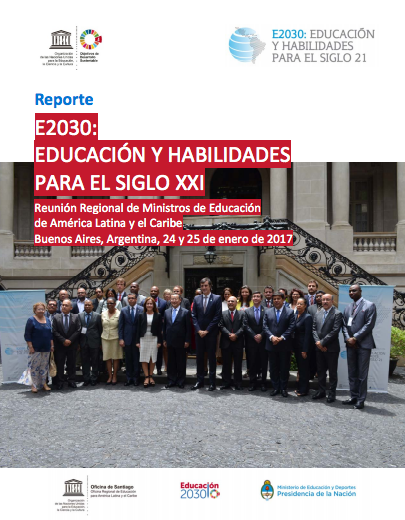 E2030: education and skills for the 21st century, report Year of publication: 2017 Corporate author: UNESCO Santiago The UNESCO Regional Bureau for Education in Latin America and the Caribbean, OREALC/UNESCO Santiago, in collaboration with the Ministry of Education and Sport of the Republic of Argentina, organized the Regional Meeting of Ministers of Education of Latin America and the Caribbean – “E2030: Education and skills for the 21st century”. Ministers of Education and high-level representatives of the education sector of the Member States of LAC; bilateral, regional and multilateral organizations; United Nations agencies; representatives of civil society; stakeholders and UNESCO experts participated in the meeting, which was held on 24-25 January 2017 in Buenos Aires, Argentina. This was the first ministerial meeting to be organized within the framework of the 2030 Agenda for Sustainable Development and its 17 Sustainable Development Goals (SDGs), in particular SDG 4 – “Ensure inclusive and quality education for all and promote lifelong learning”. It provided a space for dialogue between ministers of education and other stakeholders to debate SDG 4 in the context of the 2030 SDG Agenda. Discussions and information sharing on various topics related to the SDG 4 targets, and on the coordination mechanisms and monitoring instruments conducive to the achievement of E2030 enabled LAC Member States to reach a common vision and understanding of E2030 in the region. This joint approach on E2030 for the region is laid down in the Declaration of Buenos Aires, which ministers adopted at the end of the meeting.
 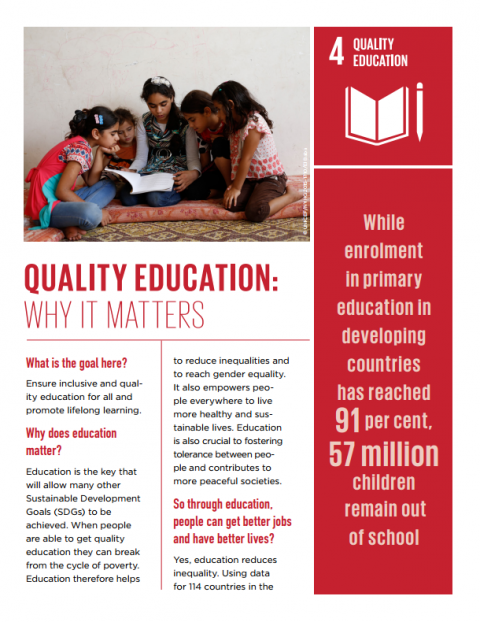 Quality Education: Why It Matters Corporate author: United Nations Children's Fund (UNICEF) Education is the key that will allow many other Sustainable Development Goals (SDGs) to be achieved. When people are able to get quality education they can break from the cycle of poverty. Education therefore helps to reduce inequalities and to reach gender equality. It also empowers people everywhere to live more healthy and sustainable lives. Education is also crucial to fostering tolerance between people and contributes to more peaceful societies. E2030: educación y habilidades para el siglo XXI; reporte Year of publication: 2017 Corporate author: UNESCO Santiago The UNESCO Regional Bureau for Education in Latin America and the Caribbean, OREALC/UNESCO Santiago, in collaboration with the Ministry of Education and Sport of the Republic of Argentina, organized the Regional Meeting of Ministers of Education of Latin America and the Caribbean – “E2030: Education and skills for the 21st century”. Ministers of Education and high-level representatives of the education sector of the Member States of LAC; bilateral, regional and multilateral organizations; United Nations agencies; representatives of civil society; stakeholders and UNESCO experts participated in the meeting, which was held on 24-25 January 2017 in Buenos Aires, Argentina. This was the first ministerial meeting to be organized within the framework of the 2030 Agenda for Sustainable Development and its 17 Sustainable Development Goals (SDGs), in particular SDG 4 – “Ensure inclusive and quality education for all and promote lifelong learning”. It provided a space for dialogue between ministers of education and other stakeholders to debate SDG 4 in the context of the 2030 SDG Agenda. Discussions and information sharing on various topics related to the SDG 4 targets, and on the coordination mechanisms and monitoring instruments conducive to the achievement of E2030 enabled LAC Member States to reach a common vision and understanding of E2030 in the region. This joint approach on E2030 for the region is laid down in the Declaration of Buenos Aires, which ministers adopted at the end of the meeting. E2030: education and skills for the 21st century, report Year of publication: 2017 Corporate author: UNESCO Santiago The UNESCO Regional Bureau for Education in Latin America and the Caribbean, OREALC/UNESCO Santiago, in collaboration with the Ministry of Education and Sport of the Republic of Argentina, organized the Regional Meeting of Ministers of Education of Latin America and the Caribbean – “E2030: Education and skills for the 21st century”. Ministers of Education and high-level representatives of the education sector of the Member States of LAC; bilateral, regional and multilateral organizations; United Nations agencies; representatives of civil society; stakeholders and UNESCO experts participated in the meeting, which was held on 24-25 January 2017 in Buenos Aires, Argentina. This was the first ministerial meeting to be organized within the framework of the 2030 Agenda for Sustainable Development and its 17 Sustainable Development Goals (SDGs), in particular SDG 4 – “Ensure inclusive and quality education for all and promote lifelong learning”. It provided a space for dialogue between ministers of education and other stakeholders to debate SDG 4 in the context of the 2030 SDG Agenda. Discussions and information sharing on various topics related to the SDG 4 targets, and on the coordination mechanisms and monitoring instruments conducive to the achievement of E2030 enabled LAC Member States to reach a common vision and understanding of E2030 in the region. This joint approach on E2030 for the region is laid down in the Declaration of Buenos Aires, which ministers adopted at the end of the meeting.