
Resources
Explore a wide range of valuable resources on GCED to deepen your understanding and enhance your research, advocacy, teaching, and learning.
104 Results found
 Water education for sustainable development: a global synthesis Year of publication: 2012 Corporate author: International Hydrological Programme (IHP) Water education is key to achieve the water related MDGs. While there is a range of materials and projects focusing on water-related education, these are not well connected to offer customised solutions to individual countries. Some of the limitations identified with the existing water education include use of outdated, biased or irrelevant information; poor medium of instruction; lack of continuity between different levels of water education; lack of integration with the wider curriculum and with local knowledge; lack of practical relevance to local and community needs; lack of resources; and poor linkages with locally available professional bodies. The programme on “Water Education” is an initiative of the International Hydrological Programme (IHP) of UNESCO, Water and Sustainable Education focused on an integrated understanding of biological and hydrological processes at a catchment’s scale in order to create a scientific basis for a new, cost-effective and systemic approach to the sustainable management of freshwater resources. Address by Irina Bokova, Director-General of UNESCO, on the occasion of Ministerial Breakfast Meeting: Scaling up Action on Education for Sustainable Development; UNESCO, 8 November 2013 Year of publication: 2013 Author: UNESCO. Director-General, 2009-2017 (Bokova, I.G.) Corporate author: UNESCO. Director-General, 2009-2017 (Bokova, I.G.) This address was given by Irina Bokova, Director-General of UNESCO, on the occasion of Ministerial Breakfast Meeting "Scaling up Action on Education for Sustainable Development." Address by Irina Bokova, Director-General of UNESCO, on the occasion of the Opening of the UNESCO World Conference on Education for Sustainable Development; Aichi-Nagoya, Japan, 10 November 2014 Year of publication: 2014 Author: UNESCO. Director-General, 2009-2017 (Bokova, I.G.) Corporate author: UNESCO. Director-General, 2009-2017 (Bokova, I.G.) This address by Irina Bokova, Director-General of UNESCO was presented on the occasion of the Opening of the UNESCO World Conference on Education for Sustainable Development.
 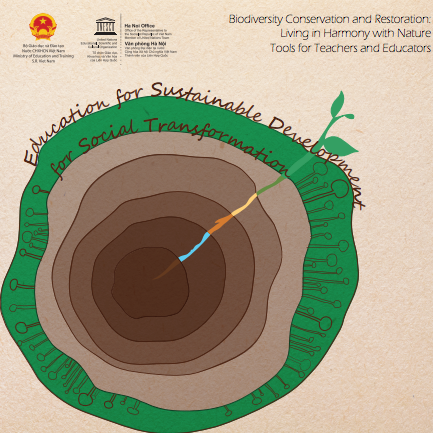 Education for sustainable development for social transformation Year of publication: 2017 Corporate author: UNESCO Hanoi | Viet Nam. Ministry of Education and Training This course on Education for Sustainable Development for Social Transformation explains the connection between sustainable development, education and the successful implementation of national and international policies and initiatives on Sustainable Development, such as the Education for Sustainable Development Framework, Global Citizenship Education and the post-2015 Development Agenda. A particular focus is placed on Viet Nam's implementation of these initiatives, including MOET's Action Plan to Implement the National Strategy on Natural Disaster Prevention, Control and Mitigation in the Education Sector in the 2011-2020 Period.The courses promote creative thinking and a holistic approach to some of our planet's most pressing issues. A contribution to sustainable development will be made by encouraging students, families, schools and communities to be bioliterate.
  Education for Sustainable Development: The Tunisian Experience as an Example Year of publication: 2006 Author: Fatima Al-Tarhouni Corporate author: Federation of the Universities of the Islamic World The author in this article is giving analytical description of education for sustainable development. She uses the Tunisian experience as an example of implementing education for sustainable development.
  Reinforcing School Health Through The Role Of The Teacher in Establishing The Environmental Education Values For Pupils. A Socio-demographic Study Of Middle School Students Through Teachers' Declaration (vol.11, no.1; Journel of Family and Society) Year of publication: 2023 Author: Khelfaoui Fahima Corporate author: University of Algiers 2 Given the significance of schools, particularly teachers, in environmental preservation, this study aims to explore the role of schools in fostering environmental education values among students. Is there a specific strategy in place for promoting these values? If so, how do teachers take the initiative to implement it for their students? Additionally, suggestions for promoting the concept of an environmental school are provided.
  Environmental Education as a Strategy for Activating Environmental Citizenship (vol.8, no.2; Research Journal) Year of publication: 2023 Author: Bel'asal Bint Nabi Yasmine | Amroush Al Houcine Corporate author: Yahia Fares University of Medea This research paper aims to explore environmental education as a strategy for promoting environmental citizenship. Throughout the latter half of the twentieth century, the environment became a focal point for numerous thinkers and researchers across various fields. The concept of environmental citizenship emerged as a crucial term aimed at fostering individual responsibility towards the environment. Achieving environmental citizenship necessitates effective environmental education, which endeavors to impart direction, values, and behaviors conducive to environmental stewardship. It seeks to elucidate key concepts and cultivate essential skills for comprehending and appreciating the intricate relationships between humanity, culture, and the environment. Topics explored include citizenship, environment, environmental education, the Tbilisi conference, and responsible environmental behavior.
  Environmental Science Course Year of publication: 2021 Author: Ula Madwer | Sakher Ajouz | Ali Alsahyouni Corporate author: University of Hama This document provides an explanation of the initial practical session in the environment science course. The practical part of the environment science course contains a set of practical exercises. It includes the following objectives: Familiarize students with the tools and equipment of the environmental laboratory Determine the types and sources of environmental pollution Air quality standards and measurement units Measurement of carbon dioxide concentration
 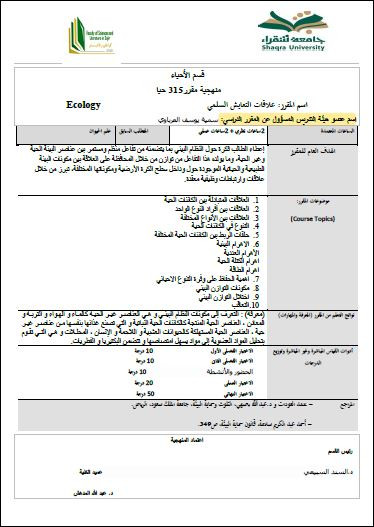 University Course: Relationships of Peaceful Coexistence Year of publication: 2021 Author: Somaya Youssef Al-Arabawy Corporate author: Shaqra University The goal is to give the student an idea about the ecosystem, including the organized and continuous interaction between the elements of the living and non-living environment, and the balance this interaction generates by maintaining the relationship between the components of the natural and living environment around and within the surface of the globe and its various components, which are highlighted through the relationships and complex functional connections.
 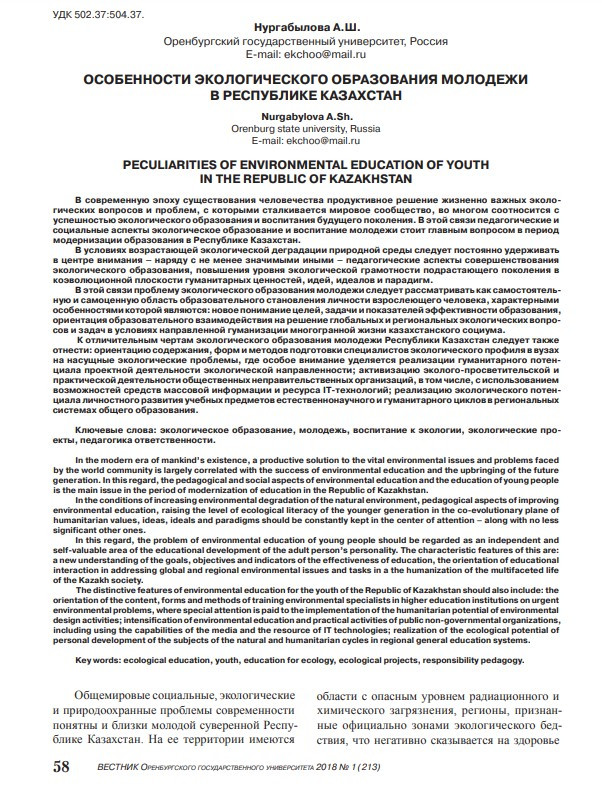 Peculiarities of Environmental Education of Youth in the Republic of Kazakhstan Year of publication: 2018 Author: Agila Sh. Nurgabylova In the modern era of mankind’s existence, a productive solution to the vital environmental issues and problems faced by the world community is largely correlated with the success of environmental education and the upbringing of the future generation. In this regard, the pedagogical and social aspects of environmental education and the education of young people is the main issue in the period of modernization of education in the Republic of Kazakhstan.