
Resources
Explore a wide range of valuable resources on GCED to deepen your understanding and enhance your research, advocacy, teaching, and learning.
104 Results found
 Education and Climate Change: Learning to Act for People and Planet Year of publication: 2024 Corporate author: Global Education Monitoring Report Team | Monitoring and Evaluating Climate Communication and Education Project (MECCE) | University of Sakatchewan How can education lead to climate change action?Despite strong evidence on the impact of education on other development outcomes and the role it plays in developing professional capacity for sustainable development transitions, education is often absent from other sectors’ strategic, policy, planning and financing considerations. The Global Education Monitoring Report is introducing a new series to advance dialogue on the interrelationship of education with the other Sustainable Development Goals.The first paper in the series focuses on climate change. It starts by reviewing the growing impact of climate change on education before turning to the role of education in climate action. Education has a somewhat underappreciated contribution to developing professional capacities for the transition to a green economy. Formal, non-formal and informal learning are also commonly believed to be playing a critical role in motivating actions on climate change mitigation and adaptation.Yet a positive association between education attainment and unsustainable consumption levels, as well as inconclusiveness of much research on the direct impact of education on climate change adaptation and mitigation actions has in part contributed to education receiving low priority in global and national climate change agendas.This paper argues that climate change education needs to adapt to fulfil its potential. The education paradigm cannot rely solely on knowledge transfer but needs to focus on social and emotional, and action-oriented learning.Much of the research has focused on the impact of education attainment and cognitive learning. More research is therefore needed to assess other drivers through which education can influence behaviours and motivate climate change action. Such research is needed to formulate viable education reform packages that improve the curriculum, strengthen climate-readiness of schools and education systems, engage learners and prepare educators accordingly.
  Education for Arctic sustainable development Year of publication: 2009 Author: Lars Kullerud Corporate author: UNESCO Education is an essential component of sustainable development. However, for the Arctic there is a history of education systems that tried to force central school models on local people, including different degrees of suppression of local language. This has been improved today to various degrees in the Arctic states. However, lack of skilled teachers with local roots is a circumpolar challenge. Arctic higher educational institutions also face many challenges when attempting to be innovative and competitive due to their small size and geographic isolation. The model of the University of the Arctic allows for a dynamic development of shared education systems through mutual cooperation. This network can be a very efficient tool to for delivering a relevant curriculum for a changing North.
  UNESCO's role, vision and challenges for the UN decade of education for sustainable development (2005-2014) Year of publication: 2006 Corporate author: UNESCO This document elaborates on UNESCO's role in guiding the Decade of Education for Sustainable Development (DESD), its vision and challenges for the DESD. Media as partners in education for sustainable development: a training and resource kit Year of publication: 2008 Author: Eleanor Bird | Richard Lutz | Christine Warwick Corporate author: UNESCO Media as Partners in Education for Sustainable Development addresses issues that are being discussed on the social, economic and environmental fronts. It does not pretend to know all the answers, but draws on existing experience and recommends resources for further inquiry and research. It encourages the media to engage in public participation and to debate improvements that can lead to sustainable development. It also seeks to contribute to media awareness and understanding of sustainability, as outlined by the Agenda 21 Plan of Action for all nations endorsed at the 1992 Earth Summit in Rio de Janeiro. Education and national sustainable development strategies Year of publication: 2009 Corporate author: UNESCO Since the Rio Earth Summit in 1992 countries around the world have been developing and implementing National Sustainable Development Strategies (NSDS). Sustainable Development competes with many deeply entrenched values and therefore progress has been slow. Tensions between long term and short term thinking, and between economic growth and social and environmental sustainability, are not easy to resolve. The NSDS process has gained impetus following the 2002 World Summit on Sustainable Development, where it was agreed that countries need to take immediate steps to elaborate and formulate NSDS systems that can continuously improve. The UN Guidance Document describes an NSDS as a comprehensive, adaptable, continuous and long term undertaking that helps a country to achieve economic prosperity and higher levels of social welfare, while at the same time preserving the environment. An NSDS is not just something that can be put together in a document and be promulgated. Development of an NSDS requires multi-stakeholder participation, partnerships, country ownership, shared vision with a commitment to continuous improvement, capacity development and the ability to build on existing knowledge and processes and a clear focus on outcomes. Education is a central dimension of achieving sustainable development, and needs to be incorporated into the NSDS process. Learning is central to the process of NSDS development and implementation. Good practices in education for sustainable development: using the Earth Charter Year of publication: 2007 Corporate author: UNESCO | Earth Charter International Secretariat This publication has been envisioned to offer stories – case studies from around the world – that highlight how groups and individuals are using the Earth Charter as a tool for education for sustainable development. These stories come from non-formal and formal educational settings and describe a variety of experiences, including the development of guidebooks for primary school teachers, the inclusion of sustainability values in universities’ departments of education, law, engineering and general studies; the reshaping of local, regional and national curricula; and, the creation of vital and engaging programs and workshops for children and youth.
  UNESCO at COP23: Climate Change Education Year of publication: 2017 Corporate author: UNESCO This brochure contains information about UNESCO's role of education in climate change through ESD(Education for Sustainable Development). Education for Sustainable Development (ESD) is increasingly recognized around the world as an effective enabler for a more sustainable future. Building climate change awareness and building capacities for adaptation and mitigation are critical dimensions of ESD. The critical role of education in climate change responses was clearly recognized at the Paris Climate Conference (COP21) in December 2015. COP22 in Marrakesh and COP23 in Bonn reiterate the importance of climate change education in achieving the global agendas.
 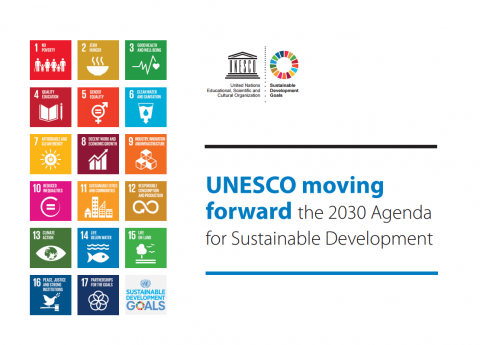 UNESCO moving forward the 2030 Agenda for Sustainable Development Year of publication: 2017 Corporate author: UNESCO The United Nations 2030 Agenda for Sustainable Development, with its 17 Sustainable Development Goals, sets forth a bold new framework for development cooperation over the next 15 years. This agenda aspires to ensure prosperity and well-being for all women and men, while protecting our planet and strengthening the foundations for peace.
  The contribution of early childhood education to a sustainable society Year of publication: 2008 Corporate author: UNESCO This report originates from the international workshop, ‘The Role of Early Childhood Education for a Sustainable Society’, jointly organized in Göteborg, Sweden, by Göteborg University, Chalmers University of Technology and the City of Göteborg, from 2 to 4 May 2007. It was attended by thirty-five participants from sixteen different countries (see ‘List of Participants’). The workshop was a follow-up to the international conference on education for sustainable development, ‘Learning to Change Our World’, held in May 2004, in Göteborg. It was one of four preparatory workshops leading to another international conference on education for sustainable development, to be organized in 2008 or 2009, in the same city. The aim of the four workshops is to discuss promoters and barriers related to learning for sustainability, and to propose recommendations for the upcoming international conference. The present workshop was conceived for the following reasons. First, our societies urgently require new kinds of education that can help prevent further degradation of our planet, and that foster caring and responsible citizens genuinely concerned with and capable of contributing to a just and peaceful world. Second, these new kinds of education must be available to all – not only a handful of people – and take place in various settings, including families and communities. Third, they must begin in early childhood, as the values, attitudes, behaviours and skills acquired in this period may have a long-lasting impact in later life. Thus, early childhood education clearly has an important place in the efforts to bring about sustainable development.
  Drivers and barriers for implementing learning for sustainable development in pre-school through upper secondary and teacher education Year of publication: 2007 Author: Inger Björneloo | Eva Nyberg Corporate author: UNESCO This publication is the product of the workshop on Drivers and Barriers for Implementing Learning for Sustainable Development in Pre-School through Upper Secondary and Teacher Education held in Göteborg, Sweden in March 2006. The workshop was the second in the series of workshops emanating from the Learning to Change Our World International Consultation on Learning for Sustainable Development, held in Göteborg in May 2004 on behalf of the Swedish Government. The purpose of this paper is to make visible some of the pluralism of different perspectives on education for sustainable development. This pluralism, which, during the workshop seemed to hinder progress, could through this be turned into a forceful driver instead of remaining a frustrating barrier.