
Resources
Explore a wide range of valuable resources on GCED to deepen your understanding and enhance your research, advocacy, teaching, and learning.
104 Results found
 Climate change education for sustainable development in small island developing states: report and recommendations Year of publication: 2012 Corporate author: UNESCO This report summarizes the key outcomes of a three-day meeting of around one hundred climate change education (CCE) experts, primarily from Small Island Developing States (SIDS) in the Caribbean, the Pacific Ocean and the Indian Ocean, representing a multi-disciplinary and diverse group of stakeholders. The meeting discussed and reflected on the challenges that climate change poses to education systems in SIDS, and on the role that education must play in adaptation to climate change. It was held from 21 to 23 September 2011 in Nassau, with the support of the Commonwealth of the Bahamas, the Government of Denmark and the Government of Japan. SIDS in the Caribbean Sea, the Indian Ocean and the Pacific Ocean are among the most vulnerable countries with regard to climate change. SIDS are already confronted with the effects of climate change, including rising sea levels and changes in weather and climate extremes such as droughts, floods and tropical cyclones/hurricanes. With current and future impacts of climate change representing a real danger to SIDS communities and livelihoods – whether based on agriculture, fisheries, forestry, tourism or trade – the need for SIDS to reduce their vulnerability to climate change by strengthening their adaptive capacity is a matter of urgency. Moving further along the path to sustainable development and achieving sustainable development objectives will depend on the ability of SIDS to strengthen this adaptive capacity. Adaptation to climate change requires individuals to be aware of potential changes in the climate and to understand the implications of changes for their lives. It requires them to assess the risks such changes hold for their identity and future, and to make informed decisions on how to adapt their livelihoods, homes and communities. Education plays an essential role in increasing the adaptative capacity of communities and nations by enabling individuals to make informed decisions. In particular, the education of girls and women has proven to have a significant impact on the capacity of communities to adapt to climate change and develop sustainably. Quality education designed for the purpose of empowering people to address climate change and live sustainably improves the adaptation capacity at the community level. This implies educational programmes that explicitly prepare communities for natural disasters. Climate change education for sustainable development (CCESD) needs also to incorporate indigenous knowledge, and promote sustainable lifestyles in which the importance of heritage is recognised as an integral part of community identity and a key asset that can help build resilience. Finally, CCESD should stress the unique cultural and natural heritage of SIDS, which plays a major role in the building of community resilience.
 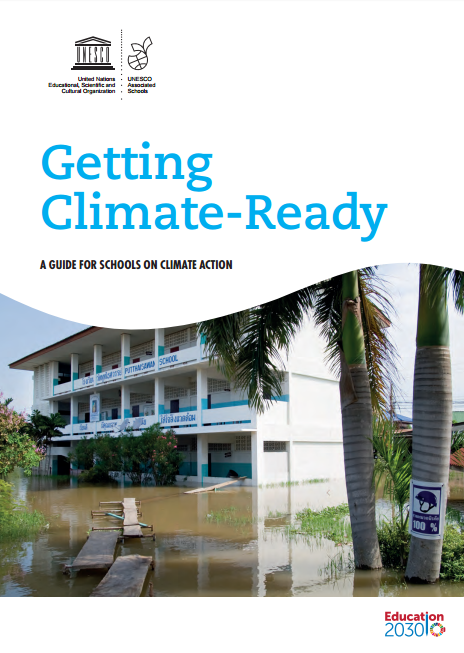 Getting climate ready: a guide for schools on climate action and the whole-school approach Year of publication: 2016 Corporate author: UNESCO Do you want to help create a healthier, fairer, more environmentally sustainable society? Do you want to empower children and young people to do the same? Do you want to make your school more climate-friendly? If so, this guide is for you! The guidelines and examples are based on a survey looking at climate action projects at 55 schools in 12 countries. All schools in the survey are part of UNESCO’s Associated Schools Project Network (ASPnet). In addition, this guide draws on examples and research published in peer-reviewed journals, books, national and international guidelines and frameworks and programme websites.
 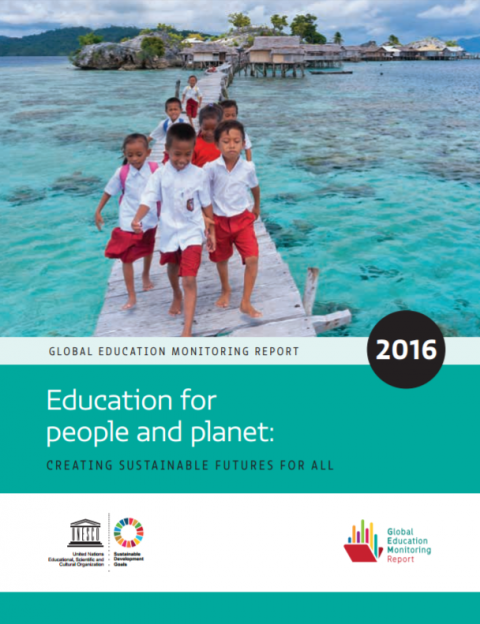 Education for People and Planet: Creating Sustainable Futures for All, Global Education Monitoring Report, 2016 Year of publication: 2016 Corporate author: UNESCO | Global Education Monitoring Report Team Education for People and Planet: Creating Sustainable Futures for All explores the complex relationship between education and the new 2030 Agenda for Sustainable Development, covering six fundamental pillars – Planet, Prosperity, People, Peace, Place and Partnerships. This report shows that education will not deliver its full potential unless participation rates increase dramatically and sustainable development guides education system reform. It also warns of the destructive impact that climate change, conflict, unsustainable consumption and the increasing gap between rich and poor have on education. A huge transformation is needed if we are to create sustainable futures for all. Sandwatch: adapting to climate change and educating for sustainable development Year of publication: 2010 Author: Gillian Cambers | Paul Diamond Corporate author: UNESCO Sandwatch provides a framework for children, youth and adults, with the help of teachers and local communities, to work together to critically evaluate the problems and conflicts facing their beach environments, and to develop sustainable approaches to address these issues. It also helps beaches become more resilient to climate change. The preliminary chapters of this publication focus on how to get started with Sandwatch activities and examine ways to address climate change impacts. The principle aim of this publication is to document the Sandwatch methodology: monitoring, analysing, sharing and taking action. An activities-orientated approach is used to provide step-by-step instructions to cover monitoring methods and data analysis, including observation and recording, erosion and accretion, beach composition, human activities, beach debris, water quality, waves, longshore currents, plants and animals. The activities are related to (a) sustainable development issues, including: beach ownership, mining beaches for construction material, conflict resolution between different beach users, pollution, conservation of endangered species, and (b) climate change adaptation issues: sea level rise, rising temperatures, ocean acidification and increased extreme events. Ways to share findings and create a Sandwatch network are detailed including methods such as the use of local media, websites, social networking and video production. Finally, ways are discussed to design, plan and implement a Sandwatch project to fulfill one or all of the following criteria: (a) addressing a particular beach-related issue, (b) enhancing the beach, and (c) promoting climate change adaptation. Sandwatch stands as an example of Education for Sustainable Development in action, and is being targeted as one of several flagship projects for the United Nations Decade of Education for Sustainable Development (2005–2014). As the world confronts the growing threat of climate change, Sandwatch presents an opportunity to help people and ecosystems respond to present and future changes in a practical manner. Beaches are among the ecosystems most at risk from climate change as they face rising sea levels and increased more intense storms. By contributing to ecosystem health and resilience, Sandwatch can help people from all walks of life learn about climate change and how their actions can contribute to the adaptation process. L'Education au développement durable: visions d'enfants Year of publication: 2011 Corporate author: UNESCO These eleven drawings and paintings were entered in the UNESCO “Draw me peace” competition. Each drawing represents a particular aspect of Education for Sustainable Development and reflects the next generations’ vision for a better, fairer future. Working knowledge: symbiosis of programmes in science teaching, environmental education, and technical and vocational education Year of publication: 2006 Author: Saif R. Samady Corporate author: UNESCO UNESCO’s work in science teaching began shortly after the Organization was established. After the Second World War, many schools in Europe were in great need of science equipment. To meet this need, the Organization sponsored the publication of a small volume entitled Suggestions for Science Teachers in Devastated Countries. The book was further developed to include a wide range of guidelines for simple equipment and science experiments and published in 1956 as the UNESCO Source Book for Science Teaching. Over the years, the Source Book was revised several times and translated into more than twenty-five languages. During five decades, the Organization promoted worldwide exchange of information and innovations in science education and assisted many Member States, especially the developing countries, in setting up science teacher training programmes, curriculum development centres, and projects for design and development of science equipment. Education for sustainable development: good practices in addressing climate change Year of publication: 2012 Corporate author: UNESCO Since the beginning of the UN Decade of Education for Sustainable Development (DESD, 2005-2014), the DESD Secretariat at UNESCO Headquarters in Paris has received numerous requests for case studies and descriptions of good practices in Education for Sustainable Development (ESD). These requests have increasingly included issues of providing an educational response to climate change. The increasing number of requests is only one indicator that climate change education is increasingly recognized in the broader education community as an essential part of ESD and life-long learning. ESD is a complex and evolving subject, and how it is applied and implemented is a challenge for all countries. The Decade aims to see ESD implemented in thousands of local situations on the ground, involving its integration into a multitude of different learning situations. These initiatives can be catalysts for action and contribute to the goals and objectives of the Decade. In such ways, organizations, local communities and individuals can be actors within the global movement for sustainable development. To support the growing interest in climate change issues and ESD, UNESCO is publishing this volume containing 17 examples of programmes addressing climate change in ESD settings and practices. These good practices and shared experiences, which were provided by a range of different stakeholders, are concrete examples of successful implementation of ESD in different fields and sectors, from the political to the school level, and including formal, nonformal and informal learning situations. International implementation scheme for the UN decade of education for sustainable development, 2005-2014 Year of publication: 2005 Corporate author: UNESCO In December 2002, the UN General Assembly adopted a resolution to put in place a UN Decade of Education for Sustainable Development, lasting from 2005 to 2014. UNESCO was tasked with leading the Decade and developing an International Implementation Scheme (IIS). Education sector technical notes: Education for Sustainable Development (ESD) Year of publication: 2013 Corporate author: UNESCO The Education Sector is called to implement a significant and broad mandate, covering many challenging issues in education in a diverse and fast-changing world. More than ever, we need to better focus and ensure greater cohesion in implementing this mandate. This document is part of a series of Technical Notes that have been developed by colleagues in the Education Sector in order to facilitate programme delivery in thematic areas related to the work of the Sector. The Technical Notes are meant to serve as a quick reference tool for UNESCO staff, providing a brief overview including basic knowledge, key priorities for UNESCO and future directions as well as practical information on each topic. Teaching resource kit for dryland countries: a creative approach to environmental education Year of publication: 2007 Author: Thomas Schaaf Corporate author: UNESCO Entitled A Creative Approach to Environmental Education/Teaching Resource Kitfor Dryland Countries, the kit is intended for secondary-school teachers in countries affected by desertification and is based on an innovative approach appealing to the creativity and artistic sensibility of pupils aged 10 to 15 years. This approach favours discovery of the environment through the senses, and emphasizes the visual and exploratory aspects of environmental study. The idea of using creativity and artistic sensibility to promote ecological awareness may in the future become a source of collaboration to be explored in detail by the different sectors of UNESCO.