
Resources
Explore a wide range of valuable resources on GCED to deepen your understanding and enhance your research, advocacy, teaching, and learning.
41 Results found
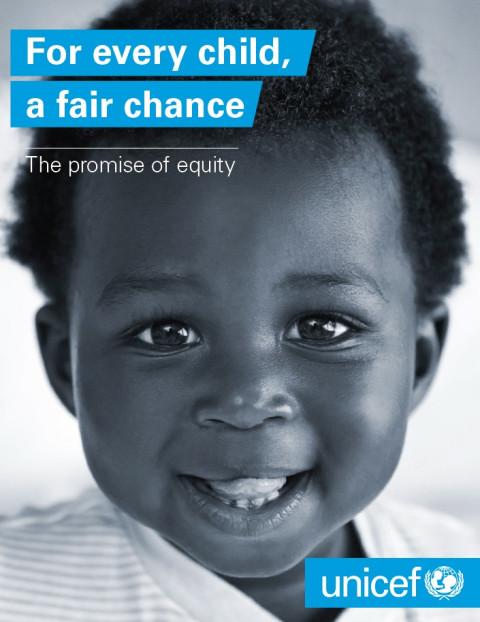 Равные возможности Обещание равенства для всех детей: Обещание равенства Year of publication: 2015 Corporate author: United Nations Children's Fund (UNICEF) Настоящий отчет основан на подробном документе, который обсуждался на специальной сессии Исполнительного комитета ЮНИСЕФ, посвященной вопросам равенства и справедливости, в Нью-Йорке в июне 2015 года. Работа ЮНИСЕФ строится на принципе равенства и справедливости, при этом основное внимание уделяется наиболее уязвимым группам детей во всем мире: детям из наиболее бедных семей и девочкам, детям с ограниченными возможностями, детям, живущим в удаленных районах, и детям из этнических или религиозных групп, сталкивающимся с дискриминацией. Представленный доклад, основываясь на фактах и опыте такой работы, приводит два основных довода в пользу устранения укоренившихся диспропорций, касающихся равенства и справедливости. В ней рассмотрены семь сфер, имеющих решающее значение для развития детеи: здоровье; ВИЧ и СПИД, вода, санитария и гигиена; питание, образование: защита ребенка; социальная интеграция. В каждой сфере наблюдаются резкие контрасты между глобальными улучшениями, с одной стороны, и неотложными неудовлетворенными потребностями наиболее уязвимых детей во всем мире - с другой.
 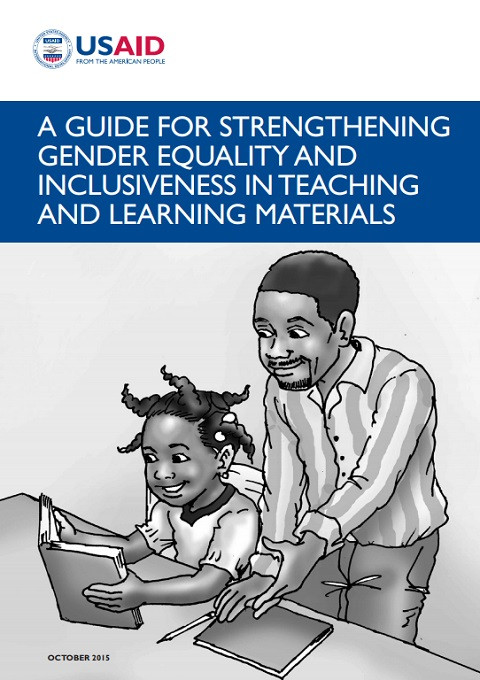 A Guide for Strengthening Gender Equality and Inclusiveness in Teaching and Learning Materials Year of publication: 2015 Corporate author: RTI International | United States Agency for International Development (USAID) The purpose of this guide is to provide guidance on how to represent members of all subgroups of a society in teaching and learning materials in equitable and non-stereotypical ways. Reviewers can use the strategies proposed in this guide to evaluate existing teaching and learning materials across primary and secondary levels. Authors or developers can employ the strategies to inform the development of new materials. This guide is organized according to themes that emerged from the review of relevant literature. Each theme reflects a particular type of bias that should be considered when evaluating or developing teaching and learning materials.
  Key Concepts: A Feminist Approach to Human Rights Education (Chapter 4) Year of publication: 2014 Author: Julie Maia Corporate author: Stanford Human Rights Education Initiative (SHREI) Developed for the Stanford Human Rights Education Initiative (SHREI), this curriculum project examines connections among Gender Studies, feminist theory, and human rights movements around the world. This SHREI project presents its four key concepts through four curricular units, or chapters, each with a series of activities that can easily be adapted for use in courses in many disciplines. Each chapter contains these elements: A definition of the key concept An example of the use of the concept in a human rights document A brief essay on the value of the concept for human rights education A series of activities that guide students in using gender, race/ethnicity/nation, and class as lenses for analyzing social justice issues include transnational and multicultural perspectives on gender and human rights issues use "best practices" pedagogies for teaching human rights topics in community colleges. Within each chapter, activities are orgaized from simple to complex. Most activities, however, have self-contained objectives and can be used independently of the others. Sections on “Extending the Learning” offer longer readings or in-depth material for advanced courses. The GCED Clearinghouse introduces only chapter 4, "global citizenship" of this SHERI project.
 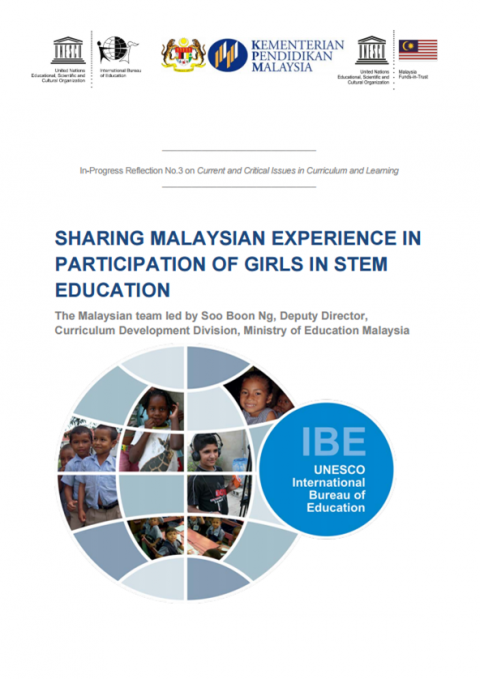 Sharing Malaysian experience in participation of girls in STEM education Year of publication: 2016 Corporate author: UNESCO International Bureau of Education (IBE) The Malaysia government has placed STEM as a focus in developing the country towards achieving the status of a developed nation. The government acknowledges the role of women as equal partners in nation building. Thus, various policies ranging from economy, education, women’s welfare and human resources have been formulated through the years. These policies have resulted in among others, the increase in women researchers from 35.8% in 2004 to 49.9% in 2012 as well as more women’s participation in selected STEM courses at the tertiary level. A total of 84 girls’ day schools with 6 of them as residential STEM Girls’ schools have been built since 1939. There are many female role models in STEM for the girls to emulate. This has been made possible by the successful implementation of the various policies related to women in STEM as well as innovative measures in facing the continuing challenges in STEM education.
 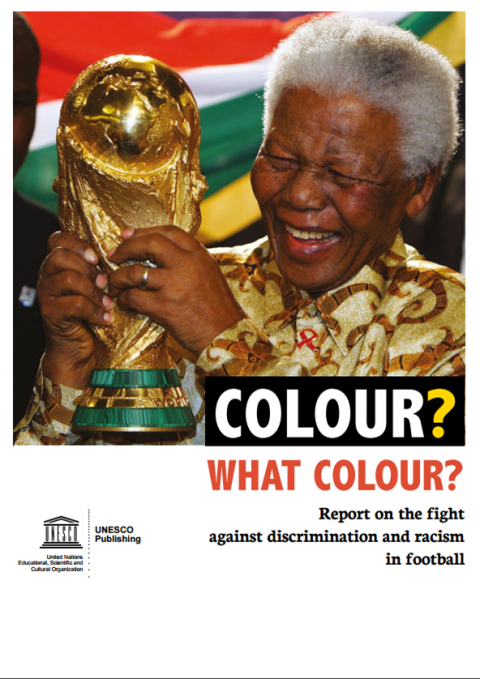 Colour? What colour? Report on the fight against discrimination and racism in football Year of publication: 2015 Author: Albrecht Sonntag | David Ranc Corporate author: UNESCO Football has been shown to be a mirror of society, it may also be viewed as providing a temporary suspension of reality for an interlude of high emotion and idealized hopes and dreams. Football’s public transcends differences of age, gender, culture, religion, and socioeconomic status to unite in support of their team. The broad diversity of backgrounds of football players represents tangible evidence of equal opportunity and meritocracy. The sport itself has team solidarity, fair play and mutual respect among members and for opponents ingrained within its rules and practices. Yet, the ‘beautiful game’ is one with an imbedded paradox. Football is also a game that may in many vaguely resemble war, where opponents face each other in a struggle to win over the other side, with the noisy and emphatic support of the spectators. An ‘us’ and ‘them’ mentality is an integral part of trying to help a team reach the objective, which is to win the game. This setting naturally produces a desire by supporters to intimidate the other side by encouraging their team and expressing both confidence and superiority through their words and actions. When the ‘us’ and ‘them’ mentality turns into symbolic exclusion of others, language of disparagement and insult based on racism or discrimination, or physical confrontation, the ‘beautiful game’ is debased. The existence of racism and discrimination in football is not a secret, but it is a shame on the game. Although much is already being done, both observers and experts feel too many problems persist and measures to tackle them have not been effective enough. This report was commissioned by UNESCO within the framework of UNESCO’s partnership with Juventus. It focuses on discrimination and racism in professional football and to some extent the amateur clubs that funnel into the leagues. It provides an overview of the historic and theoretical background. It reports on the state of affairs on the ground. It summarizes what has been done and is being done to mitigate racism and discrimination in domestic and international football, how the effects of these actions may be evaluated, and which new avenues for further, complementary action are promising. The report is based on a literature review, desk research, regional reports from the Unesco network and a field survey among a purposive sample of experts and actors in a number of countries. The report has a somewhat European focus, in its sources and examples. Europe has a unique position Executive Summary in the world of football, with its leading competitions, championships and clubs. It is the region where racism and discrimination in football has been most intensively researched. A number of civil society organisations from Europe have played a pioneering role in the fight against racism and discrimination in football. Moreover, the pressure that comes with the money invested in and generated by western European football, as well as its exposure in the media, has also made clubs, federations and UEFA particularly sensitive to the negative impact that discrimination can have on the game and its image, within Europe and worldwide. Europe must therefore occupy a central role in a study of the fight against discrimination in professional football and in determined policies to mitigate racism and discrimination related to football wherever they occur. The examples of incidents of discrimination and racism, as well as of existing measures to combat them have been selected to be as wide-ranging as possible. The authors do not, however, claim the report to be a comprehensive listing. Similarly, the examples of best practice have been collected through extensive reading and contacts, but must be looked at as an overview rather than as a directory. They are chosen by the authors to illustrate types of actions and institutions with the potential for greatest impact. The report also does not deal with the methods of allocation of resources to football, with issues of employment, or with womens’ football. While these are significant topics on which concerns can be expressed, the necessary focus of a report of this type means that they are alluded to without being treated in depth.
  From insult to inclusion: Asia-Pacific report on school bullying, violence and discrimination on the basis of sexual orientation and gender identity Year of publication: 2015 Corporate author: UNESCO This review recognises the complexity in terminology globally, and within the region, on sex, sexuality and gender. For simplicity, ‘SOGIE-based bullying, violence and discrimination’ is used to refer to the various anifestations of violence and exclusion based on gender discrimination, gender role expectations and stereotypes, intersex prejudice, and societal expectations for heterosexual relationships. This is sometimes referred to as homophobic or transphobic bullying, violence and discrimination. This report considers violence experienced by children and young people because of actual or perceived sexual orientation and gender identity or expression, or because their bodies differ from typical definitions of male or female. The term ‘LGBTI people/youth’ is used in this report when inclusive of intersex persons, and LGBT when the situation or needs of intersex people/ youth have not been considered. Local terms and those from original studies are also included, and the glossary provides information for readers on concepts and terms in this report. De l'insulte à l'inclusion: Rapport sur l'Asie-Pacifique sur les brimades à l'école, la violence et la discrimination sur la base de l'orientation sexuelle et l'identité de genre Year of publication: 2015 Corporate author: Organisation des Nations Unies pour l'éducation, la science et la culture (UNESCO) Cet avis reconnaît la complexité de la terminologie au niveau mondial, et dans la région, sur le sexe, la sexualité et le genre. Par souci de simplicité, ‘sur la base Sogie l'intimidation, la violence et la discrimination’ est utilisé pour désigner les différents anifestations de violence et d'exclusion fondées sur la discrimination entre les sexes, les attentes de rôle de genre et les stéréotypes, les préjugés intersexe et attentes de la société pour les relations hétérosexuelles. Ceci est parfois désigné comme homosexuels ou les transsexuels intimidation, la violence et la discrimination. Ce rapport considère la violence vécue par les enfants et les jeunes en raison de l'orientation et l'identité ou l'expression sexuelle réelle ou perçue, ou parce que leurs corps diffèrent des définitions typiques de sexe masculin ou féminin. Le terme «personnes LGBTI / jeunesse» est utilisé dans ce rapport lorsque compris les personnes intersexuées et LGBT lorsque la situation ou les besoins des personnes intersexuées / jeunes n'ont pas été pris en considération. Les termes locaux et ceux des études originales sont également inclus, et le glossaire fournit des informations pour les lecteurs sur les concepts et termes utilisés dans ce rapport. Values Education through Sport Year of publication: 2016 Corporate author: UNESCO Innovative education for developmentEducation in the 21st century increasingly recognizes the role of values and social skills in tackling global challenges, such as inactivity, obesity, unemployment, and conflict. This approach is at the core of the Sustainable Development Goal 4 on quality education, which advocates for inclusive lifelong learning opportunities and innovative content delivery. Dynamic forms of values-based education using sport can be introduced in schools to support teachers deliver curricula actively and cooperatively.What are sport values?Sport can teach values such as fairness, teambuilding, equality, discipline, inclusion, perseverance and respect. Sport has the power to provide a universal framework for learning values, thus contributing to the development of soft skills needed for responsible citizenship.What can Values Education through Sport offer?Values Education through Sport (VETS) programmes support active learning, complement cognitive skills and give students increasing amounts of responsibility, and enhance their level of concentration and participation. VETS programmes are flexible and have a strong cross-curricular potential: they can reinforce existing curricula and can be streamed across different subjects, including physical education, civic and moral education, nutrition, biology, arts. Ultimately, these programmes help students to transfer and put values into action outside the school environment, by getting engaged in their communities, making informed decisions, being sensitive and respecting the others and the environment. VETS contributes to the development of self-confidence, active and healthy lifestyle choices, and an understanding of rights, supporting the delicate transition to the independence of adulthood. Éducation aux Valeurs par le Sport Year of publication: 2016 Corporate author: UNESCO Éducation innovante pour le développementL'éducation au 21e siècle reconnaît de plus en plus le rôle des valeurs et des compétences sociales pour relever les défis mondiaux, tels que l'inactivité, l'obésité, le chômage et les conflits. Cette approche est au cœur de l'objectif de développement durable 4 sur l'éducation de qualité, qui milite pour des possibilités d'apprentissage inclusifs et la livraison de contenu innovant. Les formulaires dynamiques de l'éducation fondée sur les valeurs en utilisant le sport peuvent être introduits dans les écoles pour aider les enseignants offrent des programmes activement et en collaboration.Quelles sont les valeurs du sport?Le sport peut enseigner des valeurs telles que l'équité, teambuilding, l'égalité, la discipline, l'inclusion, la persévérance et le respect. Le sport a le pouvoir de fournir un cadre universel pour les valeurs d'apprentissage, contribuant ainsi au développement des compétences générales nécessaires à la citoyenneté responsable. Que peut l'éducation aux valeurs par offre de Sport?Valeurs éducation par le sport (VEPS) programmes appuient l'apprentissage actif, compléter les compétences cognitives et donner aux étudiants les montants de responsabilité de plus en plus, et d'améliorer leur niveau de concentration et de participation. programmes VEPS sont flexibles et ont un fort potentiel transdisciplinaire: ils peuvent renforcer les programmes existants et peuvent être écoutés sur différents sujets, y compris l'éducation physique, l'éducation civique et morale, la nutrition, la biologie, les arts. En fin de compte, ces programmes aident les élèves à transférer et de mettre les valeurs en action en dehors du milieu scolaire, en s'engagés dans leurs communautés, prendre des décisions éclairées, étant sensible et en respectant les autres et l'environnement. VEPS contribue au développement de la confiance en soi, des choix de vie sains et actifs, et une compréhension des droits, soutenir la transition délicate à l'indépendance de l'âge adulte.
 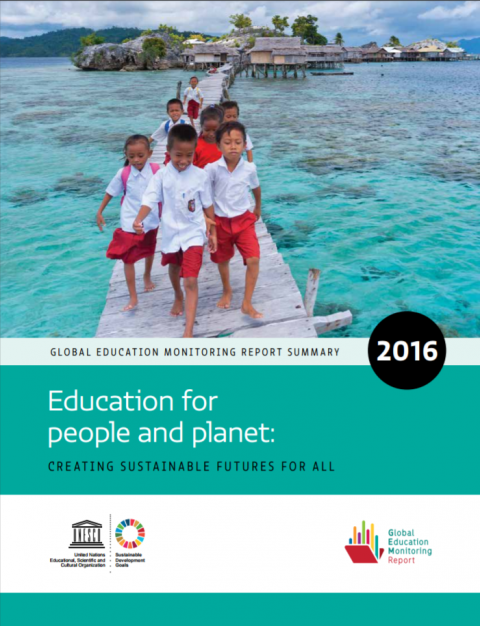 L'Education pour les peuples et la planète: créer des avenirs durables pour tous, résumé du rapport mondial de suivi sur l'éducation, 2016 Year of publication: 2016 Corporate author: UNESCO The GEM Report provides an authoritative account of how education is the most vital input for every dimension of sustainable development. Better education leads to greater prosperity, improved agriculture, better health outcomes, less violence, more gender equality, higher social capital and an improved natural environment. Education is key to helping people around the world understand why sustainable development is such a vital concept for our common future. Education gives us the key tools – economic, social, technological, even ethical – to take on the SDGs and to achieve them. These facts are spelled out in exquisite and unusual detail throughout the report. Yet the report also emphasizes the remarkable gaps between where the world stands today on education and where it has promised to arrive as of 2030.