
Resources
Explore a wide range of valuable resources on GCED to deepen your understanding and enhance your research, advocacy, teaching, and learning.
104 Results found
 Communication and Information Programme Year of publication: 2021 Corporate author: UNESCO UNESCO is the UN specialized agency building peace in the minds of people through education, the sciences, culture, communication and information. Our mission is to foster intercultural dialogue and sustainable development, by promoting the free flow of ideas.By adopting a multi-disciplinary and inclusive approach, UNESCO works with both duty-bearers and rights-holders across the world to develop and implement targeted actions that are born out of local needs, which ensures a holistic and results-based approach for sustainable change.In the field of communication and information, UNESCO defends and promotes freedom of expression, media independence and pluralism, and the building of inclusive knowledge societies underpinned by universal access to information and the innovative use of digital technologies.Through capacity-building, policy advice, international cooperation, monitoring and foresight in the fields of freedom of expression, access to information, and digital transformation, UNESCO will continue to empower key actors with a view to ensuring that fundamental freedoms are guaranteed online and offline, in line with international standards.This is all the more relevant to ensure the ethical development and use of emerging technologies, which have a growing impact on all aspects of the world’s societies. Citizens will also be empowered to enjoy these fundamental freedoms through the development of 21st century skills and the fostering of enabling environments for media pluralism and diversity.
  "Sustainable Development Goals and Gender in Kyrgyzstan" New Statistical Publication Year of publication: 2023 Corporate author: National Statistical Committee of the Kyrgyz Republic | United Nations Entity for Gender Equality and the Empowerment of Women (UN Women) This publication is intended to inform the public and government officials about the current status and progress towards achieving sustainable development in Kyrgyzstan, promote informed policy and management decisions, and help identify further priority steps to achieve the SDGs and women’s empowerment.
 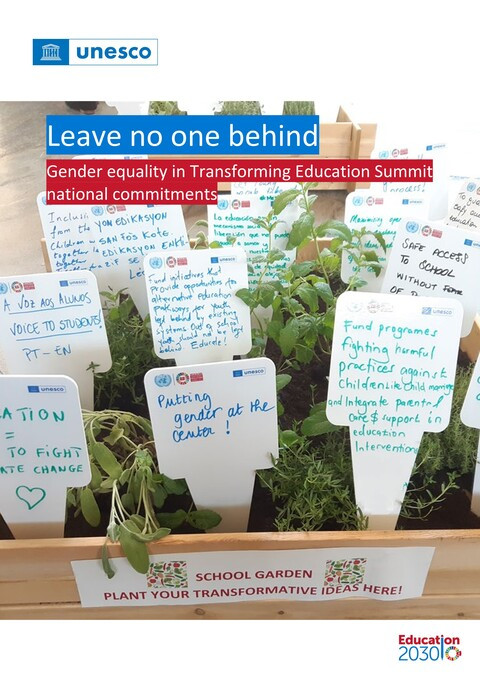 Leave No One Behind: Gender Equality in Transforming Education Summit National Commitments Year of publication: 2023 Corporate author: UNESCO The Transforming Education Summit was convened in response to a global crisis in education – one of equity and inclusion, quality and relevance. This paper applies a gender lens to the national statements of commitments made by countries during the Summit. It considers the scope of commitments to gender equality and gender- transformative education, common gender themes and considerations emerging across commitments, and notable gaps. It aims to inform future actions by the Global Platform to Drive Leadership and Accountability for Gender Equality and Girls’ and Women’s Empowerment in and through Education, and support to country action to transform education systems to advance gender equality.
 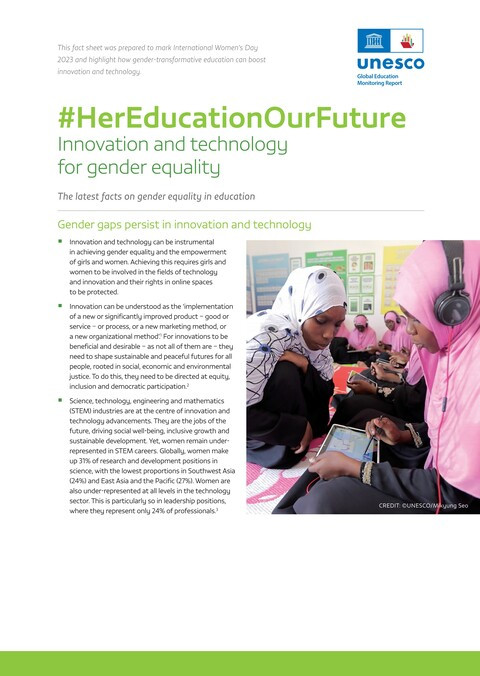 #HerEducationOurFuture: Innovation and Technology for Gender Equality; the Latest Facts on Gender Equality in Education Year of publication: 2023 Corporate author: UNESCO | Global Education Monitoring Report Team Gender gaps persist in innovation and technology Innovation and technology can be instrumental in achieving gender equality and the empowerment of girls and women. Achieving this requires girls and women to be involved in the fields of technology and innovation and their rights in online spaces to be protected.
  UNESCO in action for gender equality: 2022-2023 Year of publication: 2023 Corporate author: UNESCO <Short summary>Intersecting Global Crises Cannot Be Solved Without Gender Equality The compounding global crises that have emerged and amplified over the past two years require transformative, structural solutions if we are to build and shape sustainable and peaceful societies. Education has experienced the largest disruption in history as a result of the COVID-19 health crisis. Biodiversity has seen a steep decline – at alarming rates – on both land and in the ocean. Conflicts and emergencies that destabilise progress towards just and peaceful societies have increased in number, while human rights violations are multiplying in new contexts, including online and offline. The decisions we make and the actions we take – now – will have consequences for generations to come.None of these intersecting crises can be solved by one country alone and none of them are gender neutral. Placing gender equality at the heart of multilateral action can harness the talents, ingenuity, and visions of one-half of the world’s population. The standards of ethics and human rights demand gender equality. So, too, do the numbers. Some of humankind’s greatest challenges require efficient and tangible solutions. The paradigm shift is needed now.Yet, despite a growing demand for equity and justice, the UN now predicts it will take almost three centuries to close the gender gap. Under that reality, UNESCO will continue to meet barriers to its mandate and vision since gender inequality has a direct impact on all areas in which UNESCO works.This report shows how UNESCO and its partners have provided concrete and effective solutions during the 2022-2023 biennium to advance gender equality. It has reduced inequalities in and through quality education; it has empowered women in science and technology for environmental action; it has promoted inclusion and combatted gender-based violence; it has bridged the digital gender divide and it has promoted gender equality and women’s empowerment in crisis, emergency and early recovery contexts.UNESCO’s Global Priority Gender Equality is more relevant than ever. Together, we can amplify and expand its reach and multiply gender-transformative results for the benefit of women and girls, men and boys, all around the world.
 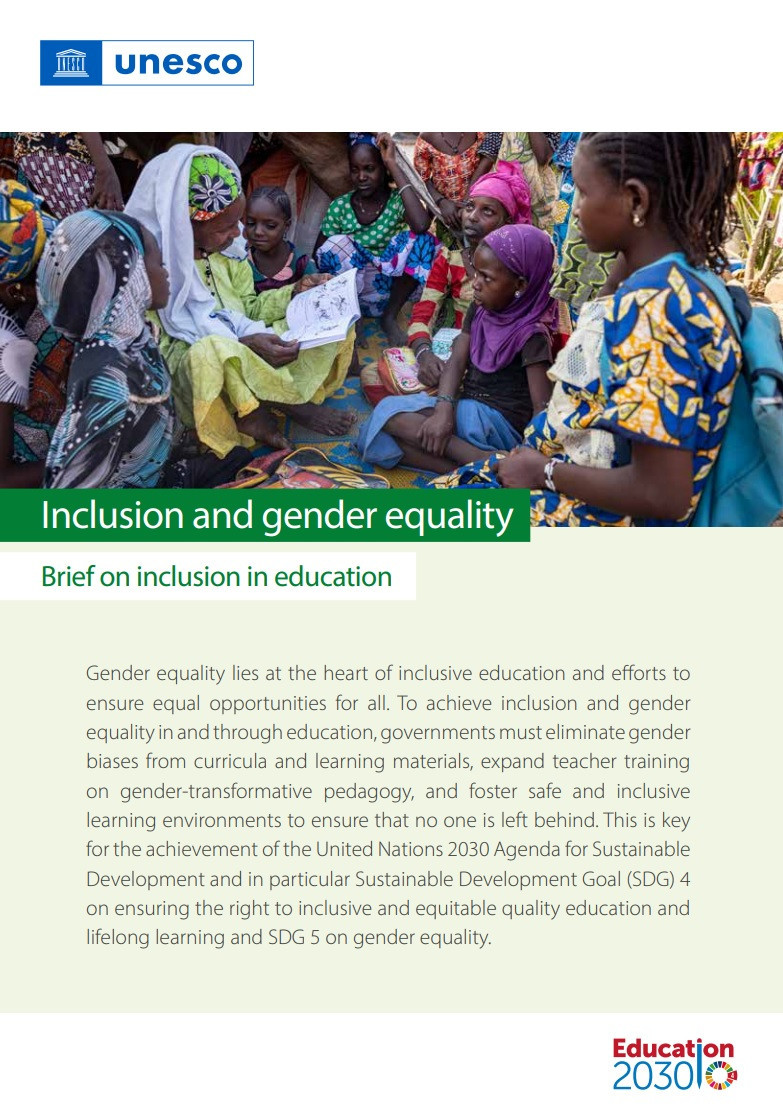 Inclusion and gender equality: brief on inclusion in education Year of publication: 2023 Corporate author: UNESCO <Brief on inclusion in education>Gender equality lies at the heart of inclusive education and efforts to ensure equal opportunities for all. To achieve inclusion and gender equality in and through education, governments must eliminate gender biases from curricula and learning materials, expand teacher training on gender-transformative pedagogy, and foster safe and inclusive learning environments to ensure that no one is left behind. This is key for the achievement of the United Nations 2030 Agenda for Sustainable Development and in particular Sustainable Development Goal (SDG) 4 on ensuring the right to inclusive and equitable quality education and lifelong learning and SDG 5 on gender equality.<Introduction>Gender refers to the socially constructed roles and relationships, personality traits, attitudes, behaviours, values, relative power and influence that society ascribes to the two sexes on a differential basis. Gender affects people’s lives every day in myriad ways. Gendered expectations, whether of oneself or of others, impact the choices people make. They structure people’s relationships and have the power to shape what people believe they can and should accomplish. Gendered power structures distribute and influence power, often resulting in systemic inequalities (UNESCO, 2021).Gender also intersects with other characteristics which can exacerbate education exclusion, such as age, geography, poverty, disability, ethnicity, indigeneity, language, religion, and migration or displacement status. Addressing the overlapping differences that create disadvantage and marginalization can help to build more inclusive and equitable education systems.Achieving gender equality in and through education is essential for inclusive education and inclusive societies. It is key to the achievement of the United Nations 2030 Agenda for Sustainable Development and in particular Sustainable Development Goal (SDG) 4 on ensuring the right to inclusive and equitable quality education and lifelong learning and SDG 5 on gender equality. In any country’s context, this means ensuring all learners have equal access to all levels of education, equal educational pathways and equal opportunities to apply the outcomes of their education. A world where inclusion and gender equality in and through education is achieved allows girls and boys, women and men and non-binary people to have equal rights and opportunities to education and the power and agency to shape their lives and futures.This brief discusses how gender equality impacts learners’ inclusion and the ways in which gender equality and inclusion are interconnected in education.
 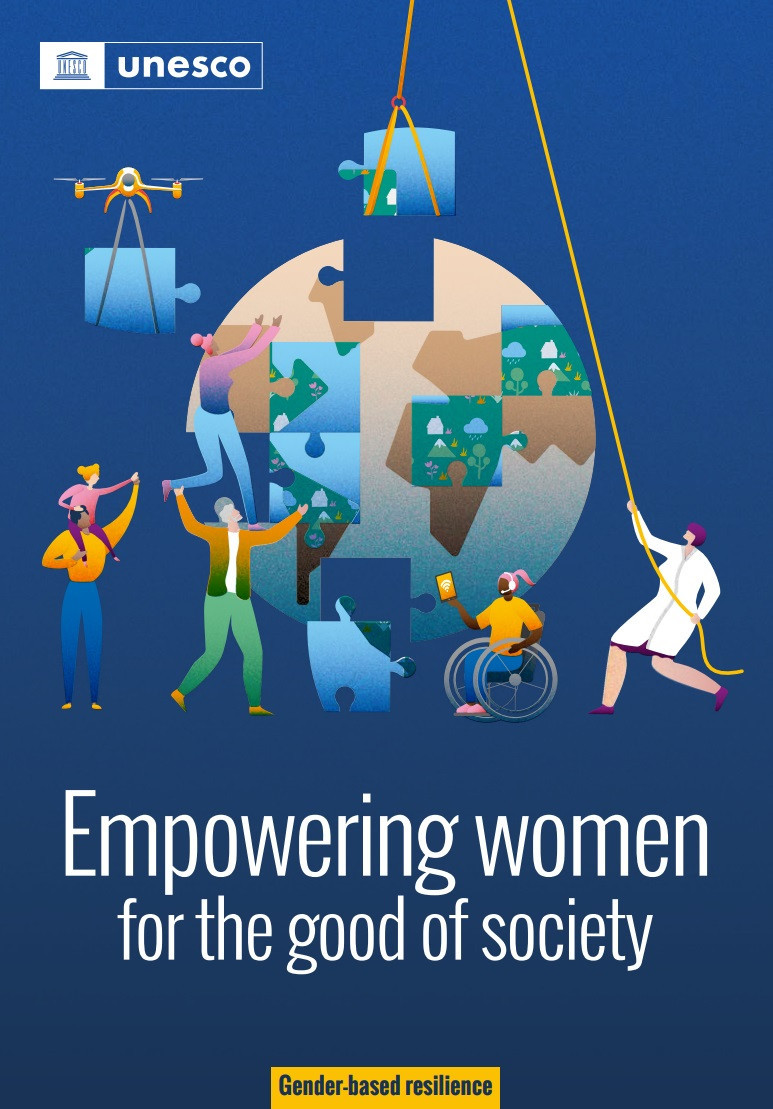 Empowering women for the good of society: gender-based resilience Year of publication: 2023 Author: Squicciarini, Mariagrazia | Sarlat, Garance | Manca, Anna Rita Corporate author: UNESCO <Short Summary> Let’s change the resilience paradigmWhat are the root causes and drivers of resilience? Societal resilience is shaped by the unique roles that individuals play and their ability to respond to shocks, gender-based expectations and discriminations hinder women’s and girls’ ability to participate in, and contribute to, society. In times of crises, their vulnerability intensifies resulting in a weakened response that ripples throughout society.In response, UNESCO designed the first Gender-Based Resilience Framework. As a compass for inclusive policymaking, this report analyzes how differences in opportunities, needs and constraints impact resilience and proposes a measurement Framework based on: (1) fundamental human rights; (2) socioeconomic characteristics, such as health, education, work, political engagement, and climate justice; (3) contextual factors, such as values and perceptions.Moving beyond the standard approach of coping with and recovering from shocks; UNESCO calls for a gender-transformative resilience, which leverages the interrelations between individuals and institutions. Decision- and policy-makers, researchers, and gender equality advocates are invited to use and add to this Framework to effectively navigate through current and future crises.It is only by empowering all women and girls, and people of all genders, that we will be able to face the challenges ahead.
 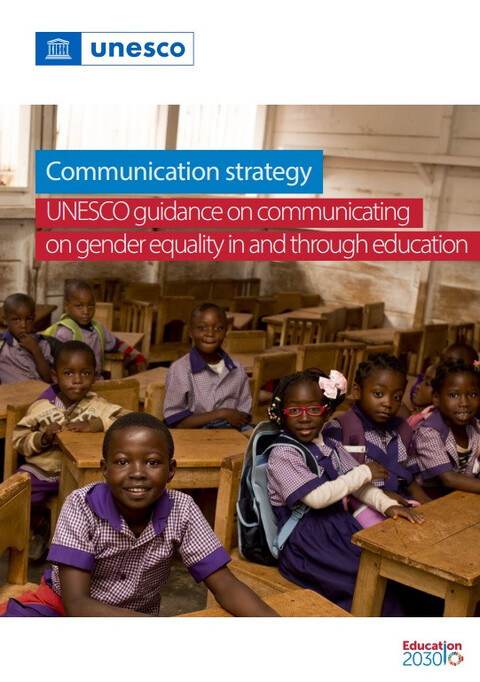 Communication Strategy: UNESCO Guidance on Communicating on Gender Equality in and through Education Year of publication: 2022 Corporate author: UNESCO About 259 million children and youth are out of school according to the UNESCO Institute for Statistics, including 127 million girls and 132 million boys. Twothirds of the 750 million non-literate adults around the world are women. This gender disparity remains one of the persistent challenges in adult literacy and education. The COVID-19 pandemic has exacerbated existing challenges, disrupting the education of over 1.5 billion learners. UNESCO estimates that close to 24 million children and youth, including over 11 million girls and 13 million boys, may drop out of school due to the pandemic’s economic impact. A window of opportunity is now more than ever open to build back equal. This communication strategy is designed to provide strategic guidance on communicating on gender equality in and through education. While prepared for UNESCO Education Sector staff, including those at Headquarters, in Field/Regional/Cluster Offices and in Institutes as well as for implementing partners, a broader audience of gender focal points, partners, Member States and others with an interest in and commitment to gender equality in and through education may also find this strategy particularly useful.
 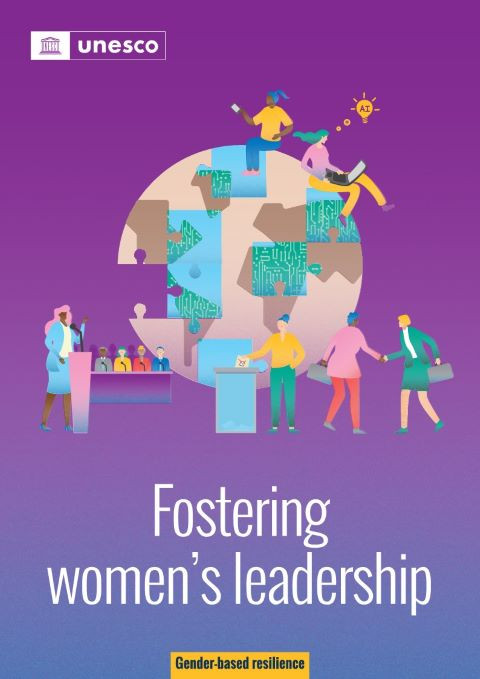 Fostering Women's Leadership Year of publication: 2024 Author: Mariagrazia Squicciarini | Anna Rita Manca | Garance Sarlat Corporate author: UNESCO No (leadership) share no gain (for societies and economies)! Leveraging UNESCO’s unique Gender-Based Resilience Framework, this report explores the role of women in leadership positions in both decision-making and high-tech, including in artificial intelligence-related innovations. It further highlights progress towards the G20 Brisbane Target, aimed to accelerate progress on gender equality by reducing the gender gap in labour market participation rates by 25% by 2025. Women remain underrepresented in decision-making, holding only about 26% of seats in national parliaments worldwide on average. In the world of work, female labour participation continues to lag behind men’s, at 47% for women against 72% for men on average. Despite progress by G20 members towards the Brisbane Target, a 2% average gap in absolute terms remained to be filled in 2022. In the high-tech world, women make up only 30% of AI professionals, and even less of leaders. Female inventors in AI account for about 37% of patents filed in 2022-23.
 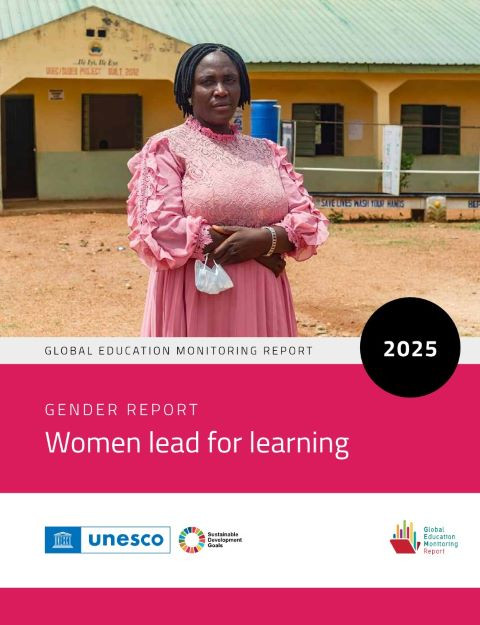 Global Education Monitoring Report 2025: Gender Report: Women Lead for Learning Year of publication: 2025 Corporate author: UNESCO Barriers to gender equality in education leadership positions can and need to be overcome This gender edition, which is part of the 2024/5 Global Education Monitoring Report on leadership in education, addresses the remaining obstacles for women in their efforts to climb up the leadership ladder in education. Although the teaching profession has been feminized, there are considerable gender gaps in school management, education administration and political leadership positions, a situation illuminated in detail with examples from all over the world. Gender disparity in education leadership is the result of entrenched stereotypes and biases – conscious or unconscious – on the one hand and on the other institutional processes or professional development mechanisms that are insufficiently supportive. Research suggests that women leaders display some differences relative to men in their approaches to education leadership, for example the extent to which they emphasize collaboration, build relationships with the community and retain a focus on learning. While there is little to suggest that these differences are universal or immutable, the evidence points to the fact that the lack of equitable opportunities translates to less talent and fewer diverse approaches to leadership, which are a loss to education systems – not to mention the obvious need for equity. This is particularly evident in parts of the world where gender disparities remain large. This gender edition calls on countries to take a much closer look at gender disparity in education leadership and adopt measures to raise awareness, improve mechanisms and strengthen capacities to address discrimination and bias and thus encourage women who aspire to such careers to pursue them. Gender disparity in education leadership is the result of entrenched stereotypes and biases – conscious or unconscious – on the one hand and on the other institutional processes or professional development mechanisms that are insufficiently supportive. Research suggests that women leaders display some differences relative to men in their approaches to education leadership, for example the extent to which they emphasize collaboration, build relationships with the community and retain a focus on learning. While there is little to suggest that these differences are universal or immutable, the evidence points to the fact that the lack of equitable opportunities translates to less talent and fewer diverse approaches to leadership, which are a loss to education systems – not to mention the obvious need for equity. This is particularly evident in parts of the world where gender disparities remain large. This gender edition calls on countries to take a much closer look at gender disparity in education leadership and adopt measures to raise awareness, improve mechanisms and strengthen capacities to address discrimination and bias and thus encourage women who aspire to such careers to pursue them.