
Resources
Explore a wide range of valuable resources on GCED to deepen your understanding and enhance your research, advocacy, teaching, and learning.
104 Results found
 G7 Global Objectives On Girls’ Education: Baseline Report Year of publication: 2022 Corporate author: United Nations Girls' Education Initiative (UNGEI) This publication serves as a baseline report to accompany efforts of the G7 Accountability Working Group to monitor progress towards the two global objectives. It presents evidence on low- and lower-middle-income countries’ progress in achieving the two global objectives and what remains to be done.It is important to stress that the two G7 global objectives on girls’ education are measures of gender parity, which are necessary but not sufficient as measures of gender equality. Assessing progress towards the latter requires information, which tends not to be available systematically enough to allow a comparative perspective. However, this report provides insights to remaining challenges.
  Globalising the school curriculum: gender, EFA and global citizenship education (RECOUP working paper 17) Year of publication: 2008 Author: Harriet Marshall | Madeleine Arnot Corporate author: Research Consortium on Educational Outcomes and Poverty (RECOUP) This paper aims to bring the school curriculum into the analysis of gender, education and development. There is a marked absence of discussion both in the academic field of development studies and in the political domain of educational policy making around Education for All about what is required of the school curriculum so that it could help promote gender equality. All too often national school curricula reproduce gender inequalities in the public and private sphere and sustain hegemonic male regimes on a national and global scale (Arnot, 2002). Curriculum research, however, can challenge these social messages embedded in curricular formations as well as raise deeper questions about whose forms of knowledge should be transmitted through official forms of schooling. Critical sociological research, for example, recognises the importance of the rules governing the access and redistribution of knowledge, and also the politics behind the selection, organisation and evaluation of legitimate knowledge through formal national educational institutions within developing economies and the impact these have on indigenous social stratifications. It can also critically assess new global interventions into the school curriculum whether in the name of economic progress, human rights or social justice. These global developments are controversial not least because of the challenge they represent to what has been considered the prerogative of national governments – to transmit its own selection of educational knowledge to its citizens, using its own contextualised pedagogic style. The study of national curricula therefore offers the possibility of exploring the equity dimensions of global–national and local educational interfaces and policy agendas. The paper has limited but hopefully valuable ambitions. It aims to initiate discussion of the curriculum in relation to gender, education and development by exploring the global significance of recent interventions on gender, and in particular girls’ education. The first section briefly considers the implications of globalisation as a transformative process on the development of educational knowledge and queries whether the school curricula could address persistent worldwide gender disparities, inequalities and female subjugation. In the second section, we focus specifically on whether new global declarations around gender equality such as those analysed in the UNESCO Education for All Global Monitoring Reports imply certain roles for the school curriculum. The final section addresses the possibilities for gender equality implied by recent interest global citizenship education – a new curriculum subject and approach that promises much. We consider in a preliminary way whether these new developments represent a move towards forms of educational knowledge that are critical rather than legitimating and ‘normalising’ in relation to gender inequalities.
 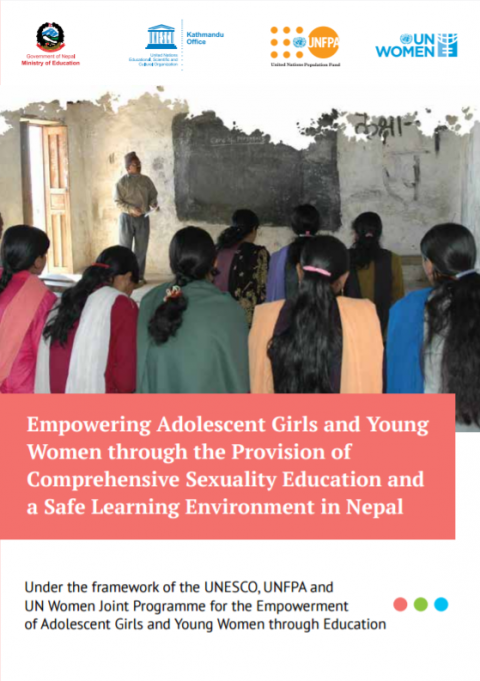 Empowering Adolescent Girls and Young Women through the Provision of Comprehensive Sexuality Education and a Safe Learning Environment in Nepal Year of publication: 2016 Corporate author: UNESCO Kathmandu | United Nations Entity for Gender Equality and the Empowerment of Women (UN Women) | United Nations Population Fund (UNFPA) There are many challenges for adolescent girls and young women in Nepal in terms of access, participation, and completion of good quality education. Child marriage and early pregnancy, gender-based violence, lack of knowledge or provision of proper hygiene facilities such as WASH (water, sanitation and hygiene) are factors preventing adolescent girls and young women from accessing education. This publication is a project plan for empowering adolescent girls and young women in Nepal.
  Addressed by Irina Bokova, Director-General of UNESCO on the Occasion of Launch of the Joint Programme in Nepal Empowering Adolescent Girls and Young Women through Education; Kathmandu, 18 April 2016 Year of publication: 2016 Corporate author: UNESCO. Director-General, 2009-2017 (Bokova, I.G.)
 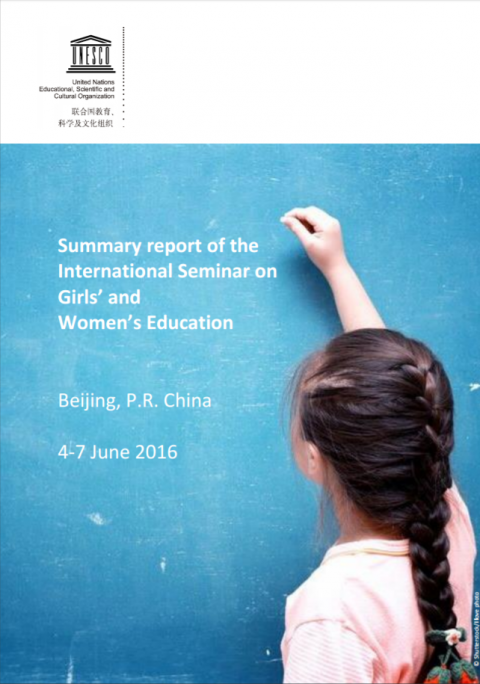 Summary Report of the International Seminar on Girls' and Women's Education, Beijing, P.R. China, 4-7 June 2016 Year of publication: 2016 Corporate author: National Commission of the People's Republic of China for UNESCO | UNESCO Beijing The International Seminar on Girls’ and Women’s Education, held 4-6 June 2016 in Beijing, explored benefits of education on girls and women along with barriers to the achievement of gender equality in education. It provided a platform for dialogue on the role of education for girls and women, particularly in the context of the 2030 Agenda for Sustainable Development, and specifically in reaching SDG 4 and supporting the achievement of other SDGs. The event also marked the first award ceremony of the UNESCO Prize for Girls’ and Women’s Education, which honoured two laureates for their outstanding innovation and contributions to advancing girls’ and women’s education. This publication presents a synthesis of information that was shared during the seminar’s sessions, and the findings and recommendations originating from the exchanges.
  Quality Physical Education (QPE): guidelines for policy makers Year of publication: 2015 Author: Nancy, McLennan | Jannine, Thompson Corporate author: UNESCO A key feature of the Post-2015 Development Agenda is sustainable development. Sustainable development starts with safe, healthy, well-educated children. Participation in quality physical education (QPE), as part of a rounded syllabus, enhances young peoples’ civic engagement, decreases violence and negative patterns of behaviour, and improves health awareness. The UNESCO QPE Policy Package is an original piece of work, which draws upon results from extensive global research (including the Worldwide Survey of School Physical Education). These guidelines, designed for global application and local adaptation, provide a means of analysing current policy through practical guidance and a ‘how-to’ approach. The materials have been developed in consultation with key partners including the European Commission, the International Council for Sport Science and Physical Education (ICSSPE), UNDP, UNICEF, UNOSDP and WHO.
  Cracking The Code: Girls’ and Women’s Education in Science, Technology, Engineering and Mathematics (STEM) Year of publication: 2017 Corporate author: UNESCO Despite significant improvements in recent decades, education is not universally available and gender inequalities persist. A major concern in many countriesis not only limited numbers of girls going to school, but also limited educational pathways for those that step into the classroom. This includes, more specifically,how to address the lower participation and learning achievement of girls in science, technology, engineering and mathematics (STEM) education. STEM underpins the 2030 Agenda for Sustainable Development, and STEM education can provide learners with the knowledge, skills, attitudes and behavioursrequired for inclusive and sustainable societies. Leaving out girls and women in STEM education and careers is a loss for all. This report aims to ‘crack the code’, or to decipher the factors that hinder or facilitate girls’ and women’s participation, achievement and continuation in STEMeducation, and what can be done by the education sector to promote girls’ and women’s interest in, and engagement with, STEM.
 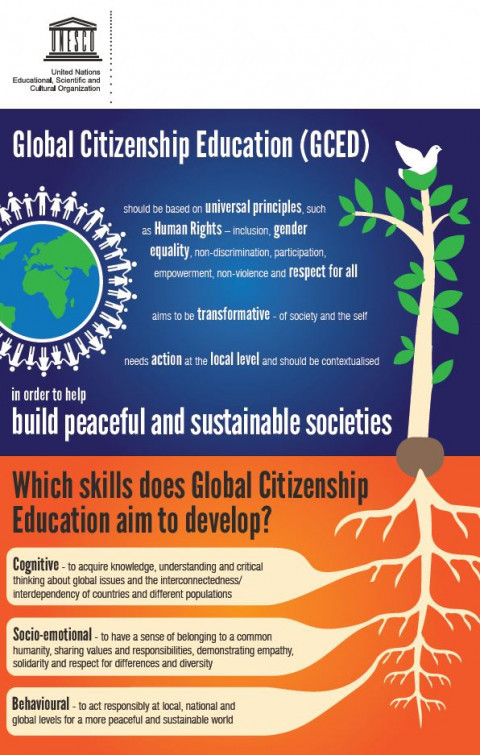 Global Citizenship Education (GCED) infographic Year of publication: 2015 Corporate author: UNESCO Which skills does Global Citizenship Education aim to develop? How can effectively implement Global Citizenship Education? Who are the key players?
  UNESCO and Gender Equality in Sub-Saharan Africa: Innovative Programmes, Visible Results Corporate author: UNESCO For over twenty years, UNESCO’s work in Africa has been undertaken in a specific framework with a range of institutional mechanisms designed to help translate into action its priorities: Africa and gender equality. During this period, UNESCO achieved important results in the areas covered by its mandate to promote gender equality.This publication highlights UNESCO’s contribution to the implementation of the African Union’s Agenda 2063 and the 2030 Agenda for Sustainable Development of the United Nations, in the field of gender equality in Africa, through examples of good practice, lessons learnt as well as suggestions and recommendations for the future.
 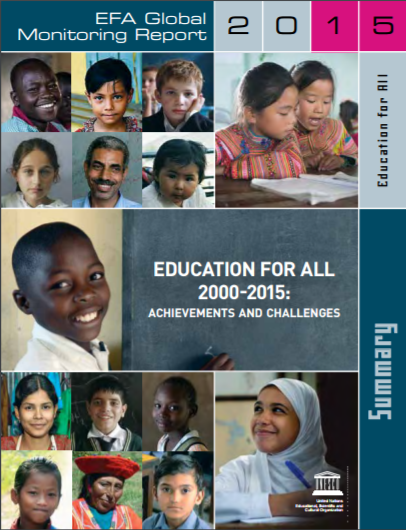 Education for All 2000-2015: Achievements and Challenges; EFA Global Monitoring Report, 2015; Summary Year of publication: 2015 Corporate author: UNESCO At the World Education Forum in Dakar, Senegal, in 2000, governments from 164 countries, together with representatives of regional groups, international organizations, donor agencies, non-government organizations (NGOs) and civil society, adopted a Framework for Action to deliver Education for All (EFA) commitments. The Dakar Framework comprised 6 goals and their associated targets to be achieved by 2015, and 12 strategies to which all stakeholders would contribute. The EFA Global Monitoring Report (GMR) has monitored progress on an almost annual basis towards the EFA goals and the two education-related Millennium Development Goals (MDGs). The 2015 GMR provides a complete assessment of progress since 2000 towards the target date for reaching the Dakar Framework’s goals. It takes stock of whether the world achieved the EFA goals and stakeholders upheld their commitments. It explains possible determinants of the pace of progress. Finally, it identifies key lessons for shaping the post-2015 global education agenda.