
Resources
Explore a wide range of valuable resources on GCED to deepen your understanding and enhance your research, advocacy, teaching, and learning.
123 Results found
 Arab Teachers and Holocaust Education: Arab Teachers Study Holocaust Education in Israel This paper examined whether change occurred in the attitudes of Arab teachers in Israel toward Holocaust education following an in-service study course. Survey and interview data indicated that after the course, teachers had a better understanding of what occurred during the Holocaust, and their willingness to know about its effects on Jewish people increased. However, the Israeli-Palestinian conflict impacted participants' views. (By the author)
  Does the Singularity of the Holocaust make it Incomparable and Inoperative for Commemorating, Studying and Preventing Genocide? Britain’s Holocaust Memorial Day as a Case Study This article is a response to the controversy surrounding the first national Holocaust Memorial Day in Britain, held on 27 January 2001. The discussion is centred on the British experience, but it is intended to have a wider resonance and relevance. It begins by summarizing the aims of Holocaust Memorial Day and then looks at some of the significant interventions in the nationwide debate about it. Much of the discussion was informed by the work of the American historian Peter Novick, so the article examines his influential argument about Holocaust commemoration and education. It concludes with an attempt to answer the question set out in the title, showing briefly that researching and teaching about the Holocaust as well as the work of remembrance and memorialization are crucial to commemorating, studying and preventing genocide. (By the author) Teaching and Learning about the Holocaust through Visiting an Exhibition This article evaluates a teaching initiative that aimed to teach about the Holocaust through a traveling exhibit on Anne Frank. Data from 10 case study schools show the success of the approach and some ways in which the teaching relevance might have been strengthened. (By the author) History at the gates: How teacher and school characteristics relate to implementation of a state mandate on Holocaust education This quantitative study examines implementation by one Florida school district's fifth grade teachers of a state mandate to teach about the Holocaust. Teachers' responses to survey questions were analyzed to determine the relationships between choosing to teach about the Holocaust and factors like exposure to Holocaust content and teacher/school demographics. In addition, this study explores descriptive data about the nature of resources, materials, and teaching methods used to teach about the Holocaust in elementary classrooms. The findings of this study demonstrate the background knowledge and resources that teachers need to increase their implementation of Holocaust education in the classroom. Suggestions for the development of more effective workshops, information dissemination strategies, and teacher resources for Holocaust education and other mandated areas are also included in this study. To provide the necessary background for the exploration of the implementation of Florida's Holocaust education mandate, this study examines: the importance of Holocaust education; effective instructional practices in Holocaust education; connections between Holocaust education and multicultural goals; and the history of the passage of legislation related to Holocaust education. As the title suggests, teachers are the final "gatekeepers" of the curriculum: their decisions determine the extent to which topics will be taught. For this reason, this study examines the connections between teachers, their experiences, and their decisions to teach about crucial, mandated subjects like the Holocaust. (By the author) Enseigner l'histoire et la prévention des génocides - Peut on prévenir les crimes contre l'humanité ? The question of barbarism dominates remembrance issues. The study of the prevention of crimes against humanity constitutes another major challenge. But these sensitive and complex debates are problematic. All fields are concerned : history, memory, law, philosophy, politics. How can schools tackle them ? Two solutions : opting for a comparative study of genocides, particularly the Holocaust and the Tutsis in Rwanda; and using the "universal/particular" dialectic, institutions and individuals. Recollections of the past and edification of the future, this book gives meaning to education and presents a sensitive reflection of the challenges of history and the contemporary world. (By the author - Translation) Enseigner l'histoire et la prévention des génocides - Peut on prévenir les crimes contre l'humanité ? La question de la barbarie domine les questions commémoratives. L'étude de la prévention des crimes contre l'humanité constitue un autre défi majeur. Mais ces débats délicats et complexes sont problématiques. Tous les champs sont concernés: l'histoire, la mémoire, le droit, la philosophie, la politique. Comment les écoles peuvent les aborder? Deux solutions: opter pour une étude comparative des génocides, en particulier l'Holocauste et les Tutsis au Rwanda; et en utilisant les « particuliers/universels» dialectiques, les institutions et les individus. Recollections du passé et de l'édification de l'avenir, ce livre donne un sens à l'éducation et présente une réflexion sensible des défis de l'histoire et le monde contemporain. (Par l'auteur - traduction)
 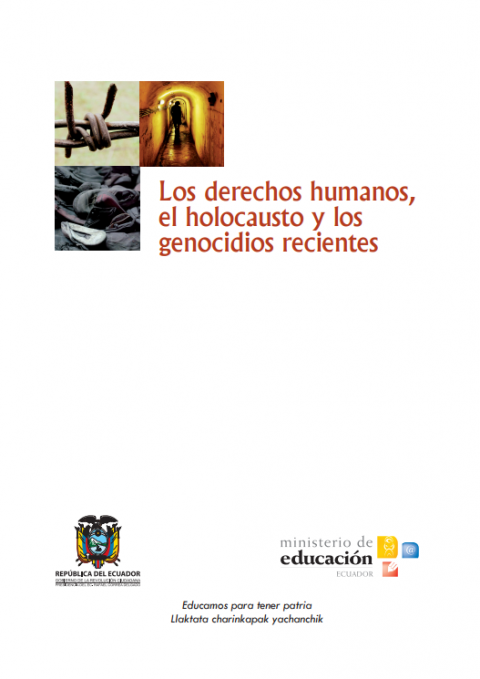 Los derechos humanos, el holocausto y los genocidos recientes Year of publication: 2008 Corporate author: Ecuador. Ministerio de Educacion This resource guide designed for high school students in Ecuador broaches Holocaust history through broader thematics such as Human Rights, mass violence and a comparative analysis with other genocides. It is an valuable document for understanding worldwide issues.
  Enseigner la Shoah au college et au lycee - De la parole antisemite a la destruction des juifs d'Europe - Livret du Professeur Year of publication: 2009 Author: Joel Kotek, Iannis Roder This teacher booklet published by the Mémorial de la Shoah contains well-constructed lessons to use entirely or partially, based on photographs and literature extracts. This guideline offers pedagogical and scientific reflections on the Holocaust’s historical treatment.
 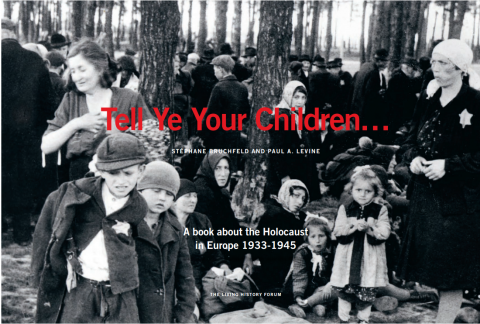 Tell Ye Your Children - A book about the Holocaust in Europe 1933-1945 Year of publication: 2012 Author: Stephane Bruchfeld, Paul. A. Levine This book is published by the Living History Forum. This Swedish public authority uses the teaching of the Holocaust and other crimes against humanity to promote tolerance, democracy and human rights. This booklet covers the rise of National Socialism until the end of the war, providing facts and information to encourage discussions. Dites-le à vos enfants - Un livre sur l'Holocauste en Europe 1933-1945 Year of publication: 2012 Author: Stephane Bruchfeld, Paul. A. Levine Ce livre est publié par le Forum d'histoire vivante. Cette autorité publique suédoise utilise l'enseignement de l'Holocauste et d'autres crimes contre l'humanité pour promouvoir la tolérance, la démocratie et les droits de l'homme. Ce livret couvre la montée du national-socialisme jusqu'à la fin de la guerre, fournissant des faits et de l'information pour encourager les discussions.