
Resources
Explore a wide range of valuable resources on GCED to deepen your understanding and enhance your research, advocacy, teaching, and learning.
123 Results found
 Learning the lessons of the Holocaust? A critical consideration of the antiracist and citizenship potential of Holocaust education in English secondary schools Year of publication: 2010 Author: Alice Pettigrew In this paper I draw upon data collected as part of a national study of current practice in Holocaust education within English secondary schools. The paper emphasises the importance placed by teachers from a variety of subject backgrounds upon study of the Holocaust as an opportunity to explore citizenship related and antiracist concerns. However, the paper also identifies and discusses a number of potential challenges and possible limitations apparent in this approach. (By the author) Tirer les leçons de l'Holocauste? Un examen critique du racisme et de la citoyenneté potentiel anti enseignement de l'Holocauste dans les écoles secondaires anglaises Year of publication: 2010 Author: Alice Pettigrew Dans cet article, je dessine sur les données recueillies dans le cadre d'une étude nationale de la pratique actuelle dans l'enseignement de l'Holocauste dans les écoles secondaires anglaises. Le document met l'aCECnt sur l'importance accordée par les enseignants à partir d'une variété de sujets d'horizons sur l'étude de l'Holocauste comme une occasion d'explorer la citoyenneté préoccupations connexes et antiracistes. Toutefois, le document identifie et examine un certain nombre de défis potentiels et les limites possibles apparentes dans cette approche également. (Par l'auteur)
 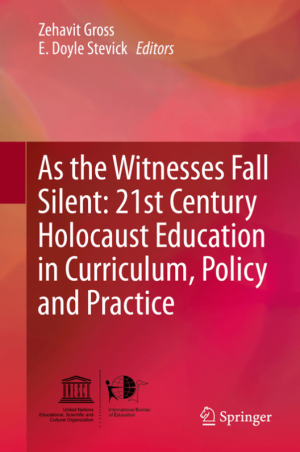 As the witnesses fall silent : 21st century Holocaust education in curriculum, policy and practice Year of publication: 2015 Corporate author: UNESCO International Bureau of Education (IBE) This UNESCO/IBE publication represents the most comprehensive collection ever produced of empirical research on Holocaust education around the world. It comes at a critical time, as the world observes the 70th anniversary of the liberation of Auschwitz. The policies and practices of Holocaust education around the world are as diverse as the countries that grapple with its history and its meaning. Educators around the globe struggle to reconcile national histories and memories with the international realities of the Holocaust and its implications for the present. These efforts take place at a time when scholarship about the Holocaust itself has made great strides. In this book, these issues are framed by some of the leading voices in the field, including Elie Wiesel and Yehuda Bauer, and then explored by many distinguished scholars who represent a wide range of expertise. (By the publisher) Comme les témoins se taire: 21e siècle Holocauste éducation dans les programmes, les politiques et la pratique Year of publication: 2015 Corporate author: UNESCO International Bureau of Education (IBE) Cette publication de l'UNESCO/BIE représente la collection la plus complète jamais produit de la recherche empirique sur l'Holocauste dans le monde entier. Il arrive à un moment critique, alors que le monde observe le 70e anniversaire de la libération d'Auschwitz. Les politiques et les pratiques de l'Holocauste dans le monde sont aussi diverses que les pays qui se débattent avec son histoire et sa signification. Les éducateurs autour de la lutte globe pour réconcilier des histoires et des mémoires nationales avec les réalités internationales de l'Holocauste et de ses implications pour le présent. Ces efforts ont lieu à un moment où la bourse de l'Holocauste lui-même a fait de grands progrès. Dans ce livre, ces questions sont encadrées par quelques-unes des principales voix dans le domaine, y compris Elie Wiesel et Yehuda Bauer, puis exploré par de nombreux spécialistes éminents qui représentent un large éventail d'expertise. (Par l'éditeur)
  Learning from genocide: a study in the failure of Holocaust education The importance of learning lessons from the Holocaust and from the mass slaughter in Rwanda was recognised in the theme underpinning Britain’s Holocaust Memorial Day in 2004. This article is principally concerned with the lessons learnt from the Holocaust by a culturally diverse group of students aged 14 to 16. They all attended schools in an outer London borough and were interviewed after taking part in a local event held to mark the 2004 commemoration. The article concludes with a discussion of the main findings of the investigation. (By the author) Historical Understanding - Beyond the Past and into the Present In this chapter Boix-Mansilla looks at the possibilities for using history to understand present-day issues. Partially funded through the Facing History and Ourselves organization, this study looked at whether learning about the Holocaust provided a more contextualized understanding of the 1994 genocide in Rwanda. This research found that students often used an ineffectual I-know-this-history-so-I-know-that-experience reasoning when making links between the two genocides, even though historical comparisons rely on both similarities and differences in analysis. Boix-Mansilla emphasizes that directed instruction on the process of historical comparison can remedy the weak reasoning demonstrated in the study and cites the literature on the strengths of using history to speak about present events to support this. (By the author) Voltooid verleden tijd? Het verband tussen kennis over de nazi-genocide en democratische attitudes bij adolescenten in Brussel Schools are expected to educate children to become democratic citizens by providing “civics” or history courses. It is believed that the formal curriculum affects each pupil’s level of awareness, which in turn influences civic competencies and social attitudes. This supposition is explicitly stated in ‘holocaust-education’ programmes and in ‘civics’courses. Accordingly, knowing about the atrocities of the Nazis would stimulate tolerance, and thus counter prejudice. The current contribution tests this supposition using surveydata (2002) from 773 French-speaking and 469 Flemish-speaking last-grade pupils from secondary schools in the Brussels-Capital Region. The survey probed for knowledge on the Nazi genocide and attitude scales (ethnocentrism and anti-democracy). The supposition about the connection between knowledge and tolerance holds partially for the Flemish, but not for the French-speaking sample. Knowledge may be a necessary, but is certainly not a sufficient, condition to foster tolerance. (By the author)
  Holocaust Memorial Days : An overview of remembrance and education in the OSCE region Year of publication: 2015 Corporate author: OSCE. Office for Democratic Institutions and Human Rights (ODIHR) This publication provides an overview of governmental and non-governmental practices in the OSCE area to commemorate the Holocaust. It is intended to promote remembrance and education by publicizing and facilitating the exchange of good practices. The publication shows that most OSCE governments, as well as many local and municipal authorities, schools, civil society organizations, religious groups and others, are actively involved in Holocaust commemoration activities. While many of these activities take place throughout the year, there is a particular focus on promoting Holocaust remembrance, research and education during Holocaust Memorial Days. Across the world, 27 January, the International Day of Commemoration in Memory of the Victims of the Holocaust, is devoted to educating future generations about the Holocaust. This overview provides a snapshot of the types of Holocaust education activities that have been developed to mark Holocaust Memorial Days, while also identifying where and how the Holocaust is taught in schools throughout the region. (By the publisher) Never again ! Does Holocaust education have an effect on pupils' citizenship values and attitudes? Year of publication: 2006 Corporate author: Scottish Executive. Department of Social Research As the education for citizenship agenda continues to make an impact on schools, this research sets out to examine whether teaching the Holocaust, in the upper primary, either as part of a study on World War 2 or as a topic on its own, has an impact, both immediate and longer term, on pupils’ citizenship values and attitudes, and particularly those values and attitudes relating to various minority or disadvantaged groups in Scotland. (By the author) Authentic Pedagogy and the Holocaust: A Critical Review of State Sponsored Holocaust Curricula Year of publication: 2005 Author: Samuel Totten | Karen L. Riley Over the past decade and a half, states in all regions of the United States have formed Holocaust councils, advisory groups, and other agencies for the purpose of developing educational programs in response to a growing interest in the Holocaust. Some states have called upon educators and Holocaust agencies within the state to develop curricula and/or resource materials for use in social studies and English classrooms. Furthermore, many states now either strongly recommend the teaching of the Holocaust or mandate that it be taught in their public schools. In the present paper, we present a critical analysis of the instructional strategies advocated in state–sponsored Holocaust curricula. We ground our evaluation within the framework of authentic pedagogy—particularly the work of Fred Newmann. More than an attempt to simply criticize these works, we offer constructive alternatives to inadequate and/or poorly designed instructional strategies. Fundamental to the intent of this paper is its usefulness as a guide for evaluating instructional activities designed to support the teaching of content knowledge about the Holocaust. (By the author)