
Resources
Explore a wide range of valuable resources on GCED to deepen your understanding and enhance your research, advocacy, teaching, and learning.
72 Results found
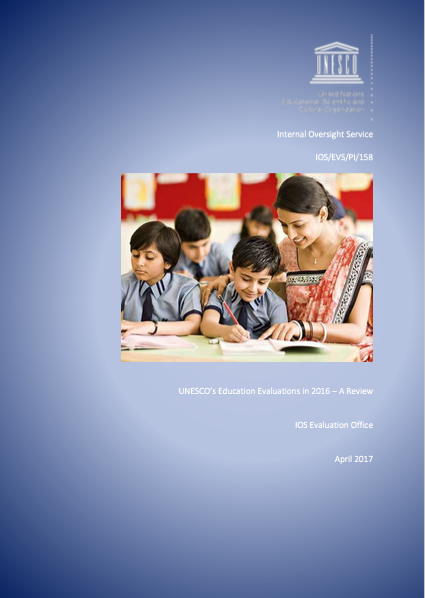 UNESCO's Education Evaluation in 2016: A Review Year of publication: 2017 Corporate author: UNESCO UNESCO completed 12 education related evaluations in 2016. Part A of this review presents the key insights and lessons learned from those evaluations. These learnings are designed to help enhance UNESCO’s leadership and coordination of the SDG 4 – Education 2030 Agenda. Part B of the review provides an assessment of the quality and usefulness of these evaluations based on the UNEG and OECD quality standards for evaluation reports.
  UNESCO and Education Year of publication: 2017 Corporate author: UNESCO Education is a fundamental human right and
a public good and, as such, has been at the core of UNESCO’s work since its inception.Education is also the path to sustainability – to poverty alleviation, better health, environmental protection and gender equality.As the only United Nations agency with a mandate to cover all aspects of education, UNESCO was entrusted in 2015 to lead the coordination and monitoring of Sustainable Development Goal 4, as part of the new Global Education 2030 Agenda.Goal 4 aims to “ensure inclusive and equitable quality education and promote lifelong learning opportunities for all,” and renewed UNESCO’s and Member States’ commitment to a vision of education that is holistic, inspirational and which leaves no one behind.This commitment is reflected in the size and scope of the Education Sector, the largest in UNESCO, with staff working at its Paris Headquarters and spread across a global network of field offices and specialized institutes and centres. With its close links with education ministries and other partners, UNESCO is strongly placed to press for action and change.UNESCO’s Education Sector supports Member States in developing education systems that foster high-quality and inclusive lifelong learning for all, empowering learners to be creative and responsible global citizens while leading the debate to help shape the future international education agenda.There is no stronger, no more lasting, investment a country can make than educating its citizens. The Education Sector exists to further this collective vision worldwide by transforming lives one by one.
UNESCO and Education Year of publication: 2017 Corporate author: UNESCO Education is a fundamental human right and
a public good and, as such, has been at the core of UNESCO’s work since its inception.Education is also the path to sustainability – to poverty alleviation, better health, environmental protection and gender equality.As the only United Nations agency with a mandate to cover all aspects of education, UNESCO was entrusted in 2015 to lead the coordination and monitoring of Sustainable Development Goal 4, as part of the new Global Education 2030 Agenda.Goal 4 aims to “ensure inclusive and equitable quality education and promote lifelong learning opportunities for all,” and renewed UNESCO’s and Member States’ commitment to a vision of education that is holistic, inspirational and which leaves no one behind.This commitment is reflected in the size and scope of the Education Sector, the largest in UNESCO, with staff working at its Paris Headquarters and spread across a global network of field offices and specialized institutes and centres. With its close links with education ministries and other partners, UNESCO is strongly placed to press for action and change.UNESCO’s Education Sector supports Member States in developing education systems that foster high-quality and inclusive lifelong learning for all, empowering learners to be creative and responsible global citizens while leading the debate to help shape the future international education agenda.There is no stronger, no more lasting, investment a country can make than educating its citizens. The Education Sector exists to further this collective vision worldwide by transforming lives one by one. 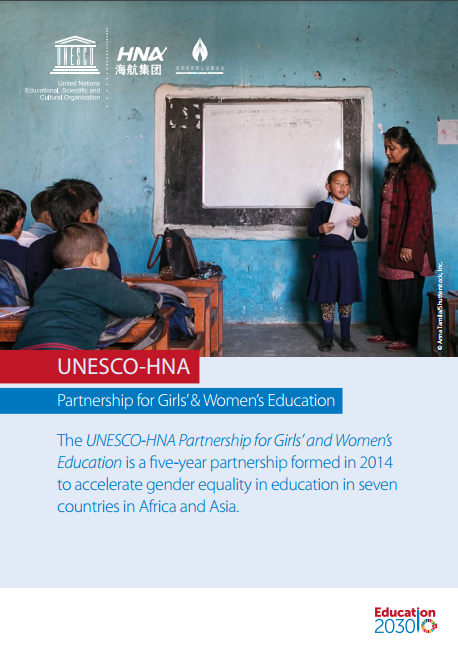 UNESCO-HNA Partnership for Girls' & Women's Education Year of publication: 2017 Corporate author: UNESCO The UNESCO-HNA Partnership for Girls’ and Women’s Education is one component of the “Better Life, Better Future” Global Partnership for Girls’ and Women’s Education launched by UNESCO in 2011. The Global Partnership recognizes that educating girls and women can break the cycle of poverty, foster greater social justice and contribute to the achievement of the Sustainable Development Goals. It aims to expand and improve the quality and relevance of education for girls and women, creating a better life and better future for all members of society for generations to come.
  Global guidance on addressing school related gender based violence Year of publication: 2016 Corporate author: UNESCO | United Nations Entity for Gender Equality and the Empowerment of Women (UN Women) More than 246 million children are subjected to gender-based violence in or around schools every year. This is a violation of their human rights, and a form of gender-discrimination that has far-reaching physical, psychological and educational consequences. Ending schoolrelated gender-based violence (SRGBV) is a priority for countries wishing to achieve ambitious global goals on inclusive and quality education for all and gender equality.WHAT IS THE AIM OF THIS GUIDANCE? This guidance aims to provide a comprehensive, one-stop resource on school-related gender-based violence (SRGBV), including clear, knowledge-based operational guidance, diverse case studies drawn from examples of promising practice and recommended tools for the education sector and its partners working to eliminate gender-based violence. It distils programme knowledge based on existing global literature, promising practices, expert recommendations and practitioner consensus.WHO IS THIS GUIDANCE FOR? The primary audience for this global guidance is the national education sector, including government policy-makers, education ministries, school administrators, educators and other school staff. The guidance may also have wider interest for other national and international stakeholders that are interested in addressing SRGBV, including NGOs, bilateral and multilateral agencies, teachers’ trade unions and policy-makers in other domestic sectors. The guidance is intended primarily for use in low- and middle-income settings, but is based on norms and principles that are universally applicable.WHAT IS COVERED IN THIS GUIDANCE? Promising practice case studies and recommended tools are embedded throughout the relevant sub-sections of the guidance. These provide readers with illustrative examples of implementation in real-life contexts and can serve as resources that have been successfully used – and can be adapted – for application in different contexts.This guidance complements other existing tools and materials for specific bilateral, multilateral and NGO audiences on violence against women and girls, and violence in schools. An expanded online version, which will be regularly updated, is available at www.endvawnow.org
 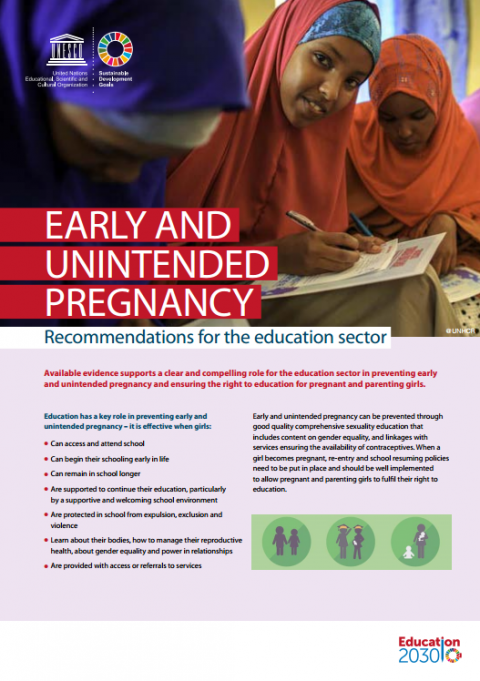 Early and unintended pregnancy: recommendations for the education sector Year of publication: 2017 Corporate author: Organisation des Nations Unies pour l'éducation, la science et la culture (UNESCO) Early and unintended pregnancy (EUP) is a major concern in many countries. It has a major impact on the lives of adolescents – especially girls – in terms of their health, social, economic and education outcomes. This brief contains the summary of recommendations from an evidence review to support the education sector to prevent and respond to EUP.
 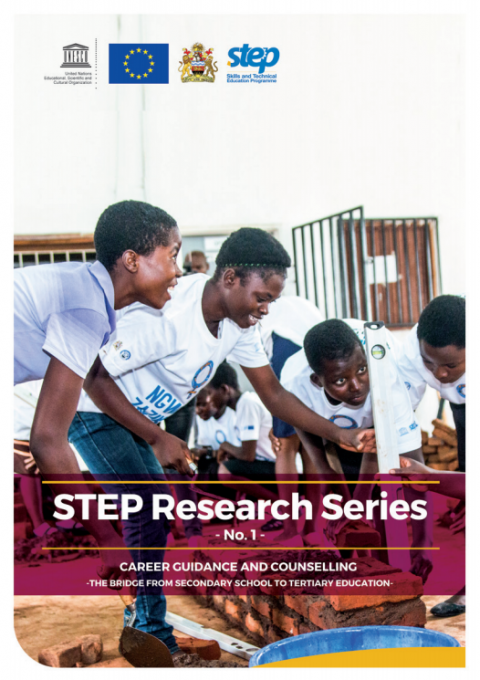 Career guidance and counselling: the bridge from secondary school to tertiary education; a review of current guidance and counselling programmes and practices in Malawi and their support in promoting technical and vocational training for girls Year of publication: 2017 Corporate author: UNESCO The objective of this report is to identify and review existing career G&C programmes and practices in secondary schools in Malawi. The review assesses to what extent such programmes and practices create an awareness of the importance of technical careers and how graduates from the secondary schools can access TEVET. Additionally, it assesses whether any affirmative action measures or approaches are used to increase girls’ interest in and applications to enter technical colleges.
  School-related gender-based violence: global guidance (Infographic) Year of publication: 2016 Corporate author: UNESCO | United Nations Entity for Gender Equality and the Empowerment of Women (UN Women) School-related gender-based violence: global guidance (Infographic)
 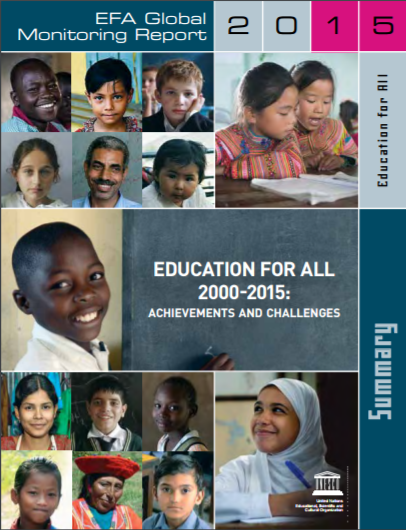 Education for All 2000-2015: Achievements and Challenges; EFA Global Monitoring Report, 2015; Summary Year of publication: 2015 Corporate author: UNESCO At the World Education Forum in Dakar, Senegal, in 2000, governments from 164 countries, together with representatives of regional groups, international organizations, donor agencies, non-government organizations (NGOs) and civil society, adopted a Framework for Action to deliver Education for All (EFA) commitments. The Dakar Framework comprised 6 goals and their associated targets to be achieved by 2015, and 12 strategies to which all stakeholders would contribute. The EFA Global Monitoring Report (GMR) has monitored progress on an almost annual basis towards the EFA goals and the two education-related Millennium Development Goals (MDGs). The 2015 GMR provides a complete assessment of progress since 2000 towards the target date for reaching the Dakar Framework’s goals. It takes stock of whether the world achieved the EFA goals and stakeholders upheld their commitments. It explains possible determinants of the pace of progress. Finally, it identifies key lessons for shaping the post-2015 global education agenda.
 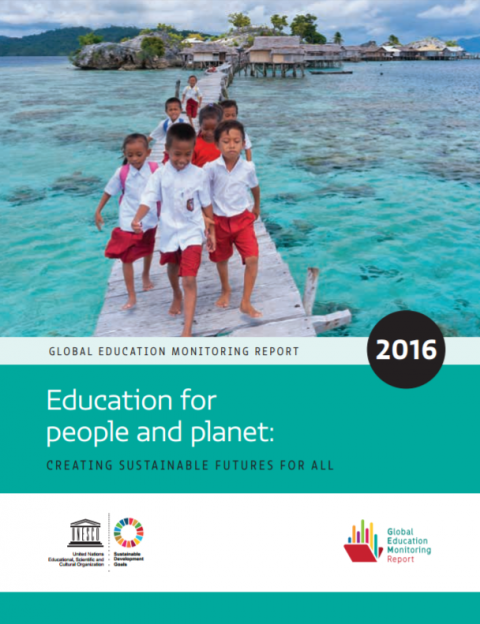 Education for People and Planet: Creating Sustainable Futures for All, Global Education Monitoring Report, 2016 Year of publication: 2016 Corporate author: UNESCO | Global Education Monitoring Report Team Education for People and Planet: Creating Sustainable Futures for All explores the complex relationship between education and the new 2030 Agenda for Sustainable Development, covering six fundamental pillars – Planet, Prosperity, People, Peace, Place and Partnerships. This report shows that education will not deliver its full potential unless participation rates increase dramatically and sustainable development guides education system reform. It also warns of the destructive impact that climate change, conflict, unsustainable consumption and the increasing gap between rich and poor have on education. A huge transformation is needed if we are to create sustainable futures for all.
  [Summary] Education for People and Planet: Creating sustainable Futures for All, Global Education Monitoring Report, 2016; Summary Year of publication: 2016 Corporate author: UNESCO Education for People and Planet: Creating Sustainable Futures for All explores the complex relationship between education and the new 2030 Agenda for Sustainable Development, covering six fundamental pillars – Planet, Prosperity, People, Peace, Place and Partnerships. This report shows that education will not deliver its full potential unless participation rates increase dramatically and sustainable development guides education system reform. It also warns of the destructive impact that climate change, conflict, unsustainable consumption and the increasing gap between rich and poor have on education. A huge transformation is needed if we are to create sustainable futures for all.