
Resources
Explore a wide range of valuable resources on GCED to deepen your understanding and enhance your research, advocacy, teaching, and learning.
114 Results found
 Exploring our roles as global citizens: an educator's guide (grades 3-5) Year of publication: 2013 Author: Elizabeth O. Crawford Corporate author: TeachUNICEF La définition se fonde sur le travail séminal dans les états et un large éventail d'organisations de travail pour faire avancer les connaissances mondiales et de la pensée critique. Un processus d'articulation minutieuse et vetting a abouti à la définition de la compétence globale proposée ici: la compétence globale est la capacité et la disposition pour comprendre et agir sur les questions d'importance mondiale. Globalement les personnes compétentes sont au courant, curieux et intéressés à en apprendre sur le monde et comment il fonctionne. Ils peuvent utiliser les grandes idées, des outils, des méthodes et des langues qui sont au cœur de toutes les disciplines (mathématiques, la littérature, l'histoire, la science et les arts) pour engager les questions pressantes de notre temps. Ils déploient et développer cette expertise comme ils enquêtent sur ces questions, reconnaissent de multiples points de vue, de communiquer leurs points de vue de manière efficace, et prendre des mesures pour améliorer les conditions. Eduquer pour Global Competence: Préparer les jeunes d'engager le monde est destiné aux enseignants, administrateurs, éducateurs informels, les décideurs, les leaders communautaires, les chercheurs, les parents, les étudiants et toutes les autres parties intéressées à préparer nos jeunes pour le 21e siècle. Devenir meilleur à l'éducation pour la compétence globale implique de repenser les pratiques et en reconnaissant qu'il n'y a pas de recettes simples pour le succès. En tant que tel, ce livre est destiné à être utilisé avec souplesse - parcourir, faire des liens, et de se concentrer sur les chapitres que vous trouverez les plus pertinents pour votre travail. Expérience avec des idées, des concepts de défi, et de partager avec des collègues. En fin de compte ce livre doit travailler pour vous. Il est destiné à être lu de la manière qui répond le mieux à vos besoins, inspire votre curiosité, et prouve fructueuse dans la salle de classe. Le premier chapitre offre un rationnel pour l'éducation mondiale dans notre pays et dans le monde. Le deuxième chapitre présente un cadre conceptuel pour la compétence globale et explique le rôle clé des fondations disciplinaires et interdisciplinaires dans l'apprentissage des élèves. Chapitre trois, quatre, cinq et six focus, respectivement, sur quatre capacités essentielles associées à la compétence mondiale: enquête dans le monde, reconnaissant les perspectives, communiquer des idées, et de prendre des mesures. Le chapitre sept considère les principes de base de l'enseignement pour l'enseignement de la compétence globale. Chapitre huit examine ce que les étudiants et les établissements d'enseignement peuvent faire pour promouvoir la compétence globale - et comment ils pourraient créer une culture de compétence globale pour les jeunes et les adultes. Enfin, le chapitre neuf places compétence globale dans le cadre plus large des systèmes d'éducation du public dans et au-delà des États-Unis.
  Global citizenship: a high school educator's guide (grades 9-12) Year of publication: 2013 Corporate author: TeachUNICEF Global Citizenship is a unit of four lessons designed to introduce the concept of global citizenship and place it in the context of international human rights; to engage students in a guided inquiry into the meaning of global citizenship and its relationship to national citizenship; to educate about how the United Nations has framed global rights and responsibilities for the 21st century and is acting on them via the Millennium Development Goals (MDGs); and to investigate how the U.S. Fund for UNICEF has engaged individuals in support of global citizenship as well as to engage students in designing and implementing a plan to act locally in support of global issues. La citoyenneté mondiale: Guide d'un éducateur de l'école secondaire (les niveaux 9-12) Year of publication: 2013 Corporate author: TeachUNICEF La citoyenneté mondiale est une unité de quatre leçons visant à introduire le concept de la citoyenneté mondiale et le placer dans le contexte des droits de l'homme internationaux; pour engager les élèves dans une enquête guidée dans le sens de la citoyenneté mondiale et de sa relation à la citoyenneté nationale; d'éduquer sur la façon dont l'Organisation des Nations Unies a formulé des droits et des responsabilités mondiales pour le 21e siècle et est d'agir sur eux par l'intermédiaire des Objectifs du Millénaire pour le développement (OMDs); et d'enquêter sur la façon dont le Fonds américain pour l'UNICEF a engagé des individus à l'appui de la citoyenneté mondiale, ainsi que d'engager les élèves dans la conception et la mise en œuvre d'un plan d'agir localement en faveur des enjeux mondiaux.
  Global citizenship: from public support to active participation Year of publication: 2012 Author: Christine Carabain | Shelena Keulemans | Marije van Gent | Gabi Spitz Corporate author: National Committee for International Cooperation and Sustainable Development (NCDO) This publication explores the concept of global citizenship by drawing on the most relevant, mainly scientific, literature. This exploration will in the coming years be the basis for NCDO’s programmes in the area of research, staff training, and knowledge sharing. NCDO has the important task of engaging people in these two major changes in perspective: what does it mean, how important is it to us, how can we contribute to it? NCDO considers it its responsibility to raise awareness amongst Dutch citizens of the growing connection and mutual dependency between people across the globe, as well as to make them aware of the opportunities they have to help tackle global issues. In other words: NCDO aims to advance the global dimension of citizenship in the Netherlands. But what exactly is that global dimension of citizenship? Despite growing awareness of the importance of global citizenship, a clear and broadly accepted definition of the concept is still lacking (Hart, 2011). To date the concept is often explained by using examples and focus areas. This publication will present the definition of global citizenship that NCDO will employ in the coming period. Global citizenship: from public support to active participation Year of publication: 2012 Author: Christine Carabain | Shelena Keulemans | Marije van Gent | Gabi Spitz Corporate author: National Committee for International Cooperation and Sustainable Development (NCDO) Cette publication explore le concept de citoyenneté mondiale en abordant essentiellement le côté scientifique, la littérature la plus pertinente,. Cette exploration dans les années à venir sera la base pour les programmes de NCDO dans le domaine de la recherche, la formation du personnel, et le partage des connaissances. NCDO a la tâche importante d'engager les gens dans ces deux grands changements en perspective: qu'est-ce que cela veut dire, combien il est important pour nous, comment pouvons-nous y contribuer? NCDO estime qu'il lui incombe de sensibiliser les citoyens néerlandais de la connexion croissante et la dépendance mutuelle entre les peuples à travers le monde, ainsi que pour leur faire connaître les possibilités qu'ils ont pour aider à résoudre les problèmes mondiaux. En d'autres termes: NCDO vise à faire progresser la dimension globale de la citoyenneté aux Pays-Bas. Mais qu'est-ce que la dimension mondiale de la citoyenneté? Malgré la prise de conscience de l'importance de la citoyenneté mondiale, une définition claire et largement acceptée du concept fait toujours défaut (Hart, 2011). À ce jour, le concept est souvent expliqué à l'aide des exemples et des domaines d'intervention. Cette publication présentera la définition de la citoyenneté mondiale qui NCDO emploiera dans la période à venir.
 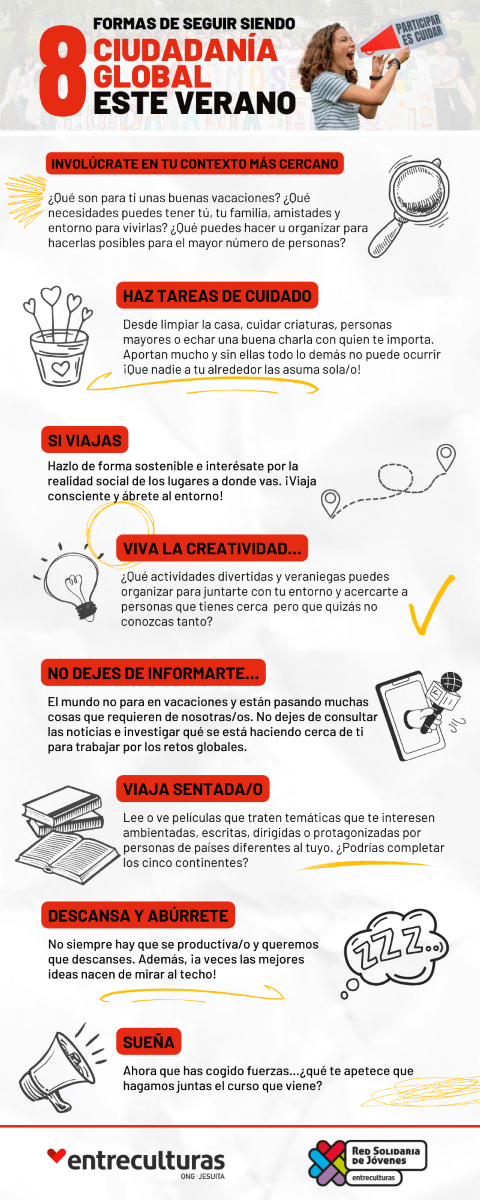 A Conscious Summer: 8 Ways to Remain a Global Citizen Year of publication: 2024 Corporate author: Entreculturas The holidays are here, and with them new ways of building global citizenship. Don't underestimate all that we can continue to do during the summer, through enjoyment, meeting and relaxation. In this infographic we present ideas to continue being global citizens. Go ahead and work on it with your groups and your environment! Un verano consciente: 8 formas de seguir siendo ciudadanía global Year of publication: 2024 Corporate author: Entreculturas Llegan las vacaciones, y con ellas nuevas maneras de construir ciudadanía global. No subestimes todo lo que, desde el disfrute, el encuentro y el descanso, podemos seguir haciendo durante el verano. En esta infografía presentamos ideas para seguir siendo ciudadanos globales. ¡Anímate a trabajarlo con tus grupos y tu entorno!
 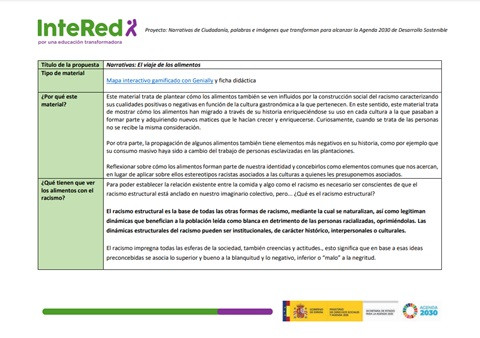 Narratives: The Journey of Food Year of publication: 2024 Corporate author: InteRed This is an interactive game that raises the question of how food is also influenced by the social construction of racism, characterising its positive or negative qualities, depending on the gastronomic culture to which it belongs. In this sense, this material tries to show how food has migrated throughout history, enriching its use in each culture it became part of and acquiring new nuances that made it grow and become richer. Curiously, when it comes to people, the same consideration is not given. On the other hand, the spread of some foods also has more negative elements in their history, such as the fact that their mass consumption has been in exchange for the work of enslaved people on plantations. Narrativas: El viaje de los alimentos Year of publication: 2024 Corporate author: InteRed Este es un juego interactivo que plantea cómo los alimentos también se ven influidos por la construcción social del racismo caracterizando sus cualidades positivas o negativas, en función de la cultura gastronómica a la que pertenecen. En este sentido, este material trata de mostrar cómo los alimentos han migrado a través de su historia enriqueciéndose su uso en cada cultura de la que pasaban a formar parte y adquiriendo nuevos matices que les hacían crecer y enriquecerse. Curiosamente, cuando se trata de las personas, no se recibe la misma consideración. Por otra parte, la propagación de algunos alimentos también tiene elementos más negativos en su historia, como por ejemplo que su consumo masivo haya sido a cambio del trabajo de personas esclavizadas en las plantaciones.
 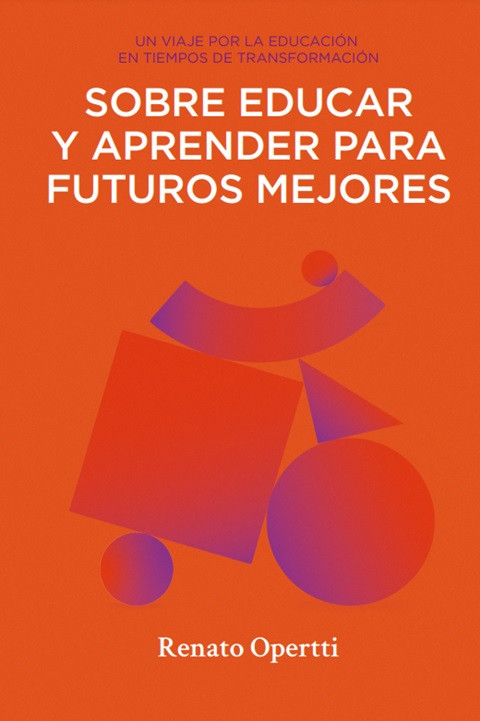 On Educating and Learning for Better Futures: A Journey Through Education in Times of Transformation Year of publication: 2024 Author: Renato Opertti The author of the book, Renato Opertti, president of the OEI Advisory Board, presents this publication divided into six chapters: On the global and the local, On Ibero-America, opportunities and pending challenges, On thinking, educating and learning, PISA findings and the resilience of educational systems, Regarding Meirieu and educators and On the new generations and the future of education in Uruguay.