
Resources
Explore a wide range of valuable resources on GCED to deepen your understanding and enhance your research, advocacy, teaching, and learning.
114 Results found
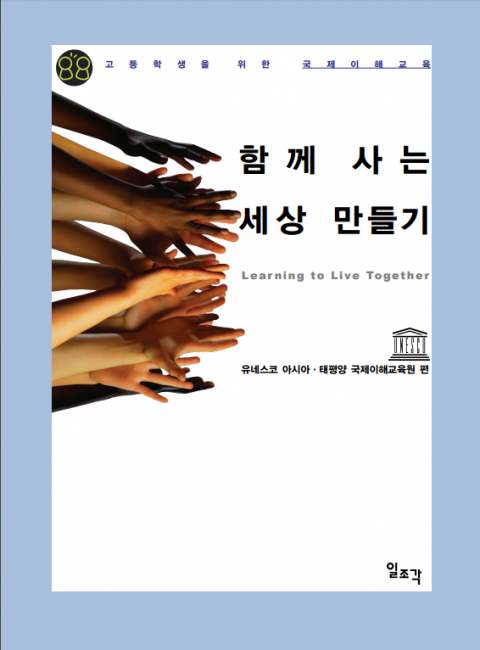 함께 사는 세상 만들기 Year of publication: 2004 Corporate author: APCEIU This book, in essence, aims to introduce Education for International Understanding (EIU) to high school students, college students and teachers at all levels as well as the general public. The growing interconnectedness and interdependence compels all of us to understand the world beyond our immediate living space, to critically reflect on issues affecting us and others, and to work together to make our world a more peaceful and sustainable one. It requires values education that is transformative and participatory in nature to arouse genuine interests and passions to learn more and eventually to make positive changes. The book is comprised of five parts, organized by five thematic areas of EIU, namely, intercultural understanding, globalization, human rights, peace and Education for Sustainable Development (ESD). It introduces carefully chosen topics and discussions which may pique readers’ interest in some of the issues at stake, thus, encourage them to critically reflect on the complexities surrounding the issues and motivate them to engage further. Using an interdisciplinary lens, the book also borrows some ideas and approaches commonly practiced in critical anthropology. 함께 사는 세상 만들기 Year of publication: 2004 Corporate author: 유네스코 아시아태평양 국제이해교육원 유네스코 아시아태평양 국제이해교육원에서는 국제이해교육을 가르치는 교사와 배우고자 하는 고등학생들에게 도움을 주기 위하여 고등학생을 위한 국제이해교육 교재를 출간하게 되었습니다우리 교육원은 아시아·태평양 지역의 45개 나라들과 함께 국제이해교육을 학교와 시민사회에서 강화하고 발전시킬 책임을 부여받았기 때문에, 여러가지 국제 회의와 연수과정, 전문가 협의회 등을 통해 이 과목의 교육 내용과 교과 과정에 대한 그림을 그려보는 노력을 부단히 전개하고 있습니다. 우리 교육원은 국내·외 여러 전문가들과 함께 많은 토론을 거쳐 국제이해교육의 기본 골격을 ① 문화 간 이해, ② 세계화, ③ 인권, ④ 평화, ⑤ 지속가능발전의 다섯 가지로 정했으며, 이를 바탕으로 초·중·고 국제이해교육 교육과정을 개발했습니다.우리 교육원은 앞으로 수년간 이러한 토대 위에서 교육자료나 수업 모형 등을 개발해보려고 합니다. 이번에 발간되는 교재 『함께 사는 세상 만들기』도 이러한 노력의 한 결실입니다. 이 책이 세계화 시대의 사회구조와 문제들을 파악하고, 함께 살 수 있는 가치관과 태도를 길러주는 데 크게 도움이 될 수 있기를 바랍니다.
  Being and Becoming Global Citizens: Measuring Progress toward SDG 4.7 (Phase I: Monitoring teacher and school readiness to enact global citizenship in the Asia-Pacific region) Year of publication: 2023 Author: Rachel Parker | Jennie Chainey | Payal Goundar | Sarah Richardson | Anna Dabrowski | Amy Berry | Claire Scoular Corporate author: Australian Council for Educational Research (ACER) | APCEIU Since 2022, APCEIU and the Australian Council for Educational Research (ACER) have conducted a study to identify enhanced tools and resources for schools and systems in the Asia-Pacific region to monitor and evaluate GCED in line with SDG 4.7.The Report of the Research for Phase 1 is available in three forms: Full report; Summary; and Policy Brief.
 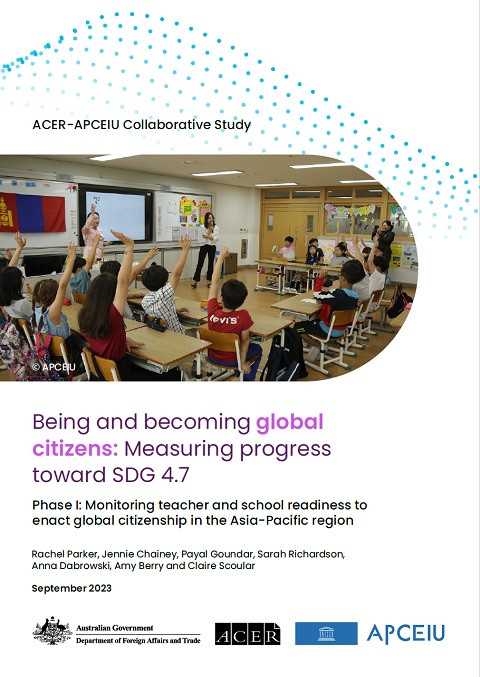 [Summary] Being and Becoming Global Citizens: Measuring Progress toward SDG 4.7 (Phase I: Monitoring teacher and school readiness to enact global citizenship in the Asia-Pacific region) Year of publication: 2023 Author: Rachel Parker | Jennie Chainey | Payal Goundar | Sarah Richardson | Anna Dabrowski | Amy Berry | Claire Scoular Corporate author: Australian Council for Educational Research (ACER) | APCEIU This is a summary report of the Being and Becoming Global Citizens: Measuring Progress toward SDG 4.7 (Phase I: Monitoring teacher and school readiness to enact global citizenship in the Asia-Pacific region), conducted by APCEIU and ACER in since 2022.
 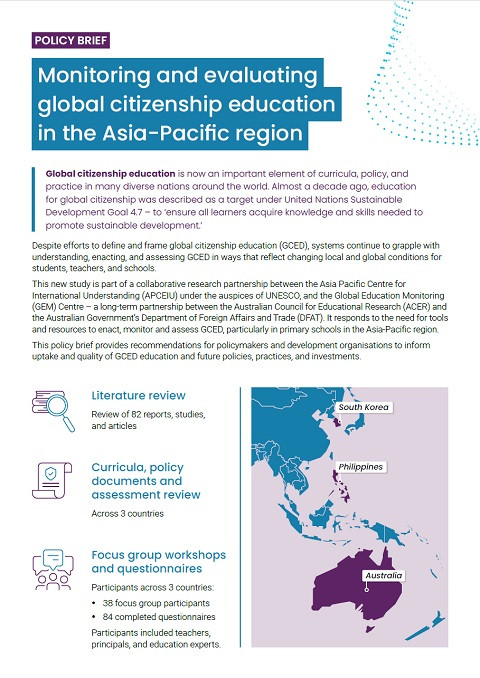 [Policy Brief] Monitoring and Evaluating Global Citizenship Education in the Asia-Pacific Region Year of publication: 2023 Author: Payal Goundar | Rachel Parker Corporate author: Australian Council for Educational Research (ACER) | APCEIU This is a policy brief version of the reserach report, Being and Becoming Global Citizens: Measuring Progress toward SDG 4.7 (Phase I: Monitoring teacher and school readiness to enact global citizenship in the Asia-Pacific region), conducted by APCEIU and ACER in since 2022.
 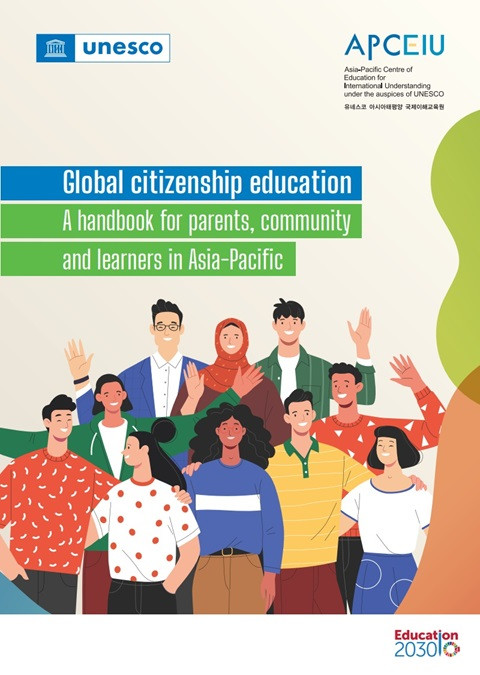 Global Citizenship Education: A Handbook for Parents, Community and Learners in Asia-Pacific Year of publication: 2023 Author: Darla K. Deardorff | Seek Ling Tan Corporate author: UNESCO Bangkok | APCEIU This handbook aspires to engage and involve parents, caregivers and the community to join the mission of developing every learner into a global citizen. To achieve this, parents, caregivers and the community will need to be empowered with the necessary GCED knowledge and skills too. In this handbook, GCED related concepts are introduced, alongside adaptable step-by-step action plans and best practices collected across the Asia-Pacific region to support parents and the community to take action in developing GCED competences in learners.
  Youth Advocacy Kit on Global Citizenship Education Year of publication: 2018 Corporate author: APCEIU APCEIU has published the Youth Advocacy Kit on Global Citizenship Education (GCED) in order to provide youth leaders a guideline on advocacy for GCED. Targeting youth activists who currently participate in GCED programmes around the world, the kit offers the overview of GCED and advocacy as well as tips and tools to effectively implement advocacy campaign for GCED in local and global context. Furthermore, by sharing cases of youth advocacy in diverse fields, this kit also provides the real life examples which can be easily referred by youth interested in GCED advocacy. <Table of Contents> Youth Advocacy Kit on GCEDChapter 1 - What is Global Citizenship Education (GCED)?Chapter 2 - What is GCED Advocacy?Chapter 3 - Youth as an Active Agent for GCEDChapter 4 - Sharing Cases of Youth AdvocacyChapter 5 - Youth Initiatives on GCED
  Peace Education in Northeast Asia: A Situational Analysis Year of publication: 2021 Author: Soonwon Kang | Cheng Liu | Ketei Matsui | Batbaatar Monkhooroi | Boyoung Park | Muyu Huang | Oyuntsetseg Dugarsuren Corporate author: APCEIU Being central to education for international understanding and global citizenship, peace education has always been an important theme in UNESCO. For effective delivery of peace education, it is critical to examine and understand the relevance of peace education and its key issues and approaches at a given juncture. With this in mind, in 2020, APCEIU conducted a study on peace education in South Korea to review its current state and suggest some policy recommendations. Following up on this study, APCEIU initiated in 2021 a research project on peace education in Northeast Asia in order to identify how peace education is interpreted and practised in the countries of the region and explore possibilities of cooperation among peace educators, researchers, and practitioners in the region. Building on this research, APCEIU hopes to develop and carry out joint projects for peace education in the region.
 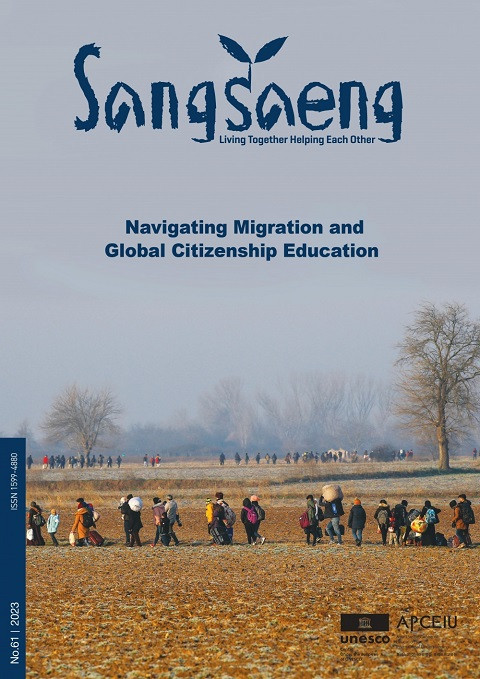 Navigating Migration and Global Citizenship Education (SangSaeng no. 61, 2023) Year of publication: 2023 Corporate author: APCEIU Migration is reshaping our societies and challenging traditional notions of identity, belonging, and cultural diversity. Global Citizenship Education, with its emphasis on fostering an understanding of global interconnectedness, human rights, social justice, and intercultural competence, is uniquely positioned to address the complex issues arising from migration. In this context, SangSaeng No. 61 explores the multifaceted relationship between migration and GCED to inspire innovative approaches to education and advocacy that address the challenges and opportunities presented by migration. Contents 03 Editor's Note 04 Special Column Renewing Our Commitment — Global Citizenship Education Should Address International Migration / Geon-soo Han 08 FOCUS: Navigating Migration and Global Citizenship EducationAfrican Migration Narratives — Mozambican Migrants in Southern Africa and Trends of African International Migration in Contemporary Africa / Joel das Neves TembeReimagining Thai Society — Burmese Migrant Children and Their Education in Thailand / Nongyao NawaratFortress Europe’s Educational Obstructions — Accessing Education for Refugees and Asylum Seekers in Europe / Prem Kumar RajaramCost of Invasion and Colonial War — Russian Invasion of Ukrainian, Refugees and Migration Governance / Franck DüvellPathway to Empowerment — Self-Reliance: A New Vision Toward Sustainable Solutions for Refugees / Kari Diener 24 Special ReportExploring Transformative Learning for Critical Empowerment through GCED / APCEIU IGCED and RND 26 Best PracticesTaking It Local — Using a Collaborative Approach to Contextualise an International Global Competence Framework / Karena Menzie-BallantyneHarmonizing the Streets for Youth — Jelajah Harmoni: Exploring the Meaning of Harmony through Community-Based Learning / Anna TanTeach to Transform — Creating Empowering Learning Spaces and Building Community of Changemakers / Rajvi Trivedi 35 Story TimeUnparalleled Look into Lives of Migrants / Virginia Pittaro 38 Peace in My MemoryCultivating Tranquillity: Thoughts on Peace / Wisdom Addo 42 GCED YOUTH NETWORKMigration and Global Citizenship Education — Youth Voices from the Ground / Oshan M. GunathilakeEducation without Borders — Empowering Displaced Children and Youth through Global Citizenship Education / Victoria Ibiwoye 48 LetterFacilitating Connections through My Experience with APCEIU / Lorena Gamerra 50 APCEIU in Action
  Asia-Pacific Living Heritage Lesson Plan 2023 Year of publication: 2023 Corporate author: APCEIU | UNESCO Bangkok | International Information and Networking Centre for Intangible Cultural Heritage in the Asia-Pacific Region (ICHCAP) In partnership with UNESCO Bangkok and ICHCAP (International Information and Networking Centre for Intangible Cultural Heritage in the Asia-Pacific Region), APCEIU (Asia-Pacific Centre of Education for International Understanding) carried out “Bringing Living Heritage to the Classroom in the Asia-Pacific” since 2020. As a part of this multi-year project, the UNESCO Asia-Pacific Living Heritage Lesson Plan Contest 2023, co-organized by UNESCO Bangkok, APCEIU, and ICHCAP was launched and 18 lesson plans from 10 countries – Bhutan, China, India, Indonesia, the Republic of Korea, Malaysia, Nepal, The Philippines, Singapore, and Viet Nam - were selected as follows. - Saykha Offering (Subject: English), Tsirangtoe Central School, Bhutan- Setting Up a Herbarium, Learning about Medicinal Herbs and their Cultural and Traditional Uses in the Community (Subject: Science/Grades 7–9), Zilukha Middle Secondary School, Bhutan- Shamanistic Worship and Propitiation to the Spirits (Subject: Bhutan History and Civics and Citizenship Education/Grade 8), Bajothang Higher Secondary School, Bhutan- Beauty of Intangible Cultural Heritage (Subject: Foundations of College Art Education/ Freshman Year), Anhui Medical University, China- The Folk Custom of Building the Peace Kiln for the Mid-Autumn Festival in Jingdezhen (Subject: Mathematics/Grade 7), Jingdezhen No.13 Secondary School, China - When Xiabu Meets Batik (Subject: Art/Grade 5–6), ChongQing Shuren Primary School, China- Agricultural Practices (Subject: Biology/Grade 8), Paramita Heritage School, India- Living Heritage – Quilting in the Kalbelia Community of Rajasthan (Subject: Social Science/Grade 9), St. Stephen's Senior Secondary School, India- My City: Varanasi (Subject: Environmental Studies/Grade 2), Sunbeam School Lahartara, India - Bringing Back the Javanese Saka Calendar through Ethnomathematics (Subject: Mathematics/Grade 7–12), Binus School Bekasi, Indonesia- Song, Play, and Dance (Subject: Interdisciplinary for Indonesian Language, Balinese Culture, Music and Physical Education/Grade 3), Green School Bali, Indonesia- Teaching Sound Wave with Sundanese Traditional Instruments (Subject: Physics/Grade 8), Binus School Bekasi, Indonesia- Wau – The Malays Traditional Kite: Introduction, Wau Bulan Appreciation, Wau Making and Flying Workshop and Wau Corner (Subject: Traditional Games/Grades 4–5), SMU (A) Tarbiah Islamiah (SABK), Malaysia- Himalayan Aromatic Incense-Making and Meditation Workshop (Subject: Economics and Social Studies/ Grades 8–9, 11–12), Pragati Pathshala, Nepal- Influence of Biodiversity on the Stability of Ecosystems (Subject: Science/Grade 10), Philippine Normal University Mindanao, The Philippines- Understanding the Nature of Religion: From the Perspective of the Tripeople (Christians, Muslims, & Lumads) of Kidapawan City, North Cotabato (Subject: Humanities and Social Sciences/Grade 12), Kidapawan City National High School, The Philippines- Bongsan Talchum that Helps the Community Become More Sustainable (Subject: Korean Language and Literature, Social Studies, P.E., Arts/Grade 6), Kimje Buk Elementary School, Republic of Korea- Exploring Community Gardens – How and why are they so precious to humans? (Subject: Geography/Grade 9), Admiralty Secondary School, Singapore