
Resources
Explore a wide range of valuable resources on GCED to deepen your understanding and enhance your research, advocacy, teaching, and learning.
219 Results found
 Education as a Security Issue Author: Ian Jamison Corporate author: Tony Blair Faith Foundation The use of education as both tool and target of religious extremists globally is perhaps one of the most important generational challenges we face today. To ensure that the next generation is open to a more pluralistic world, we must ensure that their education equips them to safely encounter the 'Other'. This not only means improving knowledge, understanding and interaction, but also critically requires investment in developing essential soft skills that can ensure these are properly employed.
  Educating Against Extremism Year of publication: 2012 Author: Dianne Gereluk Extremism is a huge concern across the world right now, fueled by its links to terrorism and religious fundamentalism. This book explores the relationship of education to extremism and examines how education could counter its more dangerous forms. Lynn Davies proposes a very different educational strategy to the conventional tolerant multiculturalism that pertains in the west. The task – a challenging one – is to politicize young people without cementing uncritical acceptance of single truths.
  Reaching the Youth: countering the Terrorist Narrative Year of publication: 2012 Author: Thomas Koruth Samuel This monograph studies the issue of the dynamics of youth and terrorism, paying close attention to the methods used by terrorists to entice the youth, the message or the narrative of the terrorists, and the possible counter-narrative that could be subsequently developed.
  Global Learning in Subject Teaching: Framework and Toolkit Year of publication: 2020 Corporate author: Center for Citizenship Education (CCE) | Global Issues, Global Subjects (GIGS) The brochure 'Global Learning in Subject Teaching: Framework and Toolkit' has been developed as a proposal for teachers, educators and educational institutions on how to reach pupils with Global Learning. In its practical part, the brochure provides the reader with a toolkit of 20 ready-to-use lesson plans for subject lessons where the subject curriculum topics are linked with global issues such as migration, climate change and gender equality.
  How to Engage Citizens with the Sustainable Development Goals Year of publication: 2020 Corporate author: Finnish Development NGOs Fingo The purpose of this booklet is to share reflections, successes and learning outcomes from the FRAME, VOICE, REPORT! (FVR) project.It can be used to find inspiration from other civil society organisations (CSOs) working on the same topics and themes you do, but also as a source for ideas for new ways of looking at old issues.This booklet covers both the more theoretical approaches and concrete cases from CSOs across Europe. These cases are examples of the many projects funded by the FVR.The project had its roots in the previous successes and tried and tested approaches of the partner organisations. The aim of FVR! was to secure resources and develop the value-based, high quality work of civil society organisations. The second aim was to enable smaller organisations to learn about EU project funding and to build capacity on how to conduct high quality global citizenship education and development communications. Finally, the overarching aim of the project was to engage EU citizens with the SDGs.
 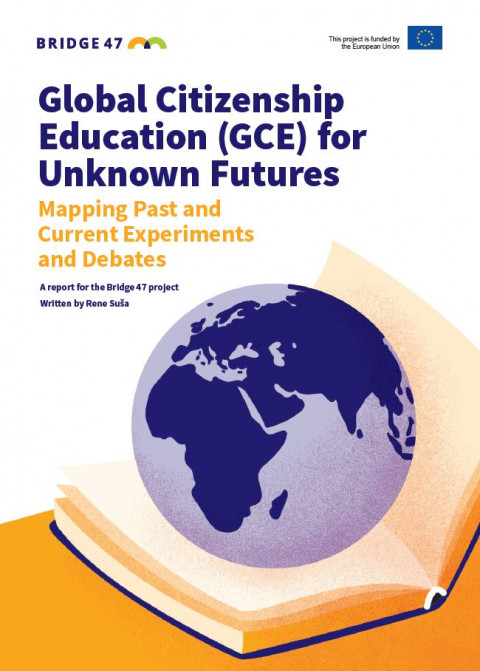 Global Citizenship Education (GCE) for Unknown Futures: Mapping Past and Current Experiments and Debates Year of publication: 2019 Author: Rene Suša Corporate author: Bridge 47 This Bridge 47-commissioned report by Rene Suša provides a thorough overview of current debates and opportunities within the field of Global Citizenship Education (GCE). The report addresses the following questions: 1) What is the benefit of GCE to our societies? 2) What is the impact of GCE to our societies? and 3) Why do we believe that GCE is the answer to global challenges?The publication also maps GCE-related or GCE-inspired initiatives, projects and partnerships, and offers key findings from a comparative study of these cases. Additionally, Susa also further builds on the recent work of Vanessa Andreotti by elucidating her taxonomy of soft, radical and beyond reform spaces for GCE, as well as relates these to current (international) policy developments in the field.
  Educating Students to Improve the World (SpringerBriefs in Education) Year of publication: 2020 Author: Fernando Reimers This open access book addresses how to help students find purpose in a rapidly changing world. In a probing and visionary analysis of the field of global education Fernando Reimers explains how to lead the transformation of schools and school systems in order to more effectively prepare students to address today’s’ most urgent challenges and to invent a better future. It discusses several global citizenship curricula that have been adopted by schools and school networks, and ties them into an approach to lead school change into the uncharted territory of the future. Given its scope, the book will help teachers, school and district leaders tackle the change management needed in order to introduce global education, and more generally increase the relevancy of education. In addition, the book offers a “bridge” for more productive collaboration and communication between those who lead the process of educational change, and those who study and theorize this important work.
 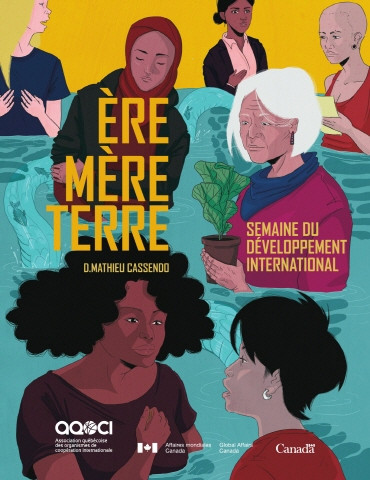 Age, Earth, Sea: International Development Week Year of publication: 2020 Author: Dimani Mathieu Cassendo Corporate author: Quebec Association of International Cooperation Organizations (AQOCI) Each year, International Development Week (IDW) highlights an international issue of concern to society. In Quebec, the Association québécoise des organismes de coopération internationale (AQOCI) organizes this public awareness week. CRÉDIL plays an active role in this campaign, and has participated in the production of comic strips as educational tools, such as "Ère, Terre, Mer" in 2021, which deals with the impact of the climate change on peoples.
  Imagining and Practising Global Citizenship Education Year of publication: 2020 Corporate author: UNESCO Venice This methodological guide illustrates the ways in which the International Cooperation Centre (ICC) has been promoting and practicing Global Citizenship Education in Italy for more than ten years. The training work developed by the ICC in the field of GCED, presented here in its theoretical articulation and in its practical outlining in some concrete experiences, may offer some reflections in the form of useful recommendations for continuing and strengthening the promotion of GCED.
  Controversial Issues - Teachers' attitudes and practices in the context of citizenship education Year of publication: 2004 Author: Christopher Oultona | Vanessa Dayb | Justin Dillon | Marcus Graced A survey of the literature suggests that the principles and methods relating to the teaching of controversial issues are themselves controversial. This irony is more relevant to teachers now than ever before. This paper explores the issue of teachers' readiness to use controversial issues in the classroom, and reports on research involving focus groups and questionnaires. We suggest that many teachers are under‐prepared and feel constrained in their ability to handle this aspect of their work.