
Resources
Explore a wide range of valuable resources on GCED to deepen your understanding and enhance your research, advocacy, teaching, and learning.
220 Results found
 Terrorism, Religious and Ethnic Intolerance Issues in the Syllabuses and Textbooks of Bengali and English Medium and Madrasah Education in Bangladesh an Appraisal Year of publication: 2014 Author: NM Sajjadul Hoque The author argues that education is a catalyst for social change and a powerful instrument for overcoming social and security problems. In other words, the author believes that syllabuses and textbooks of both the general and madrasa education streams of Bangladesh have a significant role in educating people to counter terrorism as well as religious and ethnic intolerance. This paper attempts, however, by reviewing the current syllabuses and textbooks of general and madrasa education streams, and also by assessing peoples’ opinions in Bangladesh, to know whether the syllabuses and text books are adequately addressing, or not, the issues of terrorism and religious and ethnic intolerance.
  Unsafe Gods: Security, secularism and schooling Year of publication: 2014 Author: Lynn Davies This book makes the compelling argument that religion can be complicit in conflict and that a new secularism is vital to foster security. Using insights from complexity science, it shows how dynamic secularism can be used to accommodate diverse faiths and beliefs within worldly politics. Exploration of the interplay of religion and education in the context of security and notions of safe schools offers new understandings of how religions learn – or instead remain frozen accidents that hinder societies from adapting to change. The book shows how turbulence and amplification underscore the necessity for an education that is critical even of patriarchal religious texts and that recognizes the power of satire and humour.
  Global citizenship: a typology for distinguishing its multiple conceptions Year of publication: 2013 Author: Laura Oxley | Paul Morris Corporate author: Society for Educational Studies | Taylor & Francis The promotion of ‘Global Citizenship’ (GC) has emerged as a goal of schooling in many countries, symbolising a shift away from national towards more global conceptions of citizenship. It currently incorporates a proliferation of approaches and terminologies, mirroring both the diverse conceptions of its nature and the socio-politico contexts within which it is appropriated. This paper seeks to clarify this ambiguity by constructing a typology to identify and distinguish the diverse conceptions of GC. The typology is based on two general forms of GC: cosmopolitan based and advocacy based. The former incorporates four distinct conceptions of GC – namely, the political, moral, economic and cultural; the latter incorporates four other conceptions – namely, the social, critical, environmental and spiritual. Subsequently, we briefly illustrate how the typology can be used to evaluate the critical features of a curriculum plan designed to promote GC in England. The typology provides a novel and powerful means to analyse the key features of the very diverse range of educational policies and programmes that promote GC. Educating for global citizenship: an ETFO curriculum development inquiry initiative Year of publication: 2010 Author: Alice Assor-Chandler | Mali Bickley | Jim Carleton | Antonino Giambrone | Janice Gregg | Jennifer Hunter | Laura Inglis | Leigh-Anne Ingram | Angela MacDonald | Miyuki (Erica) Moizumi | Carol Peterson | Carrie Schoemer | Nadya Weber | Tonia Wojciechowski Corporate author: Elementary Teachers’ Federation of Ontario (ETFO) Attention to educating for citizenship continues to expand and deepen worldwide. Many countries now include citizenship education as an important feature of their official curriculum, albeit in variant forms. Numerous research studies, policy reforms, and curriculum initiatives have been undertaken, as teachers, policy makers and researchers attempt to understand the intricate processes by which young people learn about democratic citizenship, and where and how citizenship education should be located and represented in school curricula.Educating for global citizenship has been a critical dimension of these discussions and investigations. Recent shifts in the speed and global reach of information and communication technologies, an increasingly interdependent global economy, challenges in human rights and social justice, and the impact of international tragedies and emergencies have, for example, created tensions and conditions that require more integrated, worldwide responses. Not surprisingly, understandings of global citizenship are being explored with increased intensity and, as might be expected, there has been a corresponding – and growing - interest among educators in various parts of the world to strengthen the global dimension of citizenship education in school curricula at all levels.In Canada, there has been increasing attention to what it means to educate for the global citizenship and provincial curriculum policy developments in recent years. A host of useful ideas in the form of new resource materials and websites to inform and guide teachers’ work have also emerged. The Canadian International Development Agency’s (CIDA) in the global classroom initiative, Classroom Connections’ Cultivating Peace in the 21st Century and Taking Action, Larsen’s ACT! Active Citizens Today: Global Citizenship for Local Schools, and UNICEF Canada’s Global Schoolhouse are a few examples of the many resources that have recently been developed. Despite this growing interest, there has been less attention devoted to examining practices of global citizenship education within Canadian classrooms, leaving a limited understanding of how it is applied in schools.A wide range of perspectives and practices has emerged, reflecting a considerable growth of interest in this dimension of education. In an effort to clarify the multiple dimensions of global citizenship education, below are two “working” frameworks that provide an overview of core learning goals and key teaching and learning practices associated with global citizenship education from the literature. They reveal both complexity and multidimensionality and provide a lens to analyse and reflect upon the breadth and depth of what it means to educate for global dimension of citizenship. Global citizenship education and its implications for curriculum goals at the age of globalization Year of publication: 2010 Author: Shahla Zahabioun | Alireza Yousefy | Mohammad H Yarmohammadian | Narges Keshtiaray Corporate author: Canadian Center of Science and Education As the inevitable process of the 21st century, globalization has affected and altered all aspects of human life including education. Therefore, one of the main tasks of any education system is to identify the features and impacts of such process. Thus, the present study was conducted aiming to discuss and examine global citizenship education and its implications for curriculum goals.This study is firstly defining global citizenship education concept as well as its significance and necessity and then it is going to explain global citizenship education concept and its purposes and implications for curriculum goals. This is an analytical research. The results indicate that global citizen holds peculiar features and requires special education in global aspects. Accordingly, the citizenship education compatible with global standards requires an overview of curriculum goals as one of the most important components of education system Herritartasun globalerako hezkuntza: Eztabaidak eta erronkak Year of publication: 2009 Author: Miguel Argibay | Gema Celorio | Juanjo Celorio Corporate author: Hegoa This publication is divided in four parts. The first part is a summary of the history of global citizenship and its role in education. It focuses on the education strategies put forth by the European Union to promote internal cohesion and responsible citizenship. The second part deals with education for development. It briefly describes the evolution of the concept and how in its last stage is a key element in the promotion of global citizenship. The third part presents an analysis on the specific requirements for Education for Global Citizenship, examples of experiences and implementation methods of pedagogical material on the subject. The last part proposes a regional study on formal, non formal and informal education in the Basque region. World citizenship education and teacher training in a global context: Canada, India and South Africa Year of publication: 2011 Author: George Cappelle | Gary Crippin | Ulla Lundgren Corporate author: Children's identity and Citizenship in Europe (CICE) In this study we change our focus from a European setting to a global one. We were interested to see how our observations from the first study would be reflected in a more global context with focus on the cases of Canada, India and South Africa looking at both the models for world citizenship education and the influence of contextual factors.In choosing these countries we were interested in:Countries on different continentsCountries in different stages of national, social and economic developmentCountries in which there was considerable diversity in the populationCountries in which citizenship and world citizenship education was seen as an important priorityCountries, because of the limitations of researchers, which used English as a primary language.In addition to background research we asked for assistance from professors in the field of teacher education in the three countries to provide us with information on key questions related to citizenship education and teacher training.
  A Teacher's Guide on the Prevention of Violent Extremism Year of publication: 2016 Corporate author: UNESCO The Guide aims to support teachers in offering young people relevant and timely learning opportunities to develop knowledge, skills and attitudes that build their resilience to violent extremist propaganda. It focuses on providing practical advice on when and how to discuss the issue of violent extremism and on creating a classroom climate that is inclusive and conducive to respectful dialogue, open discussions and critical thinking.
 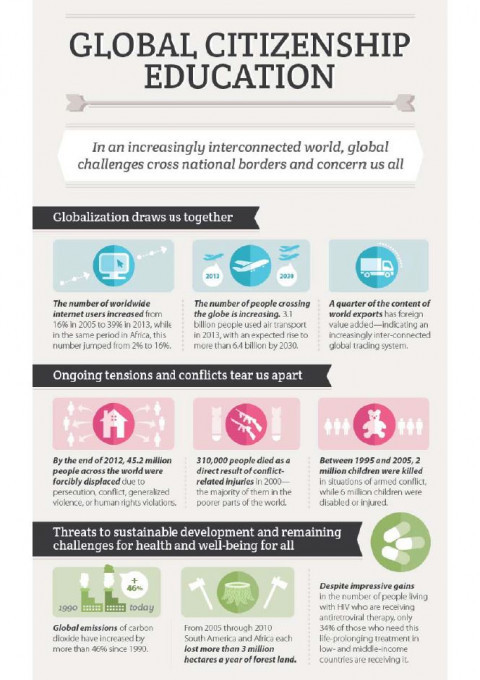 Global Citizenship Education infographic Year of publication: 2014 Corporate author: UNESCO In an increasingly interconnected world, global challenges cross national borders and concern us all. With issues like these threatening human and environmental well-being, we need to re-think the role and relevance of education. We need Global Citizenship Education. Global Citizenship Education is transformative. What are the barriers to this kind of education? What needs to change in education? What is UNESCO doing? What can you do? Second UNESCO Forum on Global Citizenship Education video Year of publication: 2015 Corporate author: UNESCO Highlights of the Second UNESCO Forum on Global Citizenship Education (GCED) Building peaceful and sustainable societies: preparing for post-2015 (28-30 January 2015, UNESCO HQs, Paris). The Forum was organized by the Division for Teaching, Learning and Content, Education Sector, UNESCO, with the support of Austria, the Sultanate of Oman and the Republic of Korea, and the UN Secretary-General's Global Education First Initiative (GEFI).