
Resources
Explore a wide range of valuable resources on GCED to deepen your understanding and enhance your research, advocacy, teaching, and learning.
219 Results found
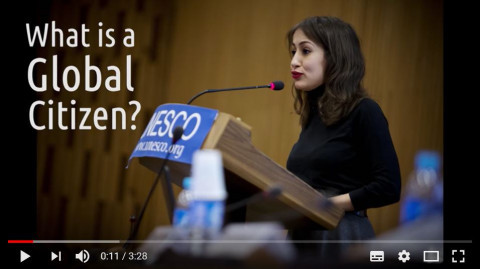 [Video] Global citizenship is ... Year of publication: 2015 Corporate author: UNESCO Participants of the Second UNESCO Forum on Global Citizenship Education (GCED) Building peaceful and sustainable societies: preparing for post-2015 (28-30 January 2015,UNESCO HQ, Paris) reflect on what Global Citizenship is. The Forum was organized by the Division for Teaching, Learning and Content, Education Sector, UNESCO, with the support of Austria, the Sultanate of Oman and the Republic of Korea, and the UN Secretary-General’s Global Education First Initiative (GEFI).
 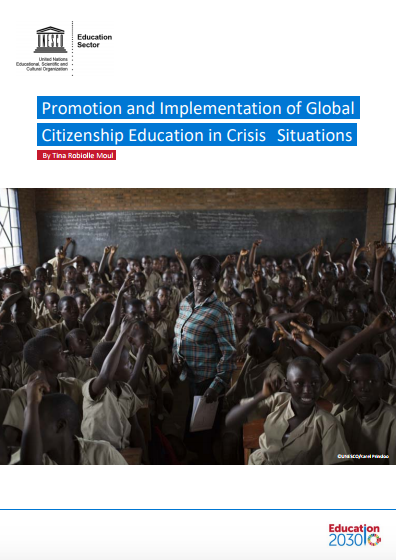 Promotion and implementation of global citizenship education in crisis situations Year of publication: 2017 Author: Robiolle Moul, Tina Corporate author: UNESCO Crisis situations affect the realization of human rights of many people and communities across all regions of the world. Within UNESCO’s relevant areas of work, GCED is a powerful approach to education that can empower people to recover from crises and transform their communities into peaceful and sustainable societies. UNESCO commissioned a desk study that aimed at reviewing existing research on the promotion and implementation of GCED and related programs in countries affected by crisis situations, with particular attention to initiatives benefiting the refugee population. This study unveils the key challenges these programs encounter in such contexts, as well as promising practices that can guide the design and implementation of future GCED in crisis situations.This report is a synthesis of this desk study and supports the evidence that, after analyzing the context and the available means, GCED and related programs can and should be systematically adapted and implemented in crisis situations, including in response to refugee crises.
  Global Education Monitoring Report, 2016: Planet: Education for Environmental Sustainability and Green Growth Year of publication: 2016 Corporate author: UNESCO PLANET: Education for environmental sustainability and green growth, a publication taken from the full 2016 Global Education Monitoring Report, explores the knowledge and skills needed for sustainable and inclusive economic growth that does not damage our planet.This publication demonstrates how education can help people understand and respond to environmental issues and climate change. Environmental education can increase green knowledge and build sustainability practices. The publication warns that while education contributes to economic growth, education systems must be careful not to encourage unsustainable lifestyles and all learners must acquire the knowledge and skills needed to promote sustainable development.It also argues that we must continue to learn throughout our lives in order to make production and consumption sustainable, and to provide green skills for green industries. Creating green industries relies on high-skill workers with specific training, yet by 2020 there could be 40 million too few workers with tertiary education relative to demand. Higher education and research should also be oriented towards green innovation and growth; innovation depends on cooperation in higher education and investment in research and development to transform production in vast swaths of the economy.It also recognises that education must change in order to keep up with the changing face of work. Green and transferable skills should be taught in both school and the workplace. The greening of industries requires not only the production of more high-skill workers, but the continued training and education for low and medium skill workers, often on the job. “To ensure the Sustainable Development Goals are implemented, everyone involved needs to think, to work, to organise, to communicate and to report in ways that are completely different from what has been done up till now. Education truly is key to a wide appreciation not just of the SDGs but the new ways of thinking and working that are going to be necessary to fulfil them. So the challenge to all of us is to re-learn, and that does not just apply to educators, but it applies to all of us.”
  UNESCO GCED eNewsletter Issue 4 Year of publication: 2016 Corporate author: UNESCO Feature: Mobilizing support for global citizenship and sustainable development through Education Target 4.7 UNESCO 1974 Recommendation used to measure progress towards education target 4.7 Measuring progress towards 4.7 Gyeongju Action Plan: NGOs join UNESCO Global capacity-building workshop on GCED organized by APCEIU Southern Africa Regional Meeting on GCED convened in Johannesburg, South Africa UNESCO launches Teacher's Guide on the Prevention of Violent Extremism Expert meeting on the Prevention of Violent Extremism through Education European ministers back education for democracy to counter extremism and racaism UN discusses innovative solutions to prevent violent extremism through education UNESCO's YESPeace Network taps the power of youth worldwide to change the future GCED Topics and Learning Objectives available in seven languages.
 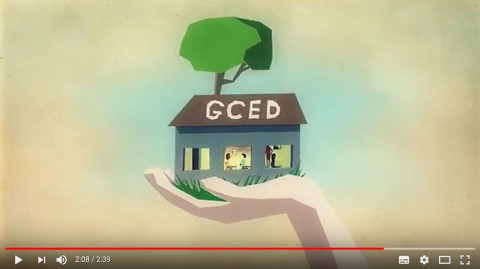 [Video] Learning to live together in peace through Global Citizenship Education Year of publication: 2016 Corporate author: UNESCO The UNESCO video on “Learning to live together in peace through Global Citizenship Education” explains the importance of Global Citizenship Education (GCED) in a globalized and increasingly interconnected and interdependent world. GCED is key to understand the interconnections between the local and the global and nurture a sense of belonging to a common humanity. It builds motivation to assume active roles to contribute to a more just, peaceful, tolerant and sustainable world. The video also illustrates how GCED can be delivered in and outside of schools.
  Historical efforts to implement the UNESCO 1974 Recommendation on Education in light of 3 SDGs Targets Year of publication: 2017 Corporate author: UNESCO This paper presents an analytical overview of historical efforts by Member States of the United Nations Educational, Scientific and Cultural Organization (UNESCO) to implement the 1974 Recommendation concerning education for international understanding, cooperation and peace education relating to human rights and fundamental freedoms. The author of the review was hired in April 2016 to undertake an analysis of Member States’ progress reports submitted for the fourth (2008) and fifth (2012) consultations on implementation of the 1974 Recommendation. The main purpose of the review was to provide a historical overview of efforts to achieve Sustainable Development Goal (SDG) Targets 4.7, 12.8 and 13.3 and their proposed measurement indicators, based on states’ historical reporting on the Recommendation. A total of 94 country reports were reviewed for the exercise: 37 from the 4th Consultation (2008); and 57 from the 5th Consultation (2012). The coding involved retrofitting the content of reportsto conceptsthat may have been developed at a later date for the Sustainable Development Agenda and coding for data that was not explicitly requested in the Consultations. Following the coding, a quantitative and qualitative analysis was undertaken and is presented in the following report.
 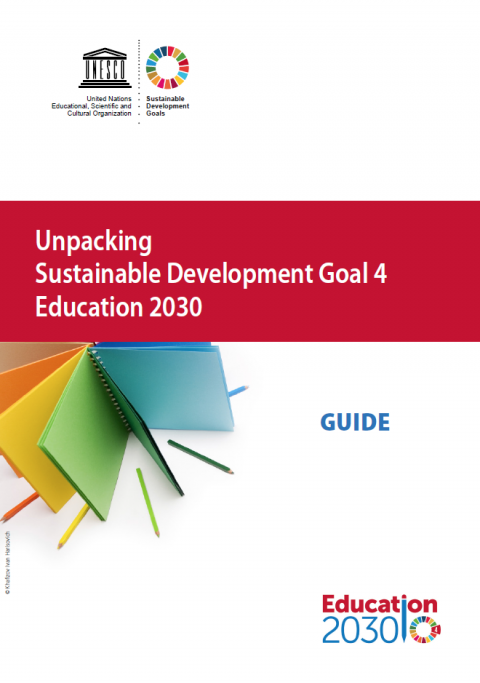 Unpacking Sustainable Development Goal 4 Education 2030: Guide Year of publication: 2017 Corporate author: UNESCO This guide, organized around a set of questions and answers to “unpack” SDG4, provides overall guidance for a deeper understanding of SDG4 within the 2030 Agenda for Sustainable Development, in order to support its effective implementation. The guide outlines the key features of SDG4-Education 2030 and the global commitments expressed in the SDG4 targets as articulated in the Incheon Declaration and the Education 2030 Framework for Action. The guide also examines the implications of translating these global commitments within, and through, national education development efforts. This guide supplements the UNESCO technical guidelines (2016) for Mainstreaming SDG4-Education 2030 into sector-wide policy and planning. It was developed by Sobhi Tawil, Margarete Sachs-Israel, Huong Le Thu, and Matthias Eck of the UNESCO Section of Partnerships, Cooperation and Research (PCR) within the Division for Education 2030 Support and Coordination.
 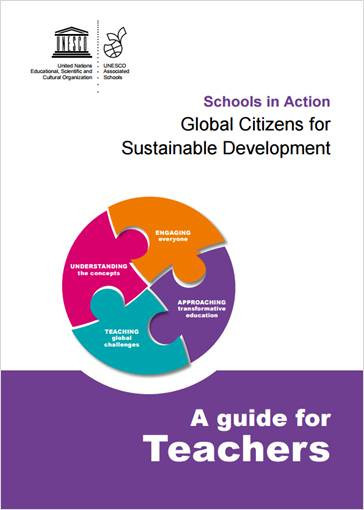 Schools in Action: Global Citizens for Sustainable Development: A Guide for Teachers Year of publication: 2016 Corporate author: UNESCO The Global Citizens for Sustainable Development Teachers’ guide aims to introduce teachers to Global Citizenship Education (GCED) and Education for Sustainable Development (ESD). It provides secondary school teachers with ideas and activities to help students become global citizens and sustainable development actors. The Teachers’ guide draws on the discussions and activities of almost 1,100 participants from 104 countries, including ASPnet National Coordinators, school principals, teachers, students and experts who contributed to the Online Collaborative Platform ASPnet in Action: Global Citizens Connected for Sustainable Development in 2014 and 2015 [http://en.unesco. org/aspnet/globalcitizens] with associated activities and initiatives. The Teachers’ guide provides: An overview of what it means for learners to become global citizens and of how learners can contribute to sustainable development. Ideas for classroom activities that can help secondary school students to develop knowledge, skills, values, attitudes and behaviours that promote GCED and ESD. Selected activities on GCED and ESD from ASPnet schools around the world.
  The ABCs of Global Citizenship Education Year of publication: 2016 Corporate author: UNESCO UNESCO's FAQ flyers on GCED
  L'ABC de l'éducation à la citoyenneté mondiale Year of publication: 2016 Corporate author: UNESCO UNESO's FAQ on Global citizenship education