
Resources
Explore a wide range of valuable resources on GCED to deepen your understanding and enhance your research, advocacy, teaching, and learning.
219 Results found
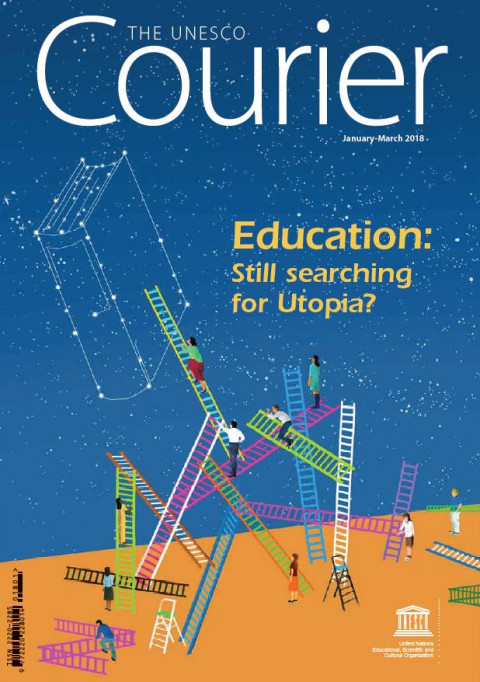 Education: Still Searching for Utopia? (The UNESCO Courier no. 1, January-March 2018) Year of publication: 2018 Corporate author: UNESCO At a time of heightened global tension, when human rights, freedom of speech, peace and the future of the planet itself may seem challenged as never before, the transformational power of education is of critical importance.In Learning: The Treasure Within, the landmark Report to UNESCO by the International Commission on Education for the Twenty-first Century in 1996, Jacques Delors, then Chairman of the Commission (1992 to 1996), spoke of education as “the necessary Utopia” and “an indispensable asset in its attempt to attain the ideals of peace, freedom and social justice.”Education was held up as neither miracle nor magic, but rather the best means to foster a climate where humanity would be improved −. and where the rich potential for learning, inherent in every individual, would be tapped. Our humanity is confronted with a very strange paradox: the world’s population has never been better educated, and yet, according to the UNESCO Institute for Statistics, 263 million children and young people are out of school, 617 million children and adolescents worldwide do not meet the minimum threshold for literacy and mathematics, at least 750 million adults are illiterate, and girls remain more likely than boys to never set foot in a classroom. Yet education is still called upon to address inequalities, poverty, terrorism and conflict. It is seen as one of the keys to global citizenship and sustainable development, two of UNESCO’s fields of action. The Organization is also mandated to lead the Education 2030 global agenda with a special focus on ensuring that no one is left behind. Under the title, “Education: Still searching for Utopia?”, the UNESCO Courier evaluates the state of global education and explores how it responds to some of the main challenges we face.
  Education and Security - a global literature review on the role of education in countering violent religious extremism Year of publication: 2016 Author: Ratna Ghosh | Ashley Manuel | W.Y. Alice Chan | Maihemuti Dilimulati | Mehdi Babaei This review demonstrates that the impact of the worldwide proliferation of violent attacks motivated by religious extremism threatens both national and personal security irrespective of location or faith. Education has been particularly damaged by direct attacks on institutions, by the removal of educational opportunity, and by the use of education to indoctrinate and recruit young people. This review suggests that more young people today are being radicalized through soft power – extremist ideas, ideology, narratives and propaganda. It questions whether this can be met adequately by hard power responses, as these methods appeal directly to the psychological, intellectual and emotional states of young people.
  ASPnet strategy for 2014-2021 global network of schools addressing global challenges: building global citizenship and promoting sustainable development Year of publication: 2014 Corporate author: UNESCO Associated Schools Project Network (ASPnet) Over the next 8 years (2014-2021), ASPnet needs to respond to the needs of education in a rapidly changing and increasingly complex world. The following strategy, therefore, has to remain flexible and requires regular re-evaluation in the light of a changing environment. Globalization and growing interconnectedness ask for increased networking and cooperation. ASPnet has proven to have a great potential for global school networking and educational innovations, which remain largely untapped. UNESCO can make much fuller use of ASPnet in its quest for and implementation of a successful Post-2015 Global Education Agenda.
 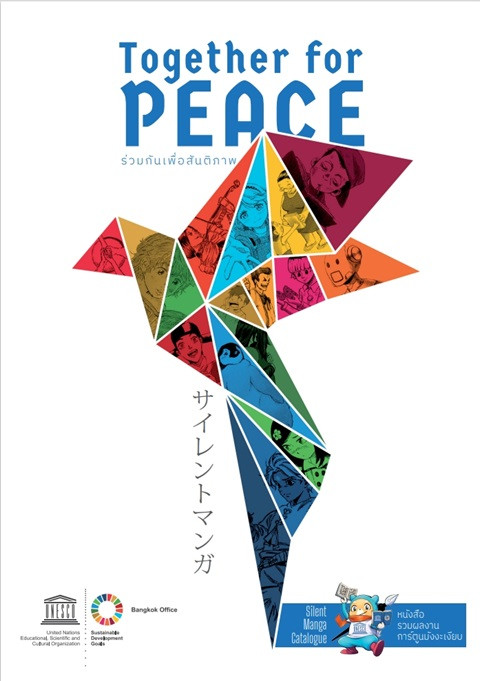 Together for Peace: Silent Manga Catalogue Year of publication: 2020 Author: Walden Schertz | Jeremy Clay | Santibhap Ussavasodhi Corporate author: UNESCO Bangkok | Coamix This Together for Peace Silent Manga Catalogue is a compilation of silent manga – manga stories told entirely through illustration without the use of dialogue. These works of art were selected from 274 entries submitted by artists in 117 countries worldwide to join SILENT MANGA AUDITION® Round 13 held under the theme Together for Peace, in collaboration with UNESCO Bangkok, the Asia and Pacific Regional Bureau for Education. Silent manga is a powerful medium of communication in the Asia-Pacific. Although the region is the most diverse in the world, it can be enjoyed by anyone regardless of their background. Silent manga has no language barrier. These works showcase different reflections of peace as expressed by artists around the world while conforming to the Japanese manga style.
  International Symposium on Cultivating Wisdom, Harvesting Peace: Educating for a Culture of Peace through Values, Virtues, and Spirituality of Diverse Cultures, Faiths, and Civilizations; Symposium Recommendations Year of publication: 2005 Corporate author: Griffith University. Multi-Faith Centre On the 10-13th August 2005, over 120 delegates from 25 countries gathered at the International Symposium to share their inspirational insights and experiences on the theme of “Cultivating Wisdom, Harvesting Peace.” The Symposium was organized and hosted by the Multi-Faith Centre of Griffith University, Brisbane, Australia with the support of Pure Land Learning College, UNESCO and various UNESCO National Commissions, centres or offices, and numerous faith, interfaith, educational and civil society organizations and institutions. Reflecting a diversity of cultures, faiths and spirituality traditions, the delegates presented rich and empowering stories as well as critical analyses of how communities, institutions, civil society organizations, and international or global agencies have organized educational projects and programs to address the root causes of violence and conflicts and build a culture of peace at all levels of life. Over four intensive days of inter-faith and intra-faith dialogue, the Symposium participants engaged with humility and passion in sharing their wisdoms on ways to promote mutual understanding, solidarity, and cooperation across cultures and national boundaries. While recognizing that differences between faiths and cultures need to be understood, the dialogue also clearly showed that all faiths, cultures, and civilizations have, at their core, key values, virtues, and ethical principles that inspire and sustain peaceful relationships, communities and societies.The Symposium also highlighted the urgent need for exemplars and possibilities for transforming principles, values and visions into personal and social actions and practices in all the multiple dimensions of a culture of peace. In this first decade of the 21st century, it is clear that there are still many formidable challenges of building peace posed by prevailing realities of conflicts and violence in local, national, international and global contexts. The Symposium on “Cultivating Wisdom, Harvesting Peace” was therefore a most timely and relevant event, not only for promoting the urgent dialogue needed, but also most importantly in proposing constructive policies for educational transformation worldwide. This Summary of the Symposium Recommendations will hopefully be a very helpful document for the implementation of effective and creative strategies and practices of educating for wisdom towards a culture of peace. It is offered to government leaders, policy makers, educators, and leaders and members of diverse faith and interfaith institutions and communities in all societies and regions, in the hope that we will join our minds, hearts and spirit in solidarity to build a “one world” of peace, compassion, justice, love and diverse shared values for the well being of a common humanity and earth community
 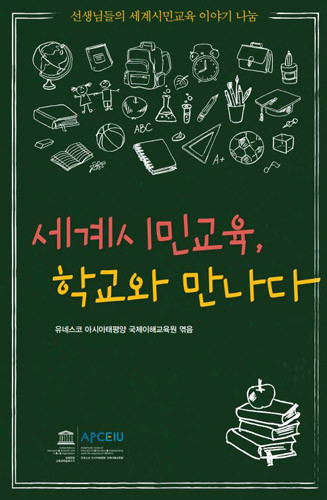 Encountering Global Citizenship Education in Schools: Stories of School Teachers on GCED Year of publication: 2016 Corporate author: APCEIU Titled “Encountering Global Citizenship Education in Schools: Stories of School Teachers on GCED,” the book includes stories of 11 GCED Lead Teachers focusing on the practical implementation of GCED in real educational setting. Readers will be able to learn from the experiences of those teachers, who worked to implement GCED in the field of education. Moreover, this publication provides an opportunity for educators from small primary schools in rural areas to the high schools in big cities, to think about the implications associated with GCED and how GCED can be used for students from diverse backgrounds and various ages. The stories included in the book are as follows: • GCED Starts from the Horizontal Relationships • GCED Practices in Small Schools • Doing by Learning, Learning by Doing • To View Social Issues from the Children's Perspective • Living through Communication with the People of Earth • Meeting Global Citizens in Jeju • Beginning of GCED with Students and Teachers • Starting with a Slow Change : The Story of a Candle • GCED with the views of the Children • A Path to the Future, Walking with Teachers to GCED • GCED is to Search for Values in Daily Lives
  Final Report: 2nd Youth Leadership Workshop on Global Citizenship Education Year of publication: 2016 Corporate author: APCEIU This report provides an overview of the activities carried out during the 2nd Youth Leadership Workshop on Global Citizenship Education (GCED) held in Busan, Republic of Korea, from 11 - 16 July 2016. As an APCEIU's 2nd youth workshop, this programme gathered 49 youth activists from 38 countries around the world to exchange their ideas and identify GCED leadership strategies in order to mobilize young people for GCED in local and national contexts and advance the agenda globally. This report also aims to convey the voice of the youth on GCED: their thoughts and reflections on GCED and its priority areas. The workshop was co-organized by APCEIU and UN Secretary General’s Global Education First Initiative (GEFI); it was sponsored by Busan University of Foreign Studies and the Geum-jeong District of Busan Metropolitan City. For more information, please contact APCEIU's Office of Education and Training at ent@unescoapceiu.org.
  Final Report: 2016 UNESCO/KOICA Joint Fellowship Programme Year of publication: 2016 Corporate author: APCEIU This report provides an overview of the activities carried out during the 2016 UNESCO/KOICA Joint Fellowship Programme held in Republic of Korea from 1 September - 31 October, 2016.In its 10th year of implementation, UNESCO/KOICA Joint Fellowship Programme 2016 invited 25 educators from 17 countries in Africa and the Asia-Pacific region for two months; from September 1st to October 31st. The overarching goal of the Programme was to enhance the capacities of participating educators under the themes of “Teacher Training for Basic Education,” “Use of ICT for Education (or e-Learning),” “Leadership in Global Education” and “Girls’ Education.” Composed of various segments such as lectures, workshops, hands-on activities, and seminars, which were closely interlinked with each module, the modules were designed to enable the participants to reorient their perspectives on educational development, to gain essential knowledge and skills, and furthermore to produce meaningful and relevant outputs that could be widely applied in their local contexts.For more information, please contact APCEIU's Office of Education and Training at ent@unescoapceiu.org.
 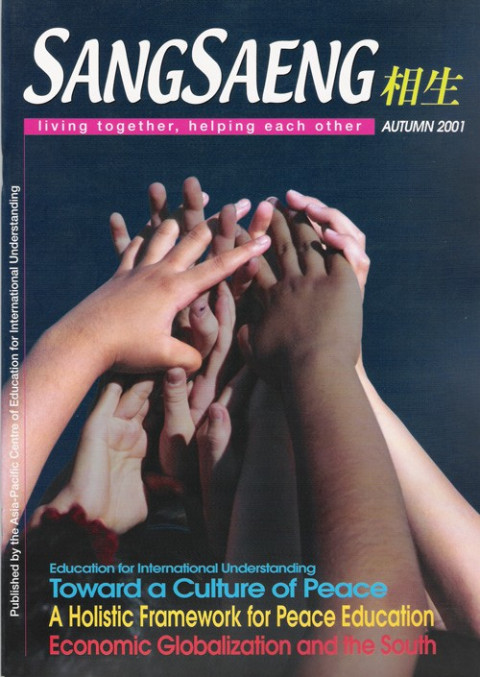 Education for international understanding: toward a culture of peace (SangSaeng vol1. autumn 2001) Year of publication: 2001 Author: Swee-Hin Toh Corporate author: APCEIU Over the past several decades of political, economic, social and cultural changes and developments throughout the world, the idea of education for international understanding (EIU) has evolved through the work of innumerable educators, researchers, institutions and organizations. Initially, the focus in school and tertiary programs tended to emphasize the need to increase the level of knowledge about other nations, societies and cultures as a key means to promote better, more “peaceful” international (economic and political) and intercultural relations. Especially in universities of the “North,” area studies of different regions and countries expanded and found their way into school-based curricula. In part, EIU was deemed important and helpful in the development of human resources needed to implement foreign aid programs. It was also a response to the increased internationalization of campuses due to the growing numbers of foreign/overseas students. By the 60s, however, a variety of social and political forces and movements were beginning to impact on this earlier focus of EIU. First, it was no longer viewed only in terms of understanding the relations between “nations” or “societies” across political and economic boundaries. EIU would need also to look closely at local and internal issues, and at problems of one’s own society that might significantly influence the direction and nature of international relations. Furthermore, conceptual perspectives on EIU began to reflect a spectrum of frameworks of understanding and analysis, from “conservative” and “liberal” to more “critical” paradigms. Underpinning the critical approaches was a questioning of the power inequities characterizing the international order of nation-states, and the need to overcome such gaps if the original vision of “world peace” was to be fulfilled. Third, the evolving theory and practice of EIU took on a host of societal, international and increasingly global issues deemed urgent at all levels of life.
 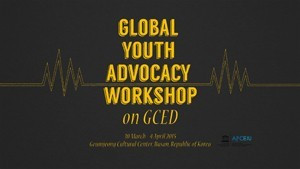 Video sketch: Global Youth Advocacy Workshop on GCED Year of publication: 2015 Corporate author: APCEIU APCEIU produced a video on the Global Youth Advocacy Workshop on GCED held in Busan, Republic of Korea, from 30 March to 4 April 2015. The workshop invited 45 youth participants from 34 countries around the world, who are actively engaged with and committed to advocating and educating youth for GCED in their local contexts.This short video sketch of the workshop provides an overview of the activities carried out during the workshop and also includes the interviews of the participants, who shared their expectations, impressions, and reflections on the workshop.The workshop was co-organized by APCEIU, UN Secretary General’s Global Education First Initiative (GEFI), and the UNESCO Mahatma Gandhi Institute of Education for Peace and Sustainable Development (MGIEP); and sponsored by Educate A Child and the Geum-jeong District of Busan Metropolitan City.