
Resources
Explore a wide range of valuable resources on GCED to deepen your understanding and enhance your research, advocacy, teaching, and learning.
219 Results found
 International Understanding and Cooperation in Education in the Post-Corona World Year of publication: 2020 Author: Dongjoon Jo | Edward Vickers | Dina Kiwan | Fei Yan | Kyujoo Seol | Kyoko Nakayama Corporate author: APCEIU Research Report of International Understanding and Cooperation in Education in the Post-Corona World APCEIU has published a report, including research studies from 6 experts in order to figure out the role of education in promoting international understanding and cooperation in the education sector in the post-pandemic world. Through this research project, APCEIU mainly sought to answer the following questions; ▲What will be the implications of COVID-19 for international exchange and cooperation especially in education?▲What should we as educators, researchers, and practitioners do to counter the rise of populist nationalism?▲What should be the focus and direction of international cooperation in education during and after the pandemic in order to promote international understanding and GCED? This research project is expected to provide insightful views on the desirable direction for international understanding and cooperation in the education sector. Table of Contents 1. The development of UNESCO’s exchange programmes and their possible rearrangements in the post-pandemic years (Dong-Joon Jo, Professor at Department of Political Science and International Relations, Seoul National University, Korea) 2. ‘Rethinking Schooling’ once again: Post-corona challenges for education for peace and sustainability in Asia (Edward Vickers, Professor of Comparative Education at Kyushu University, Japan) 3. Race, gender, disability, and their intersections under the impact of COVID-19 (Dina Kiwan, Professor in Comparative Education, University of Birmingham, United Kingdom) 4. Competition or cooperation: Configuring ‘International’ in Chinese school textbooks (Fei Yan, Post-Doctoral Research Fellow, South China University, China) 5. The implications of democratic citizenship education and global citizenship education in South Korea for the post-corona era (Kyujoo Seol, Professor of Social Studies Education, Kyeongin National University of Education, Korea) 6. What can we learn from the pandemic of COVID-19?: An attempt to develop teaching materials for international understanding and cooperation based on Japanese educational issues (Kyoko Nakayama, Professor of Social Studies Education and Multicultural Education, Teikyo University, Japan)
  Global Citizenship Concepts in the Curricula of Four Countries Year of publication: 2017 Author: Natalie Browes Corporate author: UNESCO International Bureau of Education (IBE) | APCEIU This report details the presence of Global Citizenship Education (GCED) concepts in the education systems of four countries: Cambodia, Colombia, Mongolia and Uganda. It highlights the main findings of eight reports: four expert reports, which predominately analyse curriculum content, and four situational analysis reports, which take a broader view and detail some of the country-specific challenges and opportunities with regard to GCED. Findings reveal the presence of GCED concepts across the curricula of the four countries. In addition to cognitive content related to GCED, competency-based content is also found present within the curricula of these countries. However, the majority of this content can only be indirectly linked to GCED, and it is better interpreted as part of the more traditional civics or citizenship education approach. As such, it generally lacks a global perspective and does not engage with all key themes of GCED. Furthermore, this content is often concentrated at the lower and upper secondary levels, instead of being equally distributed across all grade levels. This is particularly true in the case of behaviour-based competencies. Findings also reveal challenges beyond the curriculum. These include lack of teacher training and lack of support to implement GCED, which are concerns expressed by stakeholders in all four countries. A lack of GCED content in textbooks and lack of supplementary materials were also found to be issues. The report concludes with recommendations regarding the effective implementation of GCED within curricula. Among others, the report suggests the transversal integration of GCED - across the curriculum at all grade levels, while at the same time, actors from all levels of the education system, ranging from central government to teachers, should be engaged to ensure the use of complementary learning materials, pedagogies and assessment techniques.
  A Study on the Status of Implementation of Global Citizenship Education in Lifelong Education in South Korea Year of publication: 2019 Corporate author: APCEIU The Asia-Pacific Centre of Education for International Understanding published a report titled "A Study on the Status of Implementation of Global Citizenship Education in Lifelong Education in South Korea". In the recognition of the need for an analysis on the status of implementation for the effective and systematic implementation of Global Citizenship Education (GCED) in the Republic of Korea, APCEIU conducted a study on the status of the implementation of GCED embedded in the curriculum of primary and secondary schools in 2018. As a follow-up study, this research paper examines the practice of civic education in the field of lifelong learning for adults and the formation, status and implementation process of GCED in which it appears and explores the potential for activation.
 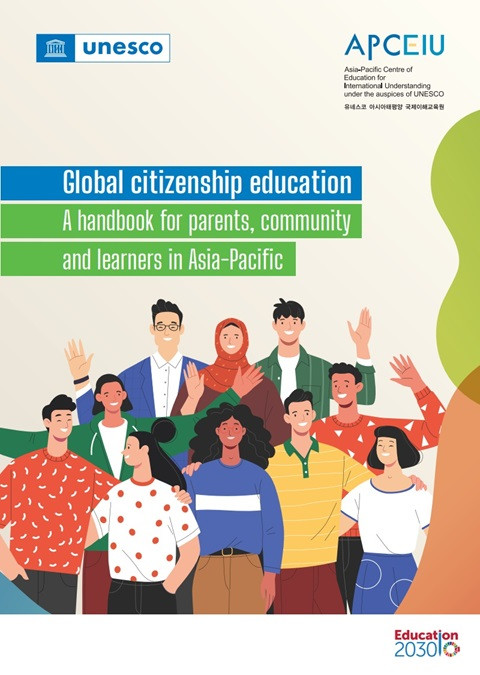 Global Citizenship Education: A Handbook for Parents, Community and Learners in Asia-Pacific Year of publication: 2023 Author: Darla K. Deardorff | Seek Ling Tan Corporate author: UNESCO Bangkok | APCEIU This handbook aspires to engage and involve parents, caregivers and the community to join the mission of developing every learner into a global citizen. To achieve this, parents, caregivers and the community will need to be empowered with the necessary GCED knowledge and skills too. In this handbook, GCED related concepts are introduced, alongside adaptable step-by-step action plans and best practices collected across the Asia-Pacific region to support parents and the community to take action in developing GCED competences in learners.
  21st Asia-Pacific Training Workshop on EIU GCED Mentorship Programme - Final Report Year of publication: 2022 Corporate author: APCEIU This report summarizes 18 GCED projects implemented in the Asia-Pacific region by the alumni of APCEIU’s 21st Asia-Pacific Training Workshop on EIU/GCED (2022).The Mentorship Programme consisted of two tracks.1) Track A: Individual Mentorship with APCEIU’s expert groups (Concretizing the GCED project with guidance from mentors)2) Track B: Developing GCED Training Programme using Design Thinking Strategy with APCEIU & Habi Education LabAsia-Pacific Training Workshop on EIU/GCED (APTW) is APCEIU’s flagship TOT (Training of Trainers) programme for educators and teacher trainers in the Asia-Pacific region, which benefitted more than 600 educators over the last 22 years. Since 2021, it has been shifted to a comprehensive training programme composed of online training workshops, mentorship, and local project implementation to further empower participants to bring changes in their local communities.In 2022, marking its 21st turn, APTW was virtually held from 30 May to 7 June with 52 passionate educators from 19 UNESCO member states in the Asia-Pacific region. This year with the theme of ‘Preparing educators for a post-pandemic world: GCED as a key to change’, the Workshop provided opportunities to explore the timely issues and pedagogies to prepare educators for the post-pandemic world.
  Roundtable of the Group of Friends for Solidarity and Inclusion with GCED: "Art Education Fostering Global Citizenship" Year of publication: 2023 Author: Hyunmook Lim Corporate author: APCEIU This report shares the overview of the Roundtable of the Group of Friends for Solidarity and Inclusion with GCED: “Art Education Fostering Global Citizenship”, held on Friday, 16 June 2023. The event was co-organized by the Permanent Delegation of the Republic of Korea to UNESCO and the Asia-Pacific Centre of Education for International Understanding (APCEIU) in partnership with the Group of Friends for Solidarity and Inclusion with GCED (Afghanistan, Armenia, Austria, Bangladesh, Canada, Colombia, Italy, Jordan, Kenya, Kuwait, Philippines, Republic of Korea, Saudi Arabia, Senegal, Serbia, Nigeria and Oman). This report shares the summary of the event, particularly the presentations on GCED activities through arts education by experts from Finland, Lebanon, the Republic of Korea and Nigeria to promote the values and initiatives of GCED through arts education.
  Establishing a Monitoring System for Global Citizenship Education in South Korea: A Preliminary Study with a Focus on Policy Area Year of publication: 2019 Corporate author: APCEIU The Asia-Pacific Centre of Education for International Understanding published a report titled "Establishing a Monitoring System for Global Citizenship Education in South Korea: A Preliminary Study with a Focus on Policy Area." The purpose of this research report is to provide implications for the development of indicators for Global Citizenship Education (GCED) which is the target 4.7 of the Sustainable Development Goals (SDGs) and the establishment of a Korean monitoring system for data accumulation. It is difficult for GCED to set up common indicators to monitor the implementation of each country, as it comprehensively deals with the direction and contents of education, whereas other targets of SDG4 are relatively clear targets and goals such as guaranteeing educational opportunities and improving educational conditions. For this reason, this study proposed Korean indicators based on domestic and international trends and analysis of issues concerning the development of SDG4.7.1 indicators and reviewed the domestic status in implementation based on them, thereby contributing to the development and consolidation of global indicators development and monitoring systems in the future.
  Inaugural Meeting of the GCED Actors' Platform: Final Report Year of publication: 2020 Corporate author: APCEIU This final report gives an overview of discussions and outcomes from the “Inaugural Meeting of the GCED Actors’ Platform” on 2 September 2019 in Seoul, Republic of Korea, held back-to-back with the 4th International Conference on GCED (3-4 September 2019, Seoul) In line with the call for closer collaboration on GCED inter-regionally, the GCED Actors’ Platform was launched by UNESCO Headquarters and APCEIU in 2019. Convening regional coordinators and different partners working on GCED, the “Inaugural Meeting of the GCED Actors’ Platform” provided an open space for the participants to discuss ways to coordinate activities and promote synergies.The regional representatives have imparted their own experiences and challenges on the ground and shared best practices of facilitating GCED.
 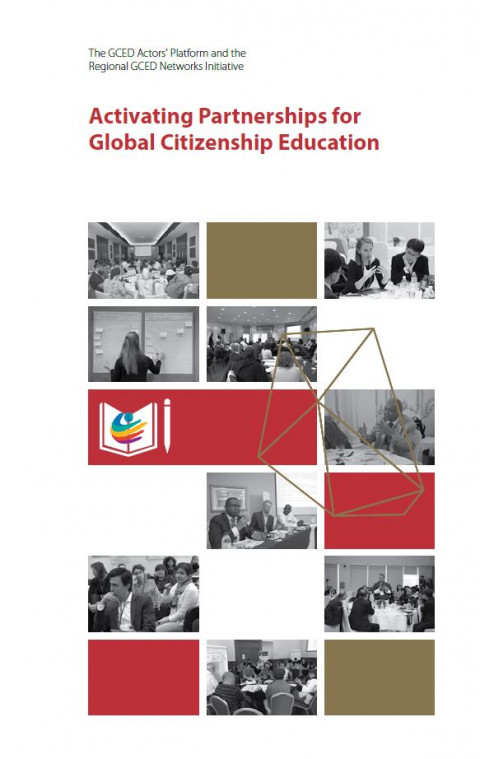 The GCED Actors' Platform and the Regional GCED Networks Initiative: Activating Partnerships for Global Citizenship Education Year of publication: 2020 Corporate author: APCEIU This brief publication introduces and summarizes the flagship GCED Network initiatives supported by APCEIU implemented globally and regionally.UNESCO Headquarters and APCEIU co-convened the launch of the GCED Actors’ Platform in which gathered key partners across the globe and representing five Regional GCED Networks. These five Regional GCED Networks include Sub-Saharan Africa, Arab States, Asia-Pacific, Europe and North America, and Latin America and the Caribbean are formed to identify regional priorities and implement regional strategies to promote GCED. The publication also showcases successful independent activities by organizations part of the GCED Network initiative.
  Asia-Pacific Teacher Exchange for Global Education Year of publication: 2019 Corporate author: APCEIU | Korea R. Ministry of Education Asia-Pacific Teacher Exchange for Global Education (APTE) is a bilateral teacher exchange programme between the Republic of Korea and Asia-Pacific partner countries, hosted by the Ministry of Education of the Republic of Korea and implemented by the Asia-Pacific Centre of Education for International Understanding under the auspices of UNESCO (APCEIU) in collaboration with the Ministries of Education of the partner countries. Launched with two partenr countries -- Mongolia and the Philippines -- in 2012, APTE has grown into a well-known regional programme, now working with seven partner countries in the Asia-Pacific region -- Cambodia, Indonesia, Malaysia, Mongolia, Philippines, Thailand, and Vietnam.