
Resources
Explore a wide range of valuable resources on GCED to deepen your understanding and enhance your research, advocacy, teaching, and learning.
219 Results found
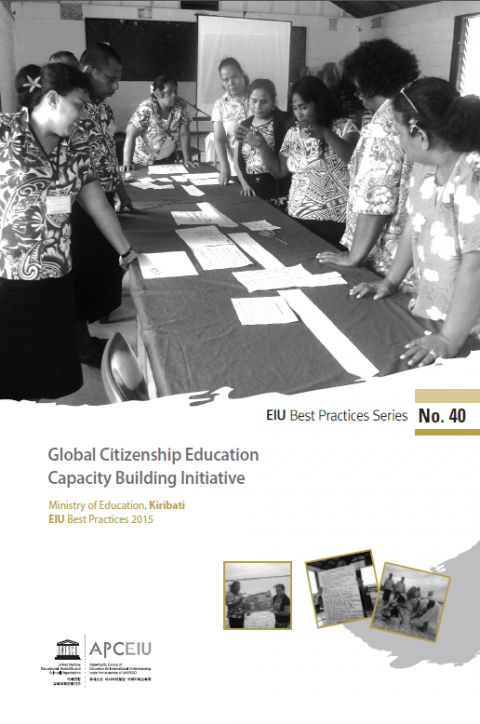 EIU Best Practices Series No.40: Global Citizenship Education Capacity Building Initiative: Misitry of Education, Kiribati Year of publication: 2015 Corporate author: APCEIU This monograph is one of APCEIU's EIU Best Practices Series, which aims to encourage educators, scholars, and activists to implement and share local initiatives on EIU. The Series No. 40 introduces a successful hosting of workshop on GCED in Kiribati. Considered the first of its kind in Kiribati, the workshop brought together education officers and teachers to learn about emerging concept of GCED and EIU and means for implementation. The exemplary workshop involving fieldtrips and seminars has created a wave of learning opportunities for key stakeholders at all levels, paving way to put GCED into practice.
 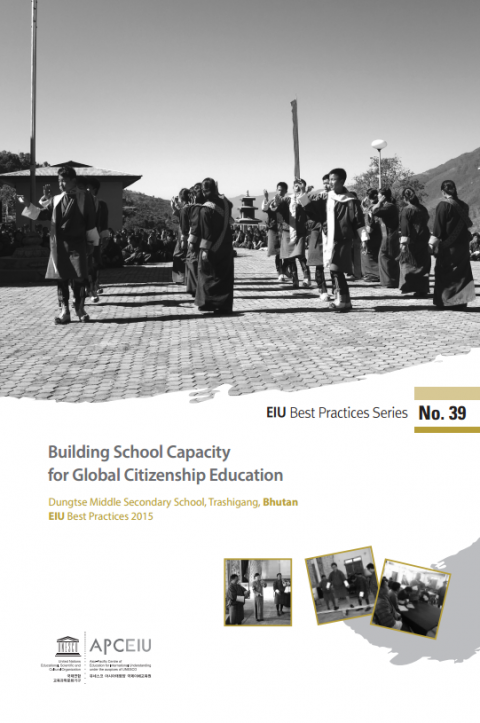 EIU Best Practices Series No. 39: Building School Capacity for Global Citizenship Education Year of publication: 2015 Corporate author: APCEIU This monograph is one of APCEIU's EIU Best Practices Series, which aims to encourage educators, scholars, and activists to implement and share local initiatives on EIU. The Series No.39 introduces the Training of Trainers (TOT) program, a workshop for teachers to better incorporate GCED/EIU concepts into respective curriculum and school environment. Upon participating in the APCEIU training workshop, Mr. Yeshi Dorji from Dungtse Middle Secondary School in Bhutan sought to create a forum in which teachers and school officials can learn to incorporate GCED. Such exemplary initiative not only enhances capacity building of educators in the school, but also has potential to have larger impact in the local and regional communities.
  [Summary] Global Citizenship Education Forum: Sharing Stories of Empowering Citizens to Tackle Global-Local Challenges Year of publication: 2022 Corporate author: Permanent Delegation of the Republic of Korea to UNESCO | Group of Friends for Solidarity and Inclusion with Global Citizenship Education | APCEIU This report shares the overview of the Global Citizenship Education Forum held under the theme ‘Sharing Stories of Empowering Citizens to Tackle Global-Local Challenges’ on Friday, 13 May 2022. The event was co-organized by the Permanent Delegation of the Republic of Korea to UNESCO and the Asia-Pacific Centre of Education for International Understanding (APCEIU) in collaboration with the Group of Friends for Solidarity and Inclusion with GCED (Afghanistan, Armenia, Austria, Bangladesh, Canada, Colombia, Italy, Jordan, Kenya, Kuwait, Philippines, Republic of Korea, Saudi Arabia, Senegal and Serbia). This report shares the summary of the event, particularly the presentations on GCED activities implemented by practitioners from Armenia, Austria, Colombia, Jordan, Kenya and the Philippines to influence more GCED programmes/initiatives on various contexts and backgrounds.
  2022 SSAEM Conference: Final Report Year of publication: 2023 Corporate author: APCEIU | Korea R. Ministry of Education The 2022 SSAEM (Sharing Stories of Asia-Pacific Education Movements) Conference is a space for examining and sharing the educational outcomes of the participating teachers and schools of the programme. This conference, which has been held annually since 2014, aims to provide an excellent opportunity for the participants and stakeholders to showcase the impact of the programme and to explore methods for strengthening cooperation for further development of the programme. The main programme included the panel discussion of the Ministry representatives of the 8 countries, the presentation of 2022 programme participants, etc.
  Asia-Pacific Teacher Exchange for Global Education 2022: Final Report Year of publication: 2022 Corporate author: APCEIU | Korea R. Ministry of Education The Asia-Pacific Teacher Exchange for Global Education (APTE), which has been in place since 2012, marks its 10th anniversary this year. APTE had been conducted according to the existing programme execution system and flow chart until 2019. However, the Office of International Teacher Exchange (ITE) focused on online exchange due to the pandemic crisis. This year’s APTE programme followed last year’s online formula and presented a new direction for utilization even post-pandemic. These efforts are expected to enhance global educational competencies for a more sustainable Global Citizenship Education.
  2022 Youth Leaders’ Mentorship & Local GCED Projects: Activity Report Year of publication: 2022 Corporate author: APCEIU This report summarizes 15 GCED projects implemented in different parts of the world by the alumni of APCEIU’s Youth Leadership Workshop on GCED in 2022. Ranging from community advocacy for global citizenship to girls’ empowerment projects, 15 GCED initiatives have been taken by the team of 15 young leaders in their own communities in Asia, Europe, Africa, Latin America, and the Caribbean. APCEIU offers GCED training programmes targeting youth leaders around the globe to encourage them to achieve the SDGs through global citizenship and GCED. Since 2015, the Youth Leadership Workshop on GCED has been held every year in the Republic of Korea, inviting 50 young global leaders to take part in an intensive training programme where they share their actions, deepen their knowledge on global/local issues, enhance their motivation to take actions for a change, and establish the young leaders’ network on GCED. Since 2021, it has been shifted to a comprehensive training programme composed of online training workshops, mentorship, and local project implementation.
  APCEIU-MNUAC Joint Research on Establishing the Foundation for Promoting Global Citizenship Education in Higher Education Institutions in Mongolia Year of publication: 2025 Author: Daehoon Jho | Jihyang Lee | Odsuren Dagmid | Mandukhai Baldandorj | Tumennast Dashtsenden | Amartuvshin Myagmarsuren | Delgertsetseg Choijilsuren | Punsaldulam Binderiya Corporate author: APCEIU | Mongolia National University of Arts and Culture (MNUAC) This report reviews the integration of global citizenship education (GCED) in higher education and examines various approaches to establishing a foundation for promoting GCED in Mongolian HEIs. To this end, the study conducted a situational analysis on the current status of GCED at MNUAC. Based on this analysis, the report proposes a GCED integration roadmap for MNAUC, outlining a sequenced pathway that begins with achievable initiatives while also offering insights for other HEIs in Mongolia. The report is available in both English and Mongolian.
  Supporting Change in Practice: Case Studies on the Use of the ACER-APCEIU Global Citizenship Education Monitoring Toolkit: Country Case-Republic of Korea Year of publication: 2025 Author: Suyeon Park | Sunmi Ji | Yoonyoung Lee Corporate author: APCEIU APCEIU is pleased to announce the release of its new publications, Supporting Change in Practice: Case Studies on the Use of the ACER-APCEIU Global Citizenship Education Monitoring Toolkit, which shares key findings from the research conducted in Australia and the Republic of Korea. The two reports, based on case studies from two countries, build upon the three-phase Asia-Pacific GCED Monitoring Project (2022–2024) jointly undertaken by ACER and APCEIU to strengthen monitoring and evaluation of GCED and support progress toward SDG 4.7 across the region. The three phases of the initiative identified enabling conditions for GCED, validated the regional GCED Monitoring Framework, and developed the ACER-APCEIU GCED Monitoring Toolkit. The reports for each phase can be found here: Phase I, Phase II, and Phase III. The newly released reports move the project forward by examining how the Toolkit can be practically applied in real educational settings. The study aimed to examine how the Toolkit could be used to support collaboration among key education stakeholders—teachers, school leaders, and education supervisors—in 1) goal setting, 2) planning, 3) implementing, and 4) reflecting on GCED practices. Through this process, the research sought to understand how the Toolkit could help strengthen the connection between policy commitments and everyday educational practice, supporting teachers, school leaders, and system leaders to embed GCED more systematically and sustainably within their existing framework. Both studies conducted in Australia and the Republic of Korea have been guided by the following research questions: 1. How does the GCED Monitoring Toolkit support key stakeholder groups to collaboratively embed GCED in policy and practice? a. What aspects of the Toolkit enable or challenge stakeholders to achieve their GCED goals and objectives? b. How do key stakeholders perceive its usefulness? 2. Are there any aspects of the Toolkit that stakeholders would change to improve its usefulness in supporting the implementation and contextualisation of GCED in policy and practice?The reports demonstrate how a GCED Monitoring Toolkit can be translated into actionable processes within real educational settings. It offers valuable insights for policymakers, school leaders, teachers, and researchers aiming to monitor and strengthen GCED implementation and systematically embed GCED within their educational ecosystems.
 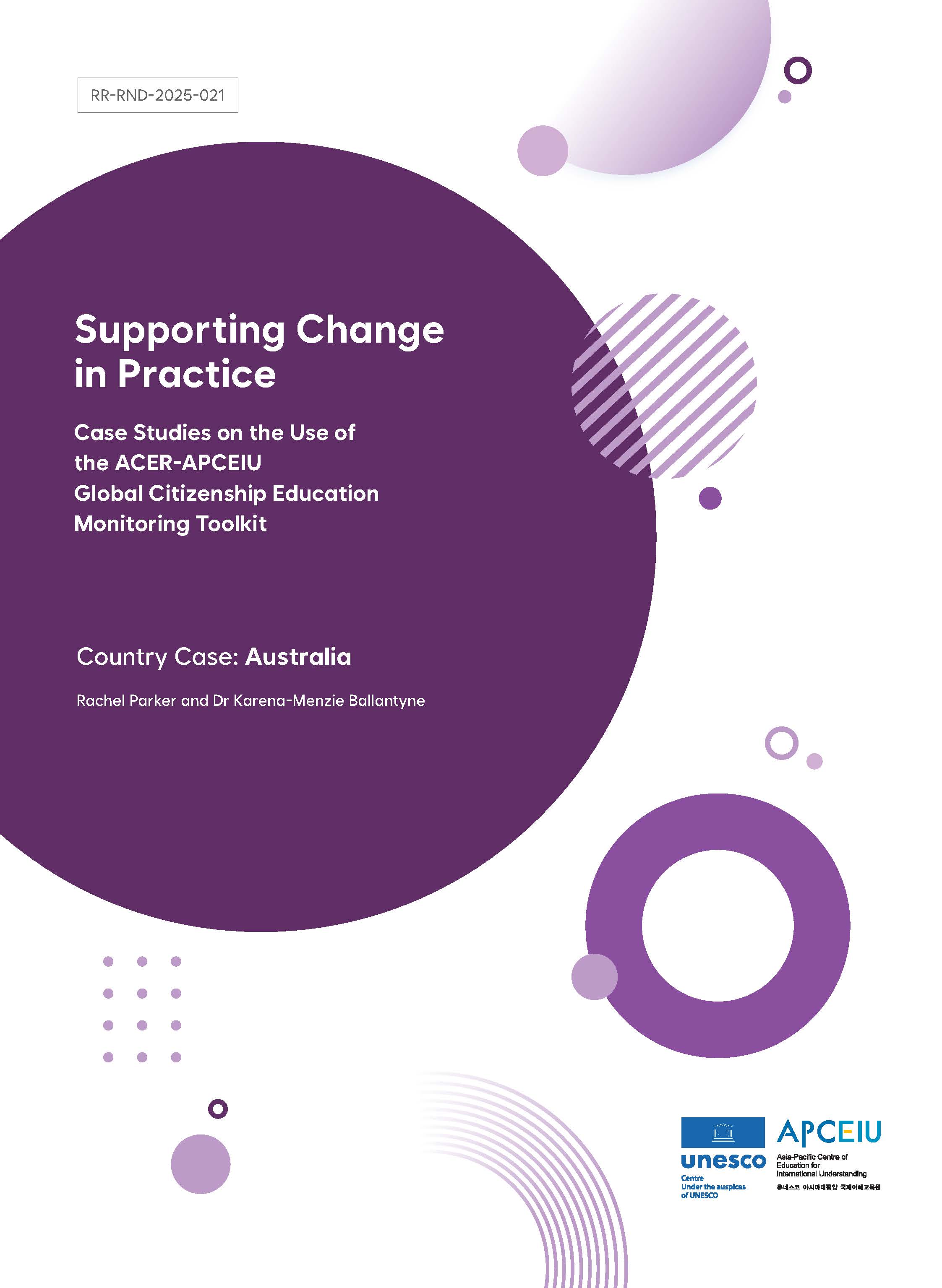 Supporting Change in Practice: Case Studies on the Use of the ACER-APCEIU Global Citizenship Education Monitoring Toolkit; Country Case-Australia Year of publication: 2025 Author: Rachel Parker | Karena Menzie-Ballantyne Corporate author: APCEIU APCEIU published Supporting Change in Practice: Case Studies on the Use of the ACER-APCEIU Global Citizenship Education Monitoring Toolkit, which shares key findings from the research conducted in Australia and the Republic of Korea. The two reports, based on case studies from two countries, build upon the three-phase Asia-Pacific GCED Monitoring Project (2022–2024) jointly undertaken by ACER and APCEIU to strengthen monitoring and evaluation of GCED and support progress toward SDG 4.7 across the region. The three phases of the initiative identified enabling conditions for GCED, validated the regional GCED Monitoring Framework, and developed the ACER-APCEIU GCED Monitoring Toolkit. The reports for each phase can be found here: Phase I, Phase II, and Phase III.The reports move the project forward by examining how the Toolkit can be practically applied in real educational settings. The study aimed to examine how the Toolkit could be used to support collaboration among key education stakeholders—teachers, school leaders, and education supervisors—in 1) goal setting, 2) planning, 3) implementing, and 4) reflecting on GCED practices. Through this process, the research sought to understand how the Toolkit could help strengthen the connection between policy commitments and everyday educational practice, supporting teachers, school leaders, and system leaders to embed GCED more systematically and sustainably within their existing framework. Both studies conducted in Australia and the Republic of Korea have been guided by the following research questions: How does the GCED Monitoring Toolkit support key stakeholder groups to collaboratively embed GCED in policy and practice? a. What aspects of the Toolkit enable or challenge stakeholders to achieve their GCED goals and objectives? b. How do key stakeholders perceive its usefulness?Are there any aspects of the Toolkit that stakeholders would change to improve its usefulness in supporting the implementation and contextualisation of GCED in policy and practice?The reports demonstrate how a GCED Monitoring Toolkit can be translated into actionable processes within real educational settings. It offers valuable insights for policymakers, school leaders, teachers, and researchers aiming to monitor and strengthen GCED implementation and systematically embed GCED within their educational ecosystems.
 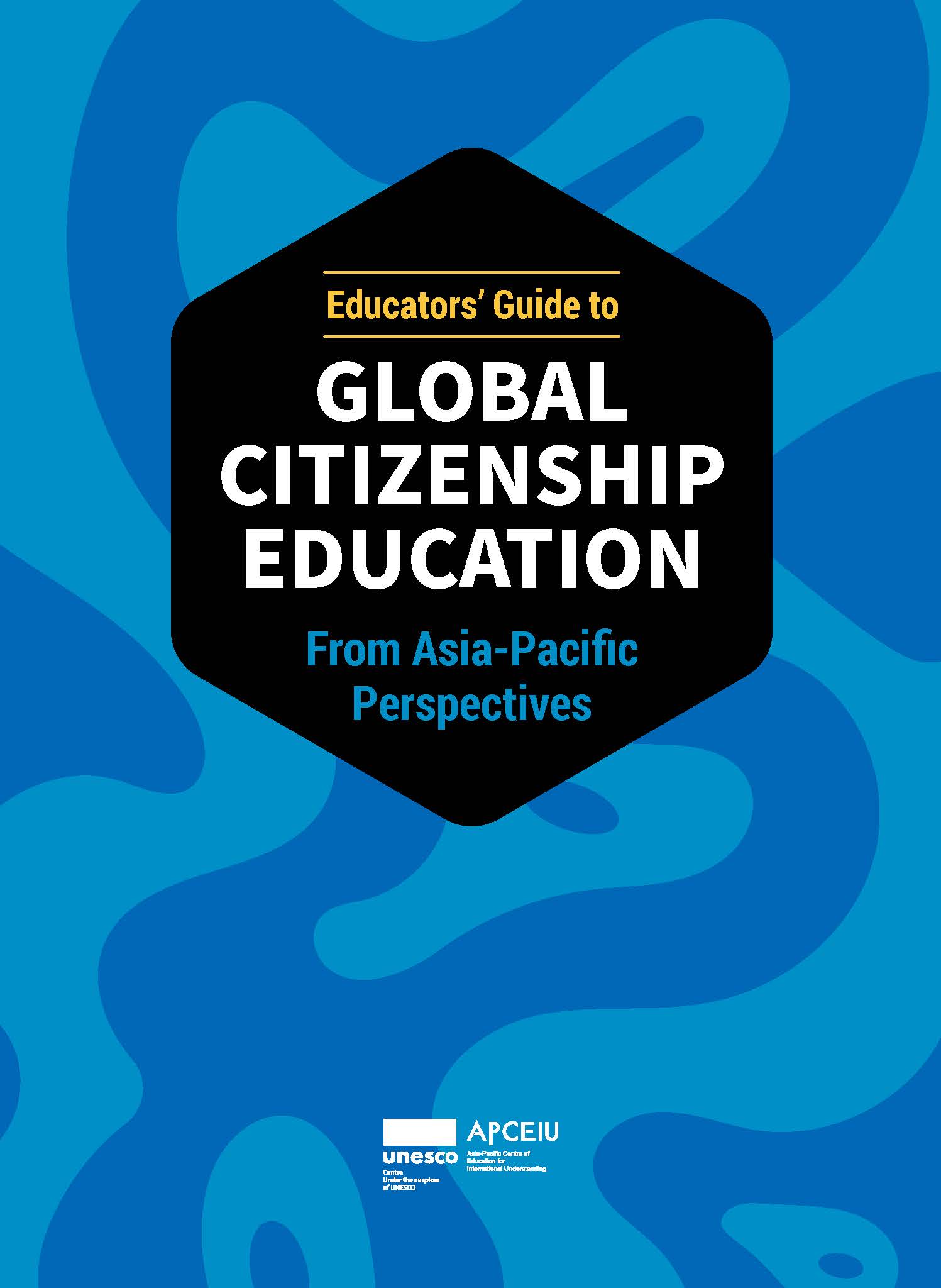 Educator's Guide to Global Citizenship Education: From Asia-Pacific Perspectives Year of publication: 2025 Author: Athapol Anunthavorasakul | Keith C. Barton | Sicong Chen | Suzanne S. Choo | Thippapan Chuosavasdi | Li-Ching Ho | Aigul Kulnazarova | Mousumi Mukherjee | Mousumi Roy | Tania Saeed | Tanya Wendt Samu | Kyujoo Seol | Jun Teng Corporate author: APCEIU Educators’ Guide to Global Citizenship Education from Asia-Pacific Perspectives is designed to translate rich discussions from Rethinking Global Citizenship Education from Asia-Pacific Perspectives (2024) into a more accessible resource for educators. This Guide supports educators by presenting scholarly insights in practical and actionable ways. Serving as a bridge between theory and practice, it helps educators grasp key ideas of global citizenship education (GCED) from Asia-Pacific perspectives, reflect on their relevance to their own contexts, and apply them through concrete activities, stories, cases examples, and instructional strategies. This Guide, which is grounded in the diverse philosophies, religions, and lived realities of the Asia-Pacific region, is intended to serve as a practical companion that helps educators understand GCED from a decolonial perspective, adapt its ideas to their own contexts, and translate it all into meaningful learning experiences for their learners. It is our sincere hope that this Guide fosters ongoing dialogue, experimentation, and collaboration, and that it contributes to nurturing learners who think critically, act with empathy and justice, and participate responsibly in shaping a more harmonious and sustainable world.