
Resources
Explore a wide range of valuable resources on GCED to deepen your understanding and enhance your research, advocacy, teaching, and learning.
219 Results found
 2023 Asia-Pacific Training Workshop on EIU: Mentorship Programme Final Report Year of publication: 2023 Corporate author: APCEIU Asia-Pacific Training Workshop on EIU/GCED (APTW) is APCEIU's flagship Training of Trainers (TOT) programme for educators and teacher trainers in the Asia-Pacific region. Over the last 23 years, APCEIU benefitted more than 650 educators through the workshop. Especially, since 2021, the workshop has been carried out online training workshops, mentorship, and local project implementation to further support the participants to bring positive and sustainable changes in their local communities. In 2023, the 22nd APTW was virtually held from 30 May to 8 June with the theme of 'GCED as a Common Vision for Change.' 56 enthusiastic educators from 16 UNESCO member states in the Asia-Pacific region joined the programme. The workshop provided a venue to learn and discuss how GCED could contribute to transforming current education. This report summarizes 14 GCED projects implemented in the Asia-Pacific region by the 22nd APTW alumni who participated in the mentorship programme.
  Global Capacity-Building Workshop on GCED 2023: Follow-Up Activity Report Year of publication: 2023 Corporate author: APCEIU This report summarizes 15 GCED projects implemented by the selected mentees/grantees of APCElU's 8th Global Capacity-Building Workshop on GCED on 13-21 July 2023. The projects include teacher training workshops, curriculum development, school-based activities, and community development projects, undertaken by educators, teachers, and practitioners in Asia, Europe, Africa, Latin America, and the Caribbean. The mentees/grantees first participated in the 8th Global Capacity-Building Workshop on GCED in August 2023. After completing the Workshop, graduates submitted GCED proposals to be selected as grantees/mentees. The selected 15 mentees/grantees were matched with expert mentors who guided them in their project development and implementation. This report describes the summary of 15 projects held in different corners of the world along with their outputs.
 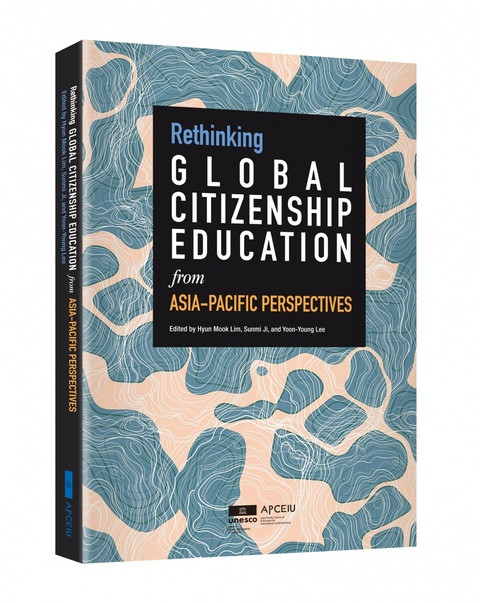 Rethinking Global Citizenship Education: From Asia-Pacific Perspectives Year of publication: 2024 Author: Sicong Chen | Suzanne S. Choo | Thippapan Chuosavasdi | Aigul Kulnazarova | Mousumi Mukherjee | Tania Saeed | Tanya Wendt Samu | Kyujoo Seol | Jun Teng Corporate author: APCEIU Rethinking Global Citizenship Education from Asia-Pacific Perspectives aims to rethink and reinterpret global citizenship and GCED in light of the cultural and historical contexts and political and economic conditions of the Asia-Pacific region. The edited volume offers an in-depth exploration of global citizenship and GCED through the contributions of nine scholars who examine the subject from a range of cultural, historical, and theoretical perspectives. Each chapter brings to light the complexities involved in fostering global citizenship in an era defined by both growing interconnectedness and intensifying political, social, and economic divides.This book is structured into three parts. The first part examines how various philosophical traditions from the Asia-Pacific region, such as Confucian cosmopolitanism, Tagore’s mindset, Pacific indigenous wisdom, and the Tianxia system, can inform and enrich the concept of GCED. The second part delves into the foundational ideas of global citizenship embedded within Asian religious and spiritual traditions, including Buddhist and Sufi perspectives. The third part provides case studies from Central and East Asia, highlighting the practical application of GCED in local contexts such as Kazakhstan, China, Japan, and South Korea. Together, these chapters offer a comprehensive analysis of the evolving challenges, opportunities, and innovations within GCED from Asia-Pacific viewpoints, emphasising the need for education systems to adapt and respond to the multifaceted nature of global citizenship.
  ACER-APCEIU Global Citizenship Education Monitoring Toolkit: For Teachers, Schools and System Leaders Year of publication: 2024 Author: Rachel Parker | Amy Berry | Payal Goundar | Karena Menzie-Ballantyne Corporate author: Australian Council for Educational Research (ACER) | APCEIU The APCEIU-ACER GCED Monitoring Toolkit was developed and informed by research conducted from 2022-2024 in collaboration with partners in Australia, Lao PDR, Philippines, and South Korea. The toolkit aims to assist education stakeholders to embed GCED within policy and practice in alignment with local, regional, and international frameworks. Target users of this toolkit include policy makers, education department and ministry personnel, leaders, and educators at all levels in both formal and non-formal education sectors.The toolkit explores effective GCED including how to conceptualise and define, plan, enact and monitor implementation, and how to measure success. By guiding educators and leaders to align their enactment and monitoring efforts to international guidance, research, theory and practice, this toolkit supports a robust and evidence-informed process for enacting GCED in ways that nurture learners as proactive and empowered global citizens.Phase I Report (Link): https://www.unescoapceiu.org/post/4995Phase II Report (Link): https://www.unescoapceiu.org/post/5184
  7th Global Capacity-Building Workshop on GCED: Mentorship Programme Activity Report Year of publication: 2023 Corporate author: APCEIU This report summarizes 15 GCED projects implemented by the selected mentees/grantees of APCElU's 7th Global Capacity-Building Workshop on GCED in 2022. 15 GCED initiatives, including teacher training workshops, curriculum development, school-based activities, and community development projects, have been taken by educators, teachers, and practitioners in Asia, Europe, Africa, Latin America, and the Caribbean. The mentees/grantees first participated in the 7th Global Capacity-Building Workshop on GCED in September 2022. After the completion of the Workshop, graduates submit the GCED proposals to be selected as the grantees/mentees. The selected 15 mentees/grantees are matched with expert mentors to be guided for their project development and implementation. This report describes the summary of 15 projects held in different corners of the world, along with its outputs.
  Korea-Japan Teacher's Network on GCED 2023: Final Report Year of publication: 2023 Corporate author: APCEIU APCEIU launched the Korea-Japan Teachers’ Network on GCED in 2021, and since then, participating teachers from Japan and Korea have engaged in varied activities, including collaborative lesson plan development, online seminars, joint classroom projects, and student exchanges. In 2023, the first in-person training workshop was held in the Republic of Korea. Designed to deepen the understanding of GCED/peace education of participants, strengthen their capacities to foster global citizenship through education, share good practices and cases, and plan for future collaboration, the Workshop was attended by 33 Korean and Japanese teachers who have actively engaged in Network activities, including teacher-student exchange.
  2023 Youth Leaders' Mentorship & Local GCED Project: Activity Report Year of publication: 2023 Corporate author: APCEIU This report summarizes 10 GCED projects implemented in different parts of the world by the alumni of APCEIU’s Youth Leadership Workshop on GCED in 2023. Ranging from community advocacy for global citizenship to youth-led campaign projects, 10 GCED initiatives have been taken by 10 young leaders in their own communities in Asia, Europe, Africa, Latin America, and the Caribbean. APCEIU offers GCED training programmes targeting youth leaders around the globe to encourage them to achieve the SDGs through global citizenship and GCED. Since 2015, the Youth Leadership Workshop on GCED has been held every year in the Republic of Korea, inviting 50 young global leaders to take part in an intensive training programme where they share their actions, deepen their knowledge on global/local issues, enhance their motivation to take actions for a change, and establish the young leaders’ network on GCED. Since 2021, it has been shifted to a comprehensive training programme composed of online training workshops, mentorship, and local project implementation.
  5th Annual Meeting of the GCED Actors' Platform: Meeting Report Year of publication: 2023 Corporate author: APCEIU This meeting report provides the summary of the 5th Annual Meeting of the GCED Actors' Platform held on 20 October 2023. The report outlined the presentations from UNESCO, regional coordinators from 4 Regional GCED Networks (Arab States, Asia-Pacific, Latin America and the Caribbean and Sub-Saharan Africa), including their achievements in advancing GCED in their respective regions over the past year and discussion on potential ways to strengthen GCED implementation on both regional and global levels.
  Report on Roundtable for Advocating Global Citizenship Education and Climate Change Education Year of publication: 2023 Corporate author: APCEIU This report shares the overview of the Roundtable for Advocating Global Citizenship Education and Climate Change Education, held on Saturday, 11 November 2023. The event was co-organized by the Permanent Delegation of the Republic of Korea to UNESCO, Office for Climate Education, Asia-Pacific Centre of Education for International Understanding (APCEIU) in partnership with the Group of Friends for Solidarity and Inclusion with GCED (Afghanistan, Armenia, Austria, Bangladesh, Canada, Colombia, Italy, Jordan, Kenya, Kuwait, Philippines, Republic of Korea, Saudi Arabia, Senegal, Serbia, Nigeria and Oman), in support of the Korean National Commission for UNESCO and the French National Commission for UNESCO. This report shares the summary of the event, particularly the presentations on GCED activities and Climate Change Education by experts from Uganda, the Republic of Korea, and France to promote the values and initiatives of GCED and CCE.
  Second Annual Meeting of the Global Citizenship Education Actors’ Platform: Meeting Report Year of publication: 2020 Corporate author: APCEIU This meeting report provides readers with an overview of the sharing and discussion points during the “Second Annual Meeting of the GCED Actors’ Platform” held on 19 November 2020 virtually. The meeting was attended by regional coordinators and key representatives from the five Regional GCED Network (Arab States, Asia-Pacific, Europa and North America, Latin America and the Caribbean and Sub-Saharan Africa) and a representative from the GCED Youth Network. The meeting provided a space for discussion on the current implementation of GCED in each region, with focus on research, and suggestions on how to further strengthen the GCED promotion and collaboration across different regions amid the pandemic.