
Resources
Explore a wide range of valuable resources on GCED to deepen your understanding and enhance your research, advocacy, teaching, and learning.
362 Results found
 Global citizenship education: the school as a foundation for a fair world Year of publication: 2009 Corporate author: Conectando Mundos Consortium (Cidac, inizjamed, Intermon Oxfam, Ucodep) Cette publication est basée sur une initiative sur l'éducation au développement, l'éducation interculturelle, l'éducation populaire, l'éducation des valeurs, l'éducation des droits de l'homme, l'éducation pour le développement durable, l'éducation pour la paix, l'éducation pour l'égalité des sexes, etc. La proposition pédagogique de l’éducation à la citoyenneté mondiale aspire d'intégrer dans une vision cohérente et stimulante, tous ces thèmes, les maintenir dans une relation étroite avec l'autre et en tenant compte de la (augmentation) interdépendance des êtres humains vivant dans une planète dont la pérennité est menacée. Ce livre est le fruit d'un processus qui a été déclenché par l'effort conjoint de quatre ONG européennes de développement, à savoir Cidac, Inizjamed, Intermon Oxfam et Ucodep dans le cadre d'un projet cofinancé par la Commission européenne. Ces organisations se sont données pour objectif de promouvoir la reconnaissance et la prise en compte du contenu et de la méthodologie de l’Éducation à la Citoyenneté Mondiale dans les contextes éducatifs formels dans leurs pays respectifs, afin de démarrer un processus de changement dans les attitudes, les valeurs et les croyances des élèves. Merci à l'initiative et les efforts des quatre organisations mentionnées ci-dessus, et par le biais de diverses réunions et séminaires réalisés au cours des trois dernières années en Espagne, Italie, Portugal et Malte, des groupes d'éducateurs ont été en mesure de venir en face-à-face avec les uns des autres, d'échanger des expériences et réfléchir sur le rôle de l'éducation formelle par rapport aux défis de notre temps. Parmi les autres expériences, la publication contient celle d'un moment clé dans le processus. Cela a eu lieu en Juillet 2008 à Cortona, une petite et belle ville Toscane près de la frontière avec l'Ombrie, et dans lequel de nombreux éducateurs partagent le bénéfice de ce qui était la première rencontre internationale des éducateurs pour la citoyenneté mondiale. L'expérience Cortona, dans lequel près de quatre-vingt dix enseignants venant d'Espagne, le Portugal, Malte, l'Italie, la République dominicaine et le Costa Rica ont participé, a été l'une des étapes - le point de départ, en fait - d'un processus et d'une relation avec pour objectif de développer aux niveaux régional, national et international. Dans cette publication, par conséquent, on peut trouver des indices théoriques mis en avant à Cortona qui encouragent les éducateurs à partager leurs expériences et de comparer le travail accompli par les différents groupes. Cette publication comporte deux parties. La première partie contient des contributions d'un type théorique, alors que la deuxième partie se concentre sur les expériences éducatives des participants à la réunion Cortona. Global citizenship: a typology for distinguishing its multiple conceptions Year of publication: 2013 Author: Laura Oxley | Paul Morris Corporate author: Society for Educational Studies | Taylor & Francis The promotion of ‘Global Citizenship’ (GC) has emerged as a goal of schooling in many countries, symbolising a shift away from national towards more global conceptions of citizenship. It currently incorporates a proliferation of approaches and terminologies, mirroring both the diverse conceptions of its nature and the socio-politico contexts within which it is appropriated. This paper seeks to clarify this ambiguity by constructing a typology to identify and distinguish the diverse conceptions of GC. The typology is based on two general forms of GC: cosmopolitan based and advocacy based. The former incorporates four distinct conceptions of GC – namely, the political, moral, economic and cultural; the latter incorporates four other conceptions – namely, the social, critical, environmental and spiritual. Subsequently, we briefly illustrate how the typology can be used to evaluate the critical features of a curriculum plan designed to promote GC in England. The typology provides a novel and powerful means to analyse the key features of the very diverse range of educational policies and programmes that promote GC. La Citoyenneté Mondiale: une typologie pour distinguer ses multiples conceptions Year of publication: 2013 Author: Laura Oxley | Paul Morris Corporate author: Society for Educational Studies | Taylor & Francis La promotion de la «Citoyenneté Mondiale» (CM) a émergé comme un objectif de scolarisation dans de nombreux pays, symbolisant l'abandon des nationaux vers des conceptions plus globales de la citoyenneté. Il intègre actuellement une prolifération d'approches et terminologies, reflétant à la fois les diverses conceptions de la nature et les contextes socio-politico au sein duquel il est approprié. Ce document vise à clarifier cette ambiguïté en construisant une typologie pour identifier et distinguer les diverses conceptions de la CM. La typologie est basée sur deux formes générales de CM: cosmopolite base et sur la base de plaidoyer. L'ancien incorpore quatre conceptions distinctes de CM - à savoir la politique, morale, économique et culturelle; celui-ci comporte quatre autres conceptions - à savoir, le spirituel sociale, critique, de l'environnement et. Par la suite, nous illustrons brièvement comment la typologie peut être utilisé pour évaluer les caractéristiques essentielles d'un plan de programme conçu pour promouvoir la CM en Angleterre. La typologie fournit une nouvelle et des moyens puissants pour analyser les principales caractéristiques de la gamme très diversifiée de politiques et de programmes éducatifs qui favorisent la CM.
 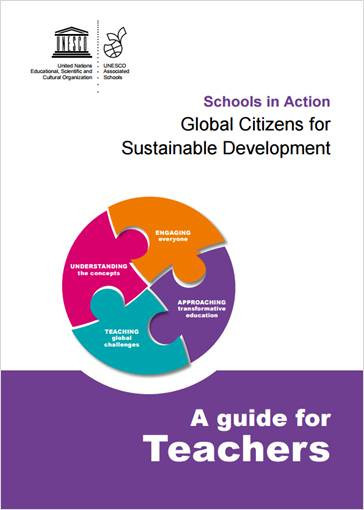 Schools in Action: Global Citizens for Sustainable Development: A Guide for Teachers Year of publication: 2016 Corporate author: UNESCO The Global Citizens for Sustainable Development Teachers’ guide aims to introduce teachers to Global Citizenship Education (GCED) and Education for Sustainable Development (ESD). It provides secondary school teachers with ideas and activities to help students become global citizens and sustainable development actors. The Teachers’ guide draws on the discussions and activities of almost 1,100 participants from 104 countries, including ASPnet National Coordinators, school principals, teachers, students and experts who contributed to the Online Collaborative Platform ASPnet in Action: Global Citizens Connected for Sustainable Development in 2014 and 2015 [http://en.unesco. org/aspnet/globalcitizens] with associated activities and initiatives. The Teachers’ guide provides: An overview of what it means for learners to become global citizens and of how learners can contribute to sustainable development. Ideas for classroom activities that can help secondary school students to develop knowledge, skills, values, attitudes and behaviours that promote GCED and ESD. Selected activities on GCED and ESD from ASPnet schools around the world. Escuelas en acción, ciudadanos del mundo para el desarrollo sostenible: guía para el profesorado Year of publication: 2016 Corporate author: UNESCO The Global Citizens for Sustainable Development Teachers’ guide aims to introduce teachers to Global Citizenship Education (GCED) and Education for Sustainable Development (ESD). It provides secondary school teachers with ideas and activities to help students become global citizens and sustainable development actors. The Teachers’ guide draws on the discussions and activities of almost 1,100 participants from 104 countries, including ASPnet National Coordinators, school principals, teachers, students and experts who contributed to the Online Collaborative Platform ASPnet in Action: Global Citizens Connected for Sustainable Development in 2014 and 2015 [http://en.unesco. org/aspnet/globalcitizens] with associated activities and initiatives. The Teachers’ guide provides: An overview of what it means for learners to become global citizens and of how learners can contribute to sustainable development. Ideas for classroom activities that can help secondary school students to develop knowledge, skills, values, attitudes and behaviours that promote GCED and ESD. Selected activities on GCED and ESD from ASPnet schools around the world. Global Citizenship Education in Hong Kong and Shanghai Secondary Schools: Ideals, Realities and Expectations (Citizenship Teaching and Learning vol 2, no. 2) Year of publication: 2006 Author: Wing On Lee | Sai Wing Leung Corporate author: Intellect The world has become increasingly interdependent with the ongoing trend of globalization. Preparation for citizenship obviously needs to extend beyond students’ national boundary, such as understanding the impact of citizenship behaviors in one region upon the other parts of the world, and the promotion of peace and justice across nations. This paper reports a study on global citizenship education (GCE) in secondary schools in Hong Kong and Shanghai conducted from December 2002 to June 2003, organized by the Centre for Citizenship Education of the Hong Kong Institute of Education, the Department of Education of the Shanghai Teachers' University, and the Love Outreach Education Academy and Oxfam Hong Kong, with funding provided by the latter. The study aimed at understanding (1) teachers’ knowledge, skills and values toward GCE, (2) GCE curriculum available in schools and its implementation; (3) difficulties in implementing GCE in schools; and (4) the kind of change and support that teachers expected for enhancing the development of GCE. The study also provided data for comparing the similarities and differences in the two major international cities in China. The study finds that that teachers in Hong Kong and Shanghai both support global citizenship education in their schools, but they have encountered problems and difficulties such as pressure from the exam-oriented curriculum, lack of training, lack of support from the school and government, and also a lack in self-efficacy, not feeling that personal efforts can bring about changes in the world. There are interesting contrasts between Hong Kong and Shanghai teachers. Shanghai teachers are comparatively more interested in global affairs, whereas Hong Kong teachers are relatively more interested in local affairs. Shanghai teachers tend to focus on knowledge and skills in global citizenship education, whereas Hong Kong teachers tend to focus on values. Educating for global citizenship: an ETFO curriculum development inquiry initiative Year of publication: 2010 Author: Alice Assor-Chandler | Mali Bickley | Jim Carleton | Antonino Giambrone | Janice Gregg | Jennifer Hunter | Laura Inglis | Leigh-Anne Ingram | Angela MacDonald | Miyuki (Erica) Moizumi | Carol Peterson | Carrie Schoemer | Nadya Weber | Tonia Wojciechowski Corporate author: Elementary Teachers’ Federation of Ontario (ETFO) Attention to educating for citizenship continues to expand and deepen worldwide. Many countries now include citizenship education as an important feature of their official curriculum, albeit in variant forms. Numerous research studies, policy reforms, and curriculum initiatives have been undertaken, as teachers, policy makers and researchers attempt to understand the intricate processes by which young people learn about democratic citizenship, and where and how citizenship education should be located and represented in school curricula.Educating for global citizenship has been a critical dimension of these discussions and investigations. Recent shifts in the speed and global reach of information and communication technologies, an increasingly interdependent global economy, challenges in human rights and social justice, and the impact of international tragedies and emergencies have, for example, created tensions and conditions that require more integrated, worldwide responses. Not surprisingly, understandings of global citizenship are being explored with increased intensity and, as might be expected, there has been a corresponding – and growing - interest among educators in various parts of the world to strengthen the global dimension of citizenship education in school curricula at all levels.In Canada, there has been increasing attention to what it means to educate for the global citizenship and provincial curriculum policy developments in recent years. A host of useful ideas in the form of new resource materials and websites to inform and guide teachers’ work have also emerged. The Canadian International Development Agency’s (CIDA) in the global classroom initiative, Classroom Connections’ Cultivating Peace in the 21st Century and Taking Action, Larsen’s ACT! Active Citizens Today: Global Citizenship for Local Schools, and UNICEF Canada’s Global Schoolhouse are a few examples of the many resources that have recently been developed. Despite this growing interest, there has been less attention devoted to examining practices of global citizenship education within Canadian classrooms, leaving a limited understanding of how it is applied in schools.A wide range of perspectives and practices has emerged, reflecting a considerable growth of interest in this dimension of education. In an effort to clarify the multiple dimensions of global citizenship education, below are two “working” frameworks that provide an overview of core learning goals and key teaching and learning practices associated with global citizenship education from the literature. They reveal both complexity and multidimensionality and provide a lens to analyse and reflect upon the breadth and depth of what it means to educate for global dimension of citizenship.
  The National Youth White Paper on Global Citizenship Year of publication: 2015 Corporate author: Centre for Global Citizenship Education and Research (CGCER) On March 20, 2015, over 400 students from five high schools across Canada, in partnership with the Centre for Global Citizenship Education, The Centre for Global Education and TakingITGlobal, came together to collaborate, through the use of technology, in a Virtual Town Hall to discuss the youth’s vision for Global Citizenship Education. From Alberta to Ontario, downtown Toronto to Yellowknife, the youth of Canada exchanged ideas, debated alternatives, and ultimately created a document that represents their voice on the relationship Canadians should have with the rest of the world. The Virtual Town Hall, an “archetype of grassroots democracy,” (Senator Grant Mitchell) was the culmination of over a month of online teamwork, 2000 hours of student collaboration, over 100 hours of teacher facilitation, and the passion of over 1000 youth to engage in a national conversation and have their voices heard.In the month prior to the Virtual Town Hall, student leaders, systematically chosen from each school to represent Canada’s diverse geographic and demographic population, met on a weekly basis to exchange ideas, work with and listen to experts, and create a common framework. Concurrently, the students were trained to use an arsenal of Web 2.0 tools (YouTube, Twitter, cell phone voting, Google Docs, H.323 Video Conference, discussion boards, blogs, etc.) to collaborate, build consensus, and create community regardless of time or location.Equipped with this knowledge and empowered through online technology, the student leaders facilitated a full-day virtual town hall. In the morning, 400 youth peers engaged in a dialogue with local and international experts. Following this session, the youth participated in breakout groups to address three critical questions: What are our obligations as global citizens? What are the rights and responsibilities that we have? To what extent can well-intentioned global citizenship initiatives reinforce or resist power inequities? What types of policies/practices will enable/facilitate global citizenship? The National Youth White Paper on Global Citizenship, written collaboratively by Canadian students, is the direct result of this full-day, interactive event. The evolution of the document involved equipping leaders with knowledge and technology, having those leaders facilitate a larger conversation among their peers, taking the data generated to their community at large for feedback and direction, and then synthesizing the results in the student white paper. It represents the voices of over one thousand youth, introduced to the complexities of global citizenship education, unified through the power of 21st century technology, and sharing a passion to contribute to the dialogue taking place on the future of Canada and its relationship to the rest of the world. Le Livre blanc de la jeunesse nationale sur la citoyenneté mondiale Year of publication: 2015 Corporate author: Centre for Global Citizenship Education and Research (CGCER) Le 20 Mars, 2015, plus de 400 élèves de cinq écoles secondaires à travers le Canada, en partenariat avec le Centre d'éducation à la citoyenneté mondiale, le Centre for Éducation globaleet TakingITGlobal, se sont réunis pour collaborer, par l'utilisation de la technologie, dans une salle virtuelle ville pour discuter de la vision de la jeunesse pour l'éducation sur la citoyenneté mondiale. De l'Alberta à l'Ontario, le centre-ville de Toronto à Yellowknife, la jeunesse du Canada a échangé des idées, débattre des solutions de rechange, et, finalement, a créé un document qui représente leur voix sur les relations Canadiens devraient avoir avec le reste du monde. Le Virtual Town Hall, un «archétype de la démocratie de base» (le sénateur Grant Mitchell) est l'aboutissement de plus d'un mois de travail d'équipe en ligne, 2000 heures de la collaboration des élèves, plus de 100 heures de facilitation des enseignants, et la passion de plus de 1000 jeunes engager dans une conversation nationale et faire entendre leurs voix dans le mois précédant l'Hôtel virtuel Ville, les leaders étudiants, systématiquement choisis parmi chaque école pour représenter la diversité population géographique et démographique du Canada, se sont réunis sur une base hebdomadaire pour échanger des idées, travailler avec et écouter les experts, et de créer un cadre commun. En même temps, les étudiants ont été formés à l'utilisation d'un arsenal d'outils Web 2.0 (YouTube, Twitter, téléphone cellulaire vote, Google Docs, H.323 Vidéo Conférence, forums de discussion, les journaux, etc.) pour collaborer, établir un consensus et créer une communauté quelle que soit de temps ou de lieu. Equipé de cette connaissance et le pouvoir grâce à la technologie en ligne, les leaders étudiants ont facilité une mairie virtuelle d'une journée complète. Dans la matinée, 400 pairs de jeunes engagés dans un dialogue avec des experts locaux et internationaux. Suite à cette session, les jeunes ont participé à des groupes de petits groupes pour répondre à trois questions essentielles: 1. Quelles sont nos obligations en tant que citoyens du monde? Quels sont les droits et les responsabilités que nous avons? 2. Pour les initiatives de citoyenneté mondiale dans quelle mesure peut bien intentionnés renforcer ou résister à des inégalités de pouvoir? 3. Quels types de politiques / pratiques permettront / faciliter la citoyenneté mondiale. Le Livre blanc de la jeunesse nationale sur la citoyenneté mondiale, écrite en collaboration par les étudiants canadiens, est le résultat direct de cette journée complète, événement interactif. L'évolution du document impliqué équipant les dirigeants ayant des connaissances et de la technologie, ayant ces dirigeants facilitent une plus grande conversation entre leurs pairs, en prenant les données générées à leur communauté dans son ensemble pour la rétroaction et la direction, et ensuite la synthèse des résultats dans le livre blanc de l'étudiant. Elle représente les voix de plus de mille jeunes, présenter à la complexité de l'éducation à la citoyenneté mondiale, unifiée par la puissance de la technologie du 21e siècle, et le partage de la passion de contribuer au dialogue qui se déroule sur l'avenir du Canada et de sa relation avec le reste du monde. Global citizenship education and its implications for curriculum goals at the age of globalization Year of publication: 2010 Author: Shahla Zahabioun | Alireza Yousefy | Mohammad H Yarmohammadian | Narges Keshtiaray Corporate author: Canadian Center of Science and Education As the inevitable process of the 21st century, globalization has affected and altered all aspects of human life including education. Therefore, one of the main tasks of any education system is to identify the features and impacts of such process. Thus, the present study was conducted aiming to discuss and examine global citizenship education and its implications for curriculum goals.This study is firstly defining global citizenship education concept as well as its significance and necessity and then it is going to explain global citizenship education concept and its purposes and implications for curriculum goals. This is an analytical research. The results indicate that global citizen holds peculiar features and requires special education in global aspects. Accordingly, the citizenship education compatible with global standards requires an overview of curriculum goals as one of the most important components of education system