
Resources
Explore a wide range of valuable resources on GCED to deepen your understanding and enhance your research, advocacy, teaching, and learning.
362 Results found
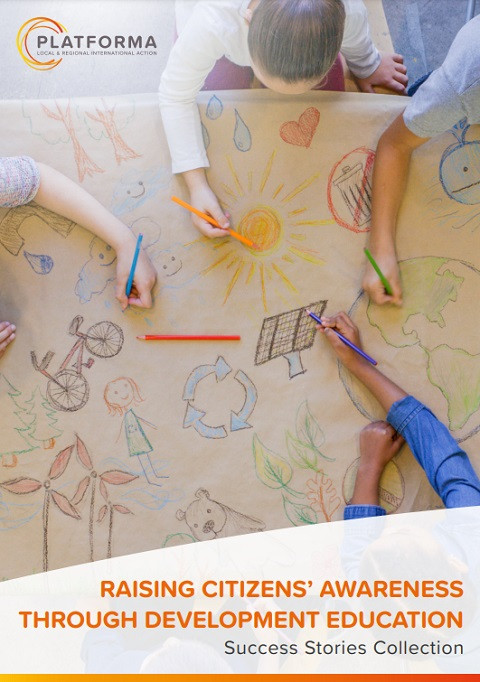 Raising Citizens' Awareness Through Development Education: Success Stories Collection Year of publication: 2020 Author: Lur Fernandez Salinas Corporate author: PLATFORMA Development Education and Awareness Raising (DEAR) are natural lines of action for local and regional governments active in development cooperation and tie in perfectly with their territorial strategies.Awareness-raising among citizens, through the action of municipalities and regions, remains a core component of the co-responsibility, solidarity, mutual knowledge and mutual understanding needed to mobilise and unite communities.Discover this Success Stories Collection which aims to showcase concrete, impactful and transformative experiences of local and regional governments and their associations actively engaged in DEAR projects and decentralised cooperation strategies. Sensibiliser les citoyens par l’éducation au développement : Exemples de réussites Year of publication: 2020 Author: Lur Fernandez Salinas Corporate author: PLATFORMA Le programme DEAR constitue une ligne d’action tout à fait naturelle pour les collectivités territoriales actives dans la coopération au développement et s’inscrit parfaitement dans leurs stratégies territoriales.La sensibilisation des citoyens, par l’action des municipalités et régions, reste une composante essentielle de la coresponsabilité, de la solidarité, de la connaissance et de la compréhension mutuelles nécessaires pour mobiliser et fédérer les communautés.Le présent recueil d’histoires de réussite vise à montrer les expériences concrètes, percutantes et transformatrices des collectivités territoriales et de leurs associations activement engagées dans des projets DEAR et des stratégies de coopération décentralisé
 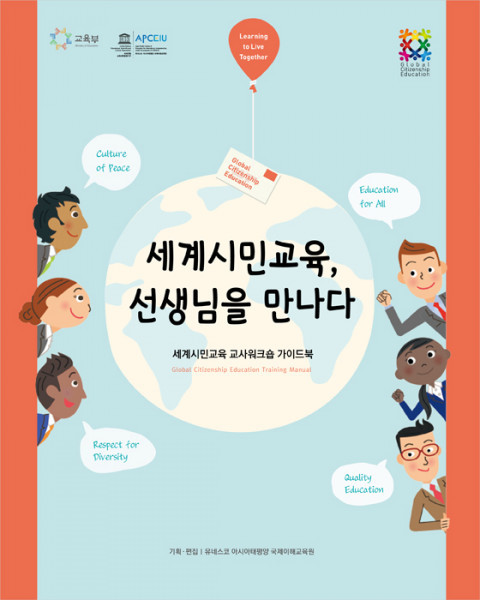 GCED Meets Teachers: GCED Teacher Workshop Guidebook Year of publication: 2015 Corporate author: APCEIU APCEIU published the GCED teacher workshop guidebook “GCED meets teachers.” This guidebook will be used at GCED workshops for teachers of 17 metropolitan and provincial offices of education carried out by GCED Lead teachers. The contents include the concept and the background of GCED, main contents, implementing methods at school. This GCED workshop manual provides teachers with opportunities to search for the ways to implement GCED at the schools, experience learning methods, and understand the main issues and themes of GCED through workshops. This guidebook is composed of 7 workshop sessions(refer to list below). Teachers and teacher educators planning GCED workshop can use this guidebook which includes the contents of the sessions, consultation to help plan and implement workshops based on participation and communication of the participants. “Global Citizenship Education meets teachers” GuidebookSession 1. Importance of World Education Forum and Global Citizenship EducationSession 2. Concept of GCED and its backgroundSession 3. Learning the contents and the theme of GCEDSession 4. Understanding the complexity and interrelationship of the issuesSession 5. Discussion class for cooperative communicationSession 6. Implementing GCED through Project Based LearningSession 7. Setting GCED action plans Éducation à la citoyenneté mondiale, rencontrer l'enseignant Year of publication: 2015 Corporate author: APCEIU APCECI publié le manuel de formation de l'ECM pour les enseignants intitulé «L’éducation à la citoyenneté mondiale: Guide de l'enseignant ».Ce guide est conçu comme un manuel pour les formateurs d'enseignants à planifier et à mettre en œuvre l'atelier d'ECM. Il comprend des informations de base sur ECM, thèmes clés, les concepts et les questions d'ECM et pédagogies transformatrices, les méthodes d'apprentissage, et la planification de l'action pour les classes d'ECM.Ce guide est composé de 7 séances de l'atelier comme ci-dessous. Les enseignants et les formateurs d'enseignants planifient des ateliers d'ECM peut concevoir et mettre en œuvre un atelier de 15 heures au niveau de base.«L'éducation à la citoyenneté mondiale: Guide des enseignants»Session 1. Forum mondial sur l'éducation (WEF) et L'éducation à la citoyenneté Mondiale (ECM) (ECM)Session 2. ECM: Concepts et Arrière-plansSession 3. thèmes et contenu ECM clésSession 4. Comprendre la complexité et de l'interdépendance des questionsSession 5. pédagogies: classe de discussion pour les communications coopérativesSession 6. pédagogies: ECM à travers (apprentissage axé sur les projets) PBLSession de planification 7. Action 세계시민교육, 선생님을 만나다 Year of publication: 2015 Corporate author: 유네스코 아시아태평양 국제이해교육원 유네스코 아시아태평양 국제이해교육원(www.unescoapceiu.org) 은 세계시민교육 교사워크숍 가이드북 “세계시민교육, 선생님을 만나다”를 출간하였다. 이 가이드북은 세계시민교육 중앙선도교사들이 17개 시·도교육청에서 소속 교사들을 대상으로 실시할 세계시민교육 연수를 위한 자료로 개발되었으며, 세계시민교육의 개념과 배경, 주요 내용, 교실에서 실천할 수 있는 세계시민교육 방법론 등에 관한 내용을 담고 있다.이 가이드북은 총 15시간의 세계시민교육 워크숍 매뉴얼로서 세계시민교육을 처음 접하는 교사들이 워크숍을 통해 세계시민교육의 배경과 기본 개념을 이해하고, 주요 내용 및 주제, 교수학습방법을 경험하며, 세계시민교육을 학교 현장에서 실천할 수 있는 방법과 기회를 모색하는 것을 목적으로 한다.총 7개의 워크숍 세션(아래 참조)으로 구성되어 있는 이 가이드북은 워크숍 진행자들이 참여와 소통에 기반한 워크숍을 기획 및 실행할 수 있도록 돕는 도움말 등이 함께 실려 있어 세계시민교육 워크숍을 기획하는 교사 및 교사교육가들에게 도움이 될 것으로 기대된다. “세계시민교육, 선생님을 만나다” 가이드북 구성 세션 1. 세계교육포럼의 의의와 세계시민교육 세션 2. 세계시민교육의 개념과 배경 세션 3. 세계시민교육의 내용과 주제 알기 세션 4: 이슈의 복합성과 상호연계성 이해하기 세션 5: 협력적 소통을 위한 토론 수업 세션 6: 프로젝트기반 학습(PBL)을 통한 세계시민교육 실천 세션 7: 세계시민교육 실천계획 수립
  Envisioning the Future of Assessment in Transformative Education: A Synthesis Report of the Expert Meeting on Evaluation and Assessment for Transformative Education: Towards and Beyond 2030 Year of publication: 2025 Author: Esther Care Corporate author: APCEIU Transformative education calls for learning that nurtures not only knowledge, but also the values, attitudes, and behaviours essential for inclusive, just, and sustainable societies. Recent global discussions, including UNESCO’s Reimagining Our Futures Together: A New Social Contract for Education and the Recommendation on Education for Peace and Human Rights, International Understanding, Cooperation, Fundamental Freedoms, Global Citizenship and Sustainable Development, emphasise learning that fosters critical thinking, empathy, cooperation, and action-oriented engagement.Within this vision, assessment needs to evolve from primarily measuring achievement to supporting a process of learning that actively enables and evidences learners’ reflection, growth, and empowerment. Traditional approaches, which prioritise standardisation and summative outcomes, are insufficient for capturing the complex competencies at the heart of transformative education, such as socio-emotional development, critical reflection, ethical reasoning, and responsible action. These limitations raise fundamental questions about not only how transformative learning outcomes can be assessed across diverse systems and contexts, but also what purposes assessment should serve.To examine these issues, APCEIU convened the Expert Meeting on Evaluation and Assessment for Transformative Education: Towards and Beyond 2030, held in Seoul, Republic of Korea, on 2–3 July 2025. The meeting brought together global experts, researchers, and policymakers to discuss current challenges, share emerging practices, and consider strategic directions for reimagining assessment in support of transformative education.Building on these rich discussions, this report synthesises the key reflections and forward-looking perspectives shared during the meeting. Part I presents analytical insights and strategic considerations for advancing assessment in transformative education, while Part II documents the meeting proceedings, including presentations and collaborative discussions.
 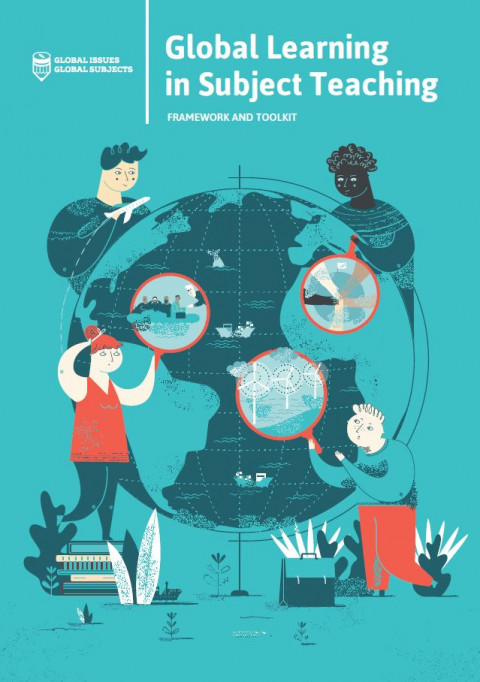 Global Learning in Subject Teaching: Framework and Toolkit Year of publication: 2020 Author: Katarzyna Dzięciołowska | Anna Wojtych Corporate author: Center for Citizenship Education (CCE) | Global Issues, Global Subjects (GIGS) The brochure 'Global Learning in Subject Teaching: Framework and Toolkit' has been developed as a proposal for teachers, educators and educational institutions on how to reach pupils with Global Learning.In its practical part, the brochure provides the reader with a toolkit of 20 ready-to-use lesson plans for subject lessons where the subject curriculum topics are linked with global issues such as migration, climate change and gender equality.
 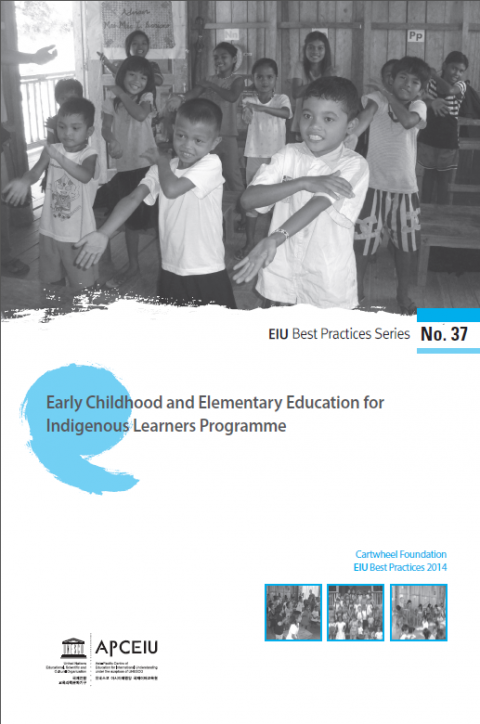 EIU Best Practices Series No.37: Early Childhood and Elementary Education for Indigenous Learners Programme Year of publication: 2014 Corporate author: APCEIU This monograph is one of APCEIU's EIU Best Practices Series, which aims to encourage educators, scholars, and activists to implement and share local initiatives on EIU. The Series No.37 introduces the Early Childhood and Elementary Education (ECEE) for Indigenous Learners Programme initiated in the Philippines. The indigenous peoples (IP) reside in the mountainous regions, away from basic social services and struggling with poverty, malnutrition, and lack of proper education. The aim of ECEE is to facilitate access to quality and culturally-relevant early childhood and elementary education for the Higaonon indigenous children. To achieve this, activities such as curriculum indigenization and teacher training are provided in collaboration with the community members. As the program creates learning process for all through openness, sharing, and collaboration, this is an exemplary case of EIU/GCED pedagogical approach.
 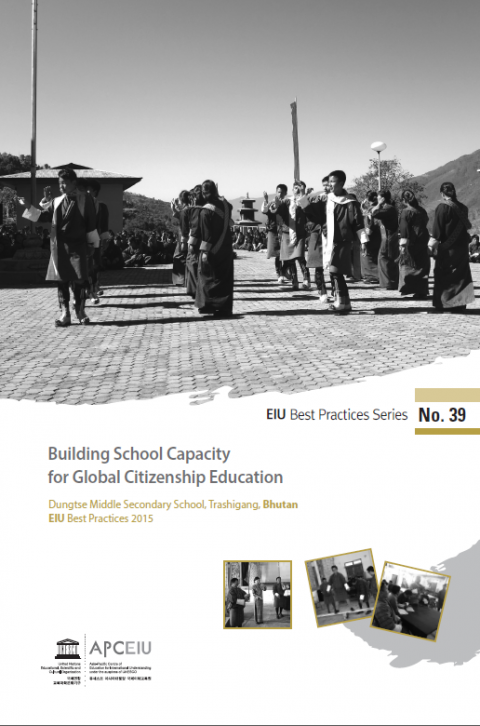 EIU Best Practices Series No.39: Building School Capacity for Global Citizenship Education: Dungtse Middle Secondary School, Trashigang, Bhutan Year of publication: 2015 Corporate author: APCEIU This monograph is one of APCEIU's EIU Best Practices Series, which aims to encourage educators, scholars, and activists to implement and share local initiatives on EIU. The Series No.39 introduces the Training of Trainers (TOT) program, a workshop for teachers to better incorporate GCED/EIU concepts into respective curriculum and school environment. Upon participating in the APCEIU training workshop, Mr. Yeshi Dorji from Dungtse Middle Secondary School in Bhutan sought to create a forum in which teachers and school officials can learn to incorporate GCED. Such exemplary initiative not only enhances capacity building of educators in the school, but also has potential to have larger impact in the local and regional communities.
 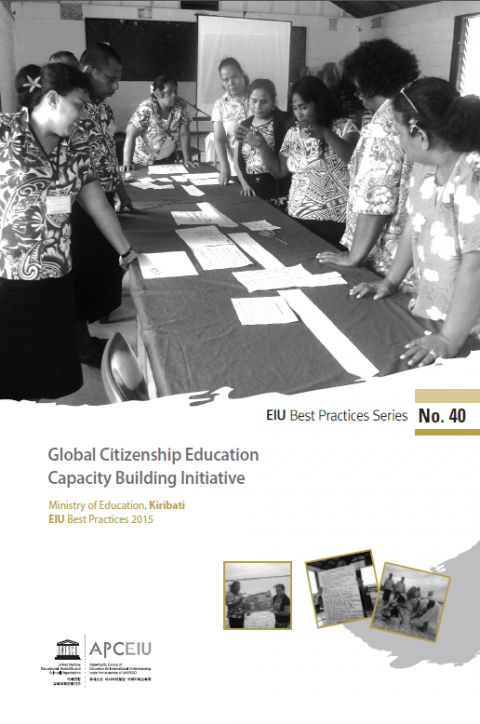 EIU Best Practices Series No.40: Global Citizenship Education Capacity Building Initiative: Misitry of Education, Kiribati Year of publication: 2015 Corporate author: APCEIU This monograph is one of APCEIU's EIU Best Practices Series, which aims to encourage educators, scholars, and activists to implement and share local initiatives on EIU. The Series No. 40 introduces a successful hosting of workshop on GCED in Kiribati. Considered the first of its kind in Kiribati, the workshop brought together education officers and teachers to learn about emerging concept of GCED and EIU and means for implementation. The exemplary workshop involving fieldtrips and seminars has created a wave of learning opportunities for key stakeholders at all levels, paving way to put GCED into practice.