
Resources
Explore a wide range of valuable resources on GCED to deepen your understanding and enhance your research, advocacy, teaching, and learning.
169 Results found
 Teaching Guidelines of the International Holocaust Remembrance Alliance The website of the International Holocaust Remembrance Alliance, an intergovernmental body dedicated to Holocaust education, remembrance and research, contains much practical information on all aspects of Holocaust education.
 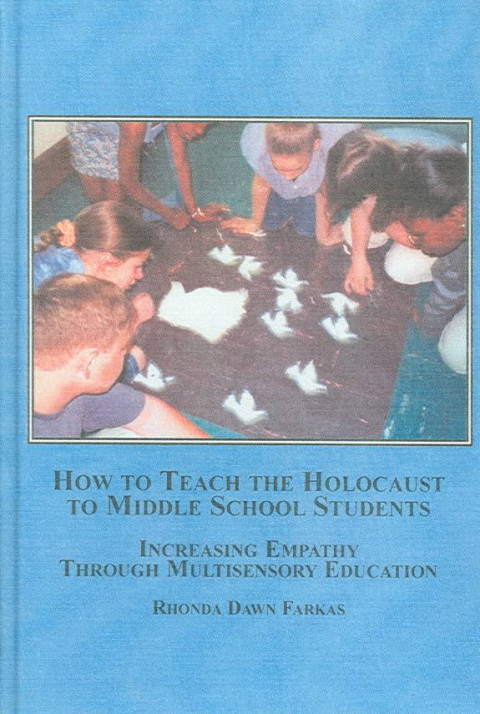 How to teach the Holocaust to Middle School Students : Increasing Empathy Through Multisensory Education This study examines the relationships among seventh-grade students' achievement scores, attitudes toward instructional approaches, empathy scales, and the transfer of skills between traditional versus multisensory education. The Learning Style Inventory (LSI) was employed to determine learning-style preferences. The data collected in this study was subjected to statistical analyses, supporting the use of a multisensory, rather than a traditional, approach for teaching lessons of the Holocaust. (By the publisher)
  Teaching the representation of the Holocaust “Can the story be told?” Jorge Semprun asked after his liberation from Buchenwald. The question is addressed from many angles in this volume of essays on teaching about the Holocaust. In their introduction, Marianne Hirsch and Irene Kacandes argue that Semprun’s question is as vital now, and as difficult and complex, as it was for the survivors in 1945. The thirty-eight contributors to Teaching the Representation of the Holocaust come from various disciplines (history, literary criticism, psychology, film studies) and address a wide range of issues pertinent to the teaching of a subject that many teachers and students feel is an essential part of a liberal arts education. This volume offers approaches to such works as Jurek Becker’s Jacob the Liar, Roberto Benigni’s Life Is Beautiful, Anne Frank’s diary, Daniel Jonah Goldhagen’s Hitler’s Willing Executioners, Claude Lanzmann’s Shoah, Primo Levi’s Survival in Auschwitz, Cynthia Ozick’s The Shawl, Dan Pagis’s “Written in Pencil in the Sealed Railway Car,” Art Spiegelman’s Maus, Steven Spielberg’s Schindler’s List, Elie Wiesel’s Night, and Abraham Yehoshua’s Mr. Mani. To the challenge “How do we transmit so hurtful an image of our own species without killing hope and breeding indifference?” posed by Geoffrey Hartman in this volume, the editors respond, “Only in the very human context of classroom interaction can we hope to avoid either false redemption or unending despair.” (By the publisher) Polin: Museum of the History of Polish Jews The Museum of History of Polish Jews offers numerous bibliographies, a list of thematic movies and several workshop guides. The Museum also delivers video recording of debates, conferences and testimonies. Polin: Musée de l'Histoire des Juifs Polonais Le Musée d'Histoire des Juifs polonais propose de nombreuses bibliographies, une liste de films thématiques et plusieurs guides de l'atelier. Le Musée offre également l'enregistrement vidéo des débats, des conférences et des témoignages.
 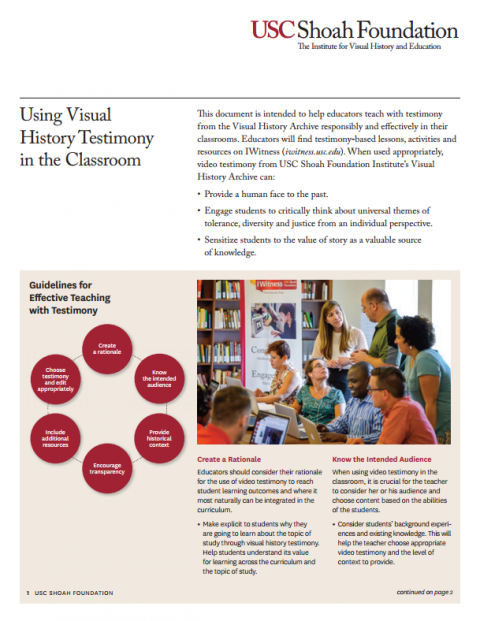 Using Visual History Testimony in the Classroom This short document published by the USC Shoah Foundation gives teachers basic key elements to integrate visual testimonies in class. The 4-page document provides constructive principles of learning applicable to all kind of digital approaches. Utilisation de l'Historique Témoignage Visuel dans la salle de classe Ce court document publié par la Fondation USC Shoah donne aux enseignants des éléments clés de base pour intégrer les témoignages visuels en classe. Le document de 4 pages fournit des principes constructifs de l'apprentissage applicable à tous les types d'approches numériques.
  Strategies in Facing Antisemitism : An educational resource guide This resource guide from Yad Vashem and the Simon Wisenthal Center is divided into two parts. First, it assesses antisemitism today. Then it proposes a few articles on ways to sensitize the public to antisemitism : how to broach the topic in the classroom, how to deal with antisemitism on internet... Stratégies pour faire face à l'Antisémitisme: Un guide de ressources éducatives Ce guide de ressources de Yad Vashem et le Centre Simon Wiesenthal est divisé en deux parties. Premièrement, il évalue l'antisémitisme aujourd'hui. Ensuite, il propose quelques articles sur les moyens de sensibiliser le public à l'antisémitisme: comment aborder le sujet en classe, comment faire face à l'antisémitisme sur internet ... Lignes directrices pour l'éducation mondiale: manuel pour les éducateurs à comprendre et à mettre en œuvre l'éducation globale Year of publication: 2008 Corporate author: North-South Centre of the Council of Europe Ces lignes directrices Éducation de Globale sont le résultat d'un besoin exprimé par (NSC) Réseau d'éducation Globale praticiens du Centre Nord-Sud - le réseau de la semaine de l'éducation globale - d'avoir un outil commun, construit sur l'expérience acquise par le réseau et d'autres partenaires, à éducateurs de soutien pour comprendre et mettre en œuvre avec succès les initiatives de l’éducation globale. En offrant des perspectives sur l'éducation globale, ainsi que les méthodes et critères d'évaluation - y compris le partage des pratiques, des outils et des ressources - ces lignes directrices visent à renforcer l'ensemble des travaux pour l'éducation mondiale. Il vise à soutenir les praticiens Présent dans les formels et non formels paramètres général en introduisant des éléments qui peuvent être développés par eux aux besoins et selon en fonction de leurs propres expériences; les aider dans l'éducation globale Identifier les approches et pratiques existantes; les aider à réfléchir et à devenir plus conscients de leurs activités d'éducation globales propres; Augmenter le partage mondial de la pratique de l'éducation et de créer des synergies entre les parties prenantes; Contribuer aux politiques d'éducation au niveau local, régional, national et international. Les lignes directrices Éducation globalesont une initiative du Programme d’Éducation Globale du Centre Nord-Sud du Conseil de l'Europe, impliquant une équipe d'éducateurs du réseau Semaine de l'éducation mondiale qui a constitué l'équipe de rédaction avec le mandat de rédiger collectivement, les lignes directrices Education Mondiale. Le processus d'écriture a inclus une méthode participative à plusieurs niveaux de l'éducation conseil mondial parmi les éducateurs et les praticiens activement impliqués dans le Centre Nord-Sud de Éducation Globale et Jeunesse. En outre, un groupe de mentors a été identifié parmi les partenaires européens et internationaux de NSC, qui comprenait, entre autres, une équipe de formateurs de l'Université du NSC Jeunesse & Développement. Sujets présentés dans les lignes directrices visent à clarifier des questions clés liées à l'éducation globale; Il suggère à élaborer des stratégies sur la façon dont le contenu; mettre en avant AIMS, les compétences, les valeurs et les attitudes; offrir des conseils sur les méthodes, la conception des programmes et de l'évaluation et la liste des contacts, des liens utiles et bibliographie. Les lignes directrices doivent être considérées comme un processus continu de l'évolution, qui devrait être régulièrement revue avec de nouvelles idées, des intrants et des pratiques brought à partir d'une diversité de partenaires et de leurs expériences.