
Resources
Explore a wide range of valuable resources on GCED to deepen your understanding and enhance your research, advocacy, teaching, and learning.
8 Results found
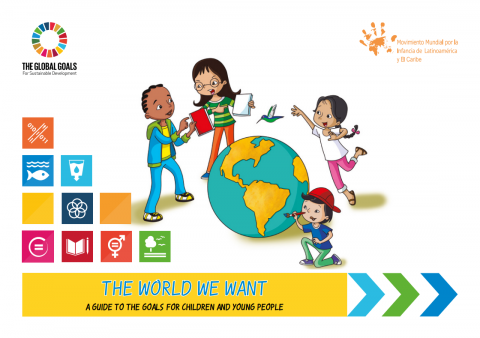 The World We Want: A Guide to the Goals for Children and Young People Year of publication: 2015 Author: Dora Bardales | Paola Arenas Corporate author: Global Movement for Children of Latin America and Caribbean | United Nations Children's Fund (UNICEF) The purpose of this guide is to help children and young people understand the Sustainable Development Goals, how they impact their life and what they can do every day to help their government achieve the Goals.
  تعزيز رفاه الشباب عبر الصحة والتعليم: رؤى وفرص Year of publication: 2019 Author: Wing Yi Chan | Jennifer Sloan | Anita Chandra Corporate author: RAND Corporation أضحى الرفاه، باعتباره ركيزة أساسية في عمليات التخطيط وصناعة السياسات وتخصيص الموارد، ضرورةً لا غنى عنها لتنمية المجتمعات والدول التي تسير في درب الازدهار، مما دفعنا في هذا التقرير لدراسة المؤلفات الأكاديمية وغير الأكاديمية وثيقة الصلة بالموضوع لتحديد الأطر النظرية التي تحقق التكامل بين الصحة والتعليم داخل منظومة واحدة. Promoting Youth Well-Being Through Health and Education: Insights and Opportunities Year of publication: 2019 Author: Wing Yi Chan | Jennifer Sloan | Anita Chandra Corporate author: RAND Corporation Putting well-being at the heart of planning, policy making, and resource allocation is emerging as critical to the development of thriving communities and nations. We examined the academic and grey literature to identify theoretical frameworks that integrate health and education. We identified and described policies and programs supporting well-being around the world, and interviewed experts from each location to gain a deeper understanding of them.The report found that although wellbeing frameworks that integrate education and health exist, few of them have been examined rigorously to reveal how both educational and health outcomes can be achieved together.
  Lifelong learning for health in cities: a guide, enacting the Yeonsu Declaration for Learning Cities Year of publication: 2023 Author: Jourdan, Didier | Gray, Nicola | Howells, Alex | Valdés-Cotera, Raúl Corporate author: UNESCO Institute for Lifelong Learning (UIL) <Executive summary> The COVID-19 health crisis has led all cities in the world to put public health issues at the top of their agendas. The pandemic has highlighted that one cannot implement public health measures without, or indeed against, the goodwill of the population. The population is not the ‘problem’. Rather, it is part of the solution to the health crisis. Cities play a major role in developing the population’s capacity to promote individual and collective health.Education and learning are at the very core of what makes ‘health for all’ possible. The crisis, therefore, has been an eye-opener regarding the importance and need for lifelong health education. Instituting such a place-based lifelong learning culture could play a key role in building resilience for individuals, communities and cities.In Yeonsu, Republic of Korea, the fifth International Conference on Learning Cities was convened from 27 to 30 October 2021. Attending in person or online were: mayors, deputy mayors, officials, representatives from 229 learning cities in 64 countries worldwide, education executives, education experts, representatives of United Nations agencies, the private sector, and regional, international and civil society organizations. At the end of the conference, a declaration was issued. It includes a set of commitments to build healthy and resilient cities.This guide aims to assist municipal teams in the concrete development of a policy that promotes lifelong learning for health within the framework of the Yeonsu Declaration. It is intended not only for cities already identified as learning cities or healthy cities – which may use the guide to integrate a lifelong learning for health dimension into existing city policies and projects – but also for all cities that wish to implement a policy promoting lifelong learning for healthThis guide proposes a three-step process for enacting such a policy: 1. raising awareness of the role of cities in lifelong learning for health; 2. developing a policy that promotes a healthy and resilient city; and 3. implementing the policy.The lifelong learning for health policy can be formalized through the creation of a learning for health pathway. The pathway makes explicit – and simultaneously formalizes – the content, the learning approaches and learning outcomes of the learning opportunities offered throughout people’s lives. It focuses on building individual capacities for awareness and understanding of complex health issues, critical judgment and action. The pathway also has a communication purpose by making what is being done to promote health in the city explicit to citizens, partners and professionals. It is based on four key action principles: ‘valuing, sharing, aligning and improving’. This approach seeks, first, to demonstrate the value of the educational work carried out in formal, non-formal and informal settings of the urban environment; then to make this known among stakeholders and to make the pathway coherent; and, finally, to identify the gaps and take the necessary initiatives to fill them.The guide can be used in different ways depending on the context, means and objectives of the individual cities. It is not always necessary to read the whole guide. And we expect that a large proportion of readers and users will simply pick and choose from the various sections of the guide elements that are of particular interest to them. Nonetheless, we hope that everyone will find something to contribute to their city’s efforts and actions for implementing an inclusive policy for promoting lifelong learning for health.
 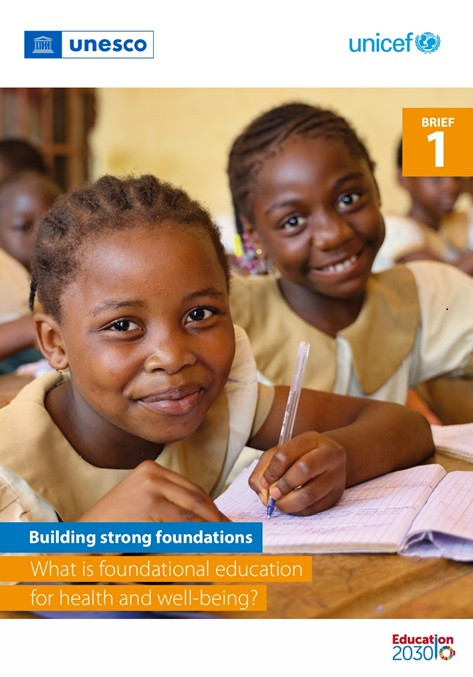 Building Strong Foundations: What is Foundational Education for Health and Well-being? (Brief 1) Year of publication: 2024 Corporate author: UNESCO | United Nations Children's Fund (UNICEF) In a rapidly changing world, establishing strong foundations for children is vital for their well-being and resilience. Quality education is central to this endeavour and is the key to lifelong health and success. Recognizing that children thrive in the classroom when they are in good health, it is crucial to learn about health and well-being early on in primary schools. The Building strong foundations briefs, developed jointly by UNESCO and UNICEF, provide evidence-based guidance to support primary school-aged children to thrive through foundational education for health and well-being. Drawing from extensive research and consultations with leading experts from various fields and across the world, these briefs serve as a roadmap for education stakeholders to equip learners with the requisite knowledge and skills to navigate their current and future health and well-being needs. This document is the first of four briefs. It provides an overview of the essential role that primary schools play in enhancing health and well-being. The document outlines what foundational refers to, why it is important for health and education, and how it contributes to paving the way for healthier, inclusive and thriving societies. The brief shares compelling evidence and case studies to distill six essential elements for an effective whole-school approach to health and well-being.
  Building Strong Foundations: What to Teach for Foundational Education for Health and Well-being (Building Strong Foundations Brief; 2) Year of publication: 2024 Corporate author: UNESCO | United Nations Children's Fund (UNICEF) In a rapidly changing world, establishing strong foundations for children is vital for their well-being and resilience. Quality education is central to this endeavour and is the key to lifelong health and success. Recognizing that children thrive in the classroom when they are in good health, it is crucial to learn about health and well-being early on in primary schools. The Building strong foundations briefs, developed jointly by UNESCO and UNICEF, provide evidence-based guidance to support primary school-aged children to thrive through foundational education for health and well-being. Drawing from extensive research and consultations with leading experts from various fields and across the world, these briefs serve as a roadmap for education stakeholders to equip learners with the requisite knowledge and skills to navigate their current and future health and well-being needs. The present document is the second of four briefs. It is a go-to resource to better understand what makes a primary school curriculum effective in supporting health, well-being and learning. The brief provides practical tips and insights on integrating core thematic concepts for health and well-being into the curriculum, including concrete examples of learning objectives for lower primary and upper primary curricula. Whether a seasoned curriculum designer, a passionate educator or an individual involved in primary school curriculum processes, this brief equips readers with the tools to design impactful curricula for transformative learning, health and well-being.
  Building Strong Foundations: How to Include the Whole School in Foundational Education for Health and Well-being (Building Strong Foundations Brief; 3) Year of publication: 2024 Corporate author: UNESCO | United Nations Children's Fund (UNICEF) In a rapidly changing world, establishing strong foundations for children is vital for their well-being and resilience. Quality education is central to this endeavour and is the key to lifelong health and success. Recognizing that children thrive in the classroom when they are in good health, it is crucial to learn about health and well-being early on in primary schools. The Building Strong Foundations briefs, developed jointly by UNESCO and UNICEF, provide evidence-based guidance to support primary school-aged children to thrive through foundational education for health and well-being. Drawing from extensive research and consultations with leading experts from various fields and across the world, these briefs serve as a roadmap for education stakeholders to equip learners with the requisite knowledge and skills to navigate their current and future health and well-being needs. The present document is the third of four briefs. It explores how a whole-school approach to health and well-being in primary schools generates significant impacts on learners’ health, well-being and education. The brief shares practical guidance and case studies to distill six essential elements for an effective whole-school approach to health and well-being.
  Building Strong Foundations: How to Put Foundational Education for Health and Well-being into Practice (Building Strong Foundations Brief; 4) Year of publication: 2024 Corporate author: UNESCO | United Nations Children's Fund (UNICEF) The African Union’s designation of 2024 as the Year of Education highlights the critical importance of education for equipping young Africans with the skills essential for their own and for the continent’s development. It is also a recognition of the multiple challenges ahead before every child can complete primary school having acquire the foundational skills that open the door for lifelong learning. Currently the out-of-school population is rising, one in five children do not complete primary school and, of those who do, only about one in five achieve minimum proficiency in reading and mathematics. African countries have set targets on primary completion and foundational learning but to effectively translate their ambitions into results, the 2024 Spotlight continental report emphasizes the importance of coherence between their curricula, textbooks, teacher guides and assessments. It evaluates the alignment of these policy documents with each other but also with a global standard of what students are expected to know and by when. It also assesses how these key documents are used in classrooms and what the implications are for children’s opportunities to learn. This report is the second in a series of three envisaged between 2022 and 2025, each covering some 12 countries of which a selection is examined in depth, in dialogue with education ministries and national stakeholders. The focus countries for this second Spotlight report cycle were Mauritania, Niger, South Africa, Uganda, and Zambia. The statistics and analysis presented in this publication aim to feed into the policy dialogue mechanism under the auspices of the African Union and its Continental Education Strategy for Africa. In particular, the Spotlight series aims to spark debate on foundational learning among African countries and encourage them to identify areas for joined action, given that they share a lot of policy challenges.