
Resources
Explore a wide range of valuable resources on GCED to deepen your understanding and enhance your research, advocacy, teaching, and learning.
24 Results found
 World programme for human rights education: second phase; plan of action Year of publication: 2012 Corporate author: UN Office of the High Commissioner for Human Rights According to Human Rights Council resolution 12/4, the second phase of the World Programme (2010–2014) will focus “on human rights education for higher education and on human rights training programmes for teachers and educators, civil servants, law enforcement officials and military personnel at all levels” and “Member States should also continue the implementation of human rights education in primary and secondary school systems”. The plan of action focuses on human rights education in two broadly defined sectors, i.e. higher education and training for civil servants, law enforcement officials and the military.
  Human rights education in Russia: analytical report Year of publication: 2008 Author: Anatoly Azarov Corporate author: Moscow School of Human Rights The book examines the status, trends, and issues of human rights education, including HIV/AIDS prevention education in the Russian Federation. It spans the period from the early 1990s to December 2008, analyzing both positive preconditions for the spread of human rights and freedoms knowledge in Russia and obstacles encountered in the process. A special focus is on laws, regulations and standards applicable to higher education. The book describes the activities of the primary social institutions engaged in HRE: comprehensive schools and universities, human rights commissioners, NGOs. It shows examples of international humanitarian law teaching; offers an evaluation of HRE literature for Russian universities; offers a concept of Science and Discipline of Human Rights. The book also examines the condition of HIV/AIDS prevention education within the context of human rights observance. The authors’ conclusions and judgments are supported with a special opinion poll.
 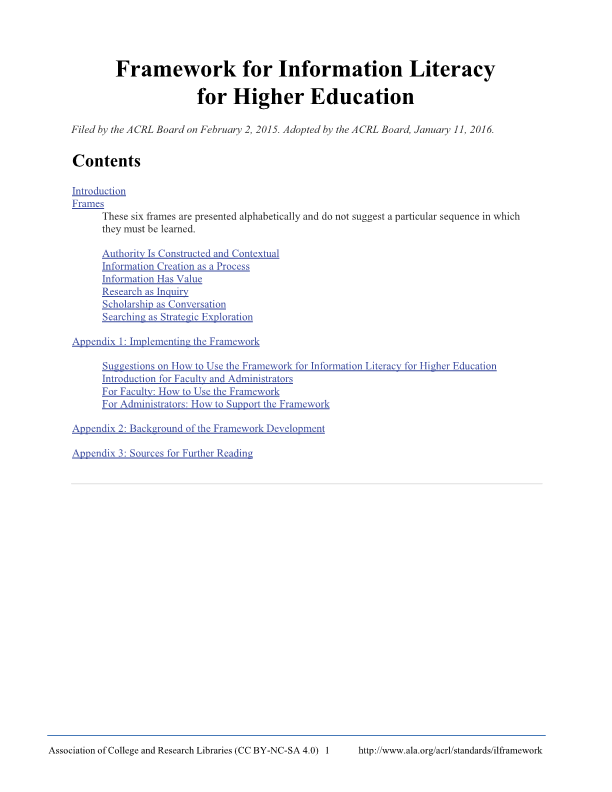 Framework for Information Literacy for Higher Education Year of publication: 2015 Corporate author: Association of College and Research Libraries (ACRL) Information literacy is the set of integrated abilities encompassing the reflective discovery of information, the understanding of how information is produced and valued, and the use of information in creating new knowledge and participating ethically in communities of learning. This Framework sets forth these information literacy concepts and describes how librarians as information professionals can facilitate the development of information literacy by postsecondary students.
  The Digital Transformation of Governmental Higher Education Institutions in the Southern Governorates of Palestine Year of publication: 2023 Author: Randa Ead Shrair The article aimed to identify the level of digital transformation in government higher education institutions in the Southern Governorates of Palestine from the point of view of its faculty members and to reveal whether there are statistically significant differences at the significance level (α ≤ 0.05). between the averages of the respondents' responses about the level of digital transformation in Government higher education institutions in the Southern Governorates of Palestine are attributed to the variables: (gender, years of service, academic degree, and specialization); by using the descriptive/surveying, a questionnaire was designed consisted of (30) items distributed on (4) axes. After verifying its validity and reliability, the questionnaire was applied to a stratified random sample of (123) male and female faculty members. The study concluded that the level of digital transformation in higher education institutions was “high" and there were no statistically significant differences between the averages of the respondents' responses about the level of digital transformation in those institutions due to the variables of the study . Inclusion, education for sustainable development, adult learning, higher education and research: four international conferences to promote equity, quality, relevance and social responsibility in education Year of publication: 2008 Corporate author: UNESCO This cycle of conferences brings together a wide array of influential stakeholders in the common interest of creating education systems that serve the needs of all learners, address the challenges of today's world and make learning a springboard of development.
  The right to higher education and gender equality: briefing note compendium Year of publication: 2023 Corporate author: UNESCO International Institute for Higher Education in Latin America and the Caribbean (IESALC) The right to higher education and gender equality Table of ContentsForeword ................................................................................................................................................................................4Introduction ..........................................................................................................................................................................5UNESCO and the right to higher education ..............................................................................................................5Aim of this compendium..................................................................................................................................................6Key findings...........................................................................................................................................................................7Gender equality in Higher Education - Maximising impacts– Gillian Cowell................................................8Gender equality and higher education: The Afghan case – Aisha Khurram............................................... 12An analysis of gender equality policies and practices in higher education institutions and their effectiveness in promoting gender equity – Angel Mbuthia........................................................ 14Gender identity and access to higher education – Martin Perea.................................................................... 16What can be done to ensure the right to higher education? – Bhavani Rao.............................................. 18Gender equality in higher education still a pending issue in Peru – Patricia Ruiz Bravo ....................... 22Gender equality in higher education: state of play and implications across OECD countries, and reflections on potential responses for policy and practice – François Staring.................................. 24
 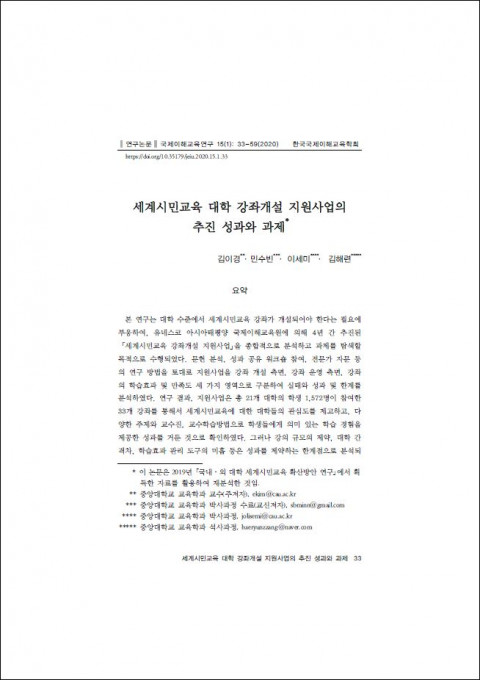 The Achievements and Tasks of the Global Citizenship Education University Course Development Project Year of publication: 2020 Author: Eegyeong Kim | Soobin Min | Semi Lee | Haeryun Kim Corporate author: Korean Society of Education for International Understanding (KOSEIU) This study seeks to analyze the achievements and tasks of the 「GCED University Course Development Project」 promoted by APCEIU. Using such research methods as literature review, workshops, and expert consultation, we analyzed the four-year project surrounding course providers, course contents, and student learning and satisfaction. The findings show that the project has heightened universities’ interest in GCED through 33 courses involving 1,572 students from 21 universities. It was also confirmed that a variety of supports allowed students to have meaningful learning experiences. However, large class sizes, disparity among universities, and the absence of performance measuring tools seemed to limit the success of the project. As a strategy for overcoming these limitations, we suggested the tasks in terms of both quantitative and qualitative aspects.
 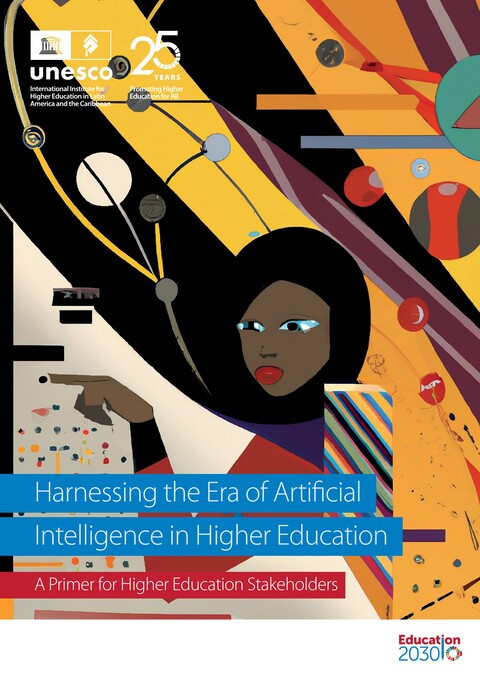 Harnessing the Era of Artificial Intelligence in Higher Education: A Primer for Higher Education Stakeholders Year of publication: 2023 Author: Bosen Lily Liu | Diana Morales | Jaime Roser-Chinchilla | Emma Sabzalieva | Arianna Valentini | Daniele Vieira do Nascimento | Clarisa Yerovi Corporate author: UNESCO | UNESCO International Institute for Higher Education in Latin America and the Caribbean (IESALC) The International Institute for Higher Education in Latin America and the Caribbean (UNESCO IESALC) is one of UNESCO’s key education-focused institutes and is the only institute in the United Nations with a specific mandate for higher education. Taking a holistic and integrated intersectoral and cross-sectoral approach to higher education, UNESCO IESALC provides support to Member States through policy-driven and action-oriented research and publications, capacity development, training, advocacy and networking. Following the release of a Quick Start Guide on using ChatGPT and Artificial Intelligence (AI) in higher education, UNESCO IESALC is pleased to offer to the wider community of higher education stakeholders worldwide this Primer on AI and higher education. Providing information and tips for developing further thinking and policies related to the use of AI processes and outcomes in higher education institutions, the Primer is a comprehensive and comprehensible introduction to AI. It also serves as a practical tool for guidance and reference with recommendations for its use in higher education.
 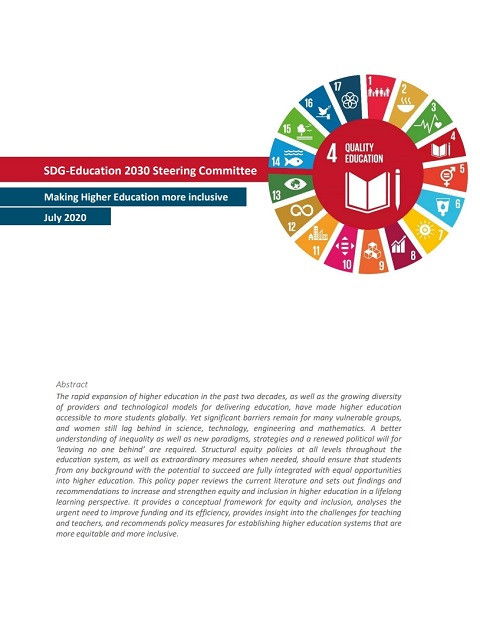 SDG-Education 2030 Steering Committee: Making Higher Education More Inclusive, July 2020 Year of publication: 2020 Corporate author: UNESCO The rapid expansion of higher education in the past two decades, as well as the growing diversity of providers and technological models for delivering education, have made higher education accessible to more students globally. Yet significant barriers remain for many vulnerable groups, and women still lag behind in science, technology, engineering and mathematics. A better understanding of inequality as well as new paradigms, strategies and a renewed political will for ‘leaving no one behind’ are required. Structural equity policies at all levels throughout the education system, as well as extraordinary measures when needed, should ensure that students from any background with the potential to succeed are fully integrated with equal opportunities into higher education. This policy paper reviews the current literature and sets out findings and recommendations to increase and strengthen equity and inclusion in higher education in a lifelong learning perspective. It provides a conceptual framework for equity and inclusion, analyses the urgent need to improve funding and its efficiency, provides insight into the challenges for teaching and teachers, and recommends policy measures for establishing higher education systems that are more equitable and more inclusive.
  Transforming Knowledge and Research for Just and Sustainable Futures: Towards a New Social Imaginary for Higher Education (Education, Research and Foresight: Working Papers; No.33, 2024) Year of publication: 2024 Author: Leon Tikly Corporate author: UNESCO The paper considers why it is important to transform knowledge and research for just and sustainable futures and discusses the role of higher education in these transformation processes. The paper sets out how knowledge, research, and knowledge systems can be understood and critiques knowledge hierarchies that have emerged in the context of colonialism, leading to the marginalization of the knowledge systems and languages of the colonized. It is argued that there is a need to create new ecologies of knowledge that value and develop synergies between ‘all of the archives of the world’ and that can revitalize and expand the knowledge commons and contribute to more just and sustainable futures. Higher education has a pivotal role to play in the creation of new ecologies of knowledge and a revitalized knowledge commons through promoting socially and ethically engaged research, the decolonization and reorientation of university curricula and pedagogy to foster sustainable futures, and the democratization of universities to better represent historically marginalized groups. Underpinning this role must be a shift from a Western modernist social imaginary of higher education to one based on a new planetary consciousness.