
Resources
Explore a wide range of valuable resources on GCED to deepen your understanding and enhance your research, advocacy, teaching, and learning.
276 Results found
 Developing Positive Values: A case study of Holocaust Memorial Day in the primary schools of one local authority in Scotland Many schools and local authorities saw the initial Holocaust Memorial Day as an important stimulus to develop lessons and events in Holocaust history amongst young people of vital importance for today. The focus of this paper is to examine the potential for Holocaust education in the primary curriculum in Scotland and whether the instance of Holocaust Memorial Day and the undertaking of a serious commitment to it by a local authority had an impact on the teaching and raising of Holocaust issues in the primary schools in that area. The authors previously argued (Maitles & Cowan, 1999) that there needed to be a major commitment from the Scottish Executive and/or local councils to encourage teachers and schools to coordinate or introduce Holocaust education in the schools. To test this, the field research for this survey was conducted by means of a questionnaire to every primary school in the local authority and achieved a 91% response rate. Strong national commitment to Holocaust educational activities, backed up by commitment from the local authority, in terms of staff development and teaching materials, ensured a quality of experience as well as the quantity. Linked to this was an effective structure in the schools, with a designated Holocaust education coordinator and the involvement of the wider community. This led teachers in schools to imaginatively develop pupil skills, knowledge and understanding and informed attitudes in Holocaust history which potentially has a resonance in the wider citizenship area. (By the publisher) Values and Attitudes - Positive and Negative: A study of the impact of teaching the Holocaust on citizenship among Scottish 11-12 year olds Previous research on teaching the Holocaust, notably case studies in the primary or the secondary sectors, suggests that Holocaust education can make a significant contribution to citizenship by developing pupils’ understandings of justice, tolerance, human rights issues, and the many forms of racism and discrimination. Yet, there have been no longitudinal studies into its impact on primary pupils. This paper reports on the first stages of ongoing longitudinal research (sponsored by the Scottish Executive Education Department) and concentrates on the relevance of Holocaust education to citizenship, by comparing the attitudes of primary 7 pupils before and after Holocaust teaching using data from questionnaires. Results show an improvement in pupils’ values and attitudes after learning about the Holocaust in almost every category related to minority groups, ethnic or otherwise. One significant finding was a deep anti-English feeling and this in itself indicates the need for further investigation. (By the author)
 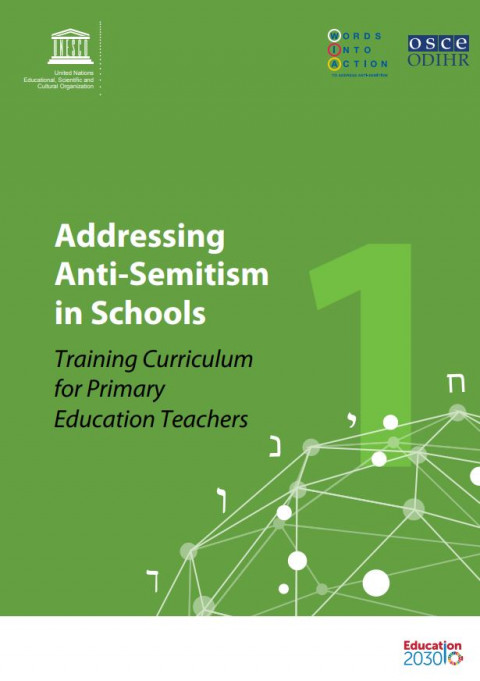 Addressing Anti-semitism in Schools: Training Curriculum for Primary Education Teachers Year of publication: 2020 Corporate author: UNESCO | OSCE. Office for Democratic Institutions and Human Rights (ODIHR) This OSCE/ODIHR and UNESCO co-publication aims to help primary school teachers to prevent and respond to anti-Semitism. The curriculum, intended for teacher trainers, is designed to be comprehensive, robust, practical and adaptable. It suggests concrete ways to address anti-Semitism and counter prejudice in and through education, while promoting human rights, global citizenship education, and gender equality.The co-publication is part of a series of four training curricula, designed for trainers of (1) primary school teachers, (2) secondary school teachers, (3) vocational school teachers, and (4) school directors.
  Translating globalization theories into educational research : thoughts on recent shifts in Holocaust education Much educational research on globalization aims to prepare students to be successful citizens in a global society. We propose a set of three concepts, drawing on systems theory (Nassehi, Stichweh) and theories of the subject (Butler, Foucault), to think the global which enables educational research to step back from hegemonic discourses and reflect on current practices. Globalization is understood in this approach as referring to: (1) a cognitive shift; (2) expanding relevancy spaces; and (3) new forms of subjectivation. The framework is illustrated with examples from educational policy and learning materials, with an extended look at how globalization is articulated in recent shifts in Holocaust education. (By the author)
 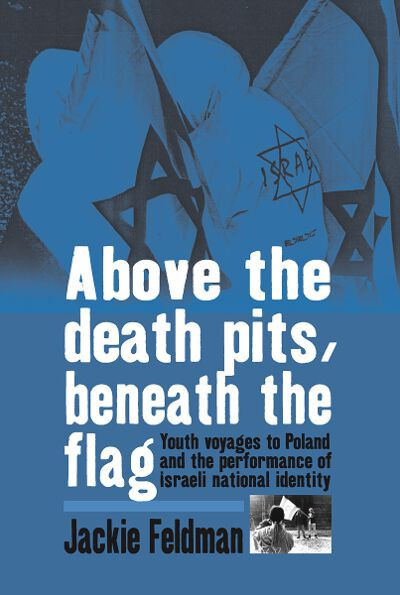 Above the Death Pits, Beneath the Flag - Youth Voyages to Poland and the Performance of Israeli National Identity Israeli youth voyages to Poland are one of the most popular and influential forms of transmission of Holocaust memory in Israeli society. Through intensive participant observation, group discussions, student diaries, and questionnaires, the author demonstrates how the State shapes Poland into a living deathscape of Diaspora Jewry. In the course of the voyage, students undergo a rite of passage, in which they are transformed into victims, victorious survivors, and finally witnesses of the witnesses. By viewing, touching and smelling Holocaust-period ruins and remains, by accompanying the survivors on the sites of their suffering and survival, crying together and performing commemorative ceremonies at the death sites, students from a wide variety of family backgrounds become carriers of Shoah memory. They come to see the State and its defense as the romanticized answer to the Shoah. These voyages are a bureaucratic response to uncertainty and fluidity of identity in an increasingly globalized and fragmented society. This study adds a measured and compassionate ethical voice to ideological debates surrounding educational and cultural forms of encountering the past in contemporary Israel, and raises further questions about the representation of the Holocaust after the demise of the last living witnesses. (By the author) Experiential learning of history through youth journeys to Poland Keren (1985), who examined the centrality of the Holocaust in five different periods in the history of the state of Israel, claims that the turning point for the educational system was an outcome not only of increased public awareness, but of the events 'receding' into history, which allowed an objective, and more balanced and detached, perspective. The study revealed that children whose parents were born in Europe or in Western countries were more eager to learn about the Holocaust than those of non-European origin, indicating a relationship between origin and desire to know about the Holocaust period. The journey experience had not yet matured and shaped into a deeper understanding that could be attributed to the personal identity of the participant and to examining it after the journey using accepted research tools. (By the author) Israeli and Diaspora Students Travel to the Holocaust Sites in Poland: The Impact on the Perceptions of the Holocaust, Jewish Identity, and Israel-Diaspora Ties The Ministry of Education encourages Israeli students to visit sites of historic Jewish communities in Poland and the sites of Nazi death camps. The trip is designed to reinforce the youngsters’ sense of belonging to the Jewish people, their connection to and identification with Jewish heritage and history, and their commitment to the future of Jewish life in Israel and its sovereignty. This study explores the impact of trips to Poland, organized by Tachlit Center, on Israeli and overseas university students. The vast majority of participants confirm that the trip emphasizes the important role of the Holocaust memory and commemoration. Findings on the impact of Holocaust education on other Israeli and Jewish values (e.g., the significance of immigration to Israel and ties to the Jewish Diaspora) are discussed, along with the implications for future Holocaust education programs. (By the author) Does vicarious experience of suffering affect empathy for an adversary? The effects of Israelis’ visits to Auschwitz on their empathy for Palestinians Empathy for the adversary is part of peace education. Does the vicarious experience of suffering affect empathy towards the suffering of an adversary? Specifically, does the visit of Israeli youth to Auschwitz affect their empathy toward the Palestinians? Three hundred and nine high school students participated in the study: One half went on the journey, while the other, comparable half, served as a control group. Findings tended to support the hypotheses. The journey increased empathy among participants with initially more positive attitudes toward the Palestinians but it also decreased empathy among those with initially more negative ones. The choice of nationalistic lessons about the holocaust affected feelings of pride and identification with the victims but not empathy. The choice of universalistic lessons affected feelings of fear and helplessness and contributed to increased empathy. Conclusions are drawn pertaining to peace education programs aiming at increasing empathy toward an adversary. (By the author) "Why Do We Always Have to Say We're Sorry?" A Case Study on Navigating Moral Expectations in Classroom Communication on National Socialism and the Holocaust in Germany Against the background of the pedagogization and internationalization of Holocaust memory discourse, this contribution focuses on the specific conditions of history classes on National Socialism and the Holocaust in Germany. Using a case study, this article shows both how the meanings of these subjects are communicatively negotiated in history classes and how these classroom discourses relate to the specific context of the culture of memory in Germany. Particular attention is given to the question of guilt and the concomitant moral expectations—which can be interpreted as a specific condition of the memory of the Holocaust in the successor state of the Third Reich. Within this context, the central questions of my study are: (1) How do today's youth in Germany navigate the moral expectations that are implicit within the established historical narratives on the Holocaust? (2) How do ethnically and nationally linked conceptions of memory play a role in youth's sense-making about the Holocaust? (By the author) Bilder, Gefühle, Erwartungen : Über die emotionale Dimension von Gedenkstätten und den Umgang von Jugendlichen mit dem Holocaust What role do emotions play in the way in which young people confront the history of the Holocaust? This article examines memorial sites and video interviews of survivors as interfaces of the representation and appropriation of the past. These contact zones satisfy the need for emotional participation and for information. Videos uploaded by youngsters on the internet following their visit to memorial sites, and short films extracted by pupils from survivor's video interviews, were used as examples in order to examine emotional strategies. These products of involvement point to stored images and ideas mediated by mass media. This repertoire of cultural knowledge and feelings can serve as a template for understanding how young people process the Holocaust emotionally. (By the author)