
Resources
Explore a wide range of valuable resources on GCED to deepen your understanding and enhance your research, advocacy, teaching, and learning.
276 Results found
 The pain of knowledge : Holocaust and genocide issues in education Year of publication: 2005 Author: Yair Auron Violation of the rights of a human being and indifference in the face of suffering jeopardize the very existence of human society. The Holocaust is the most extreme example of such violations, and the greatest moral failure mankind has experienced. Confronting the Holocaust, as well as genocide, may contribute to understanding the importance of humanistic and democratic values, and help construct tools for making moral judgments. That is why courses on the study of genocide and the Holocaust have become part of the curricula of educational institutions in the United States and elsewhere. This book asks how the moral messages of the Holocaust and genocide can best be transmitted. The Pain of Knowledge deals not with historical events, but with possible ways of learning about these events and their significance. It attempts to examine and deal critically with some of the profound dilemmas at the core of Holocaust and genocide issues in education. The underlying purpose of this book is to expose the reader to sometimes antithetical, and at other times complementary, views concerning the teaching of these subjects, both in Israel and elsewhere in the world. This book will contribute to the teaching of the Holocaust and genocide, and encourage readers to examine these issues from a broad perspective. Among the subjects dealt with in The Pain of Knowledge are: how societies crystallize their collective memories; historical processes and changes in the teaching of the Holocaust in Israel during different periods of time; commemoration of Holocaust Martyrs and Heroes Remembrance Day; journeys of Israeli youth to sites connected with the Holocaust in Poland; attitudes of Israeli adolescents toward the Holocaust; attitudes of Israeli Arabs toward the Holocaust; general world attitudes toward the Holocaust; teaching of the Holocaust throughout the world; and teaching of genocide in Israel and elsewhere. (By the publisher) Perceptions of the Holocaust in Europe and Muslim communities : Sources, Comparisons and Educational challenges Year of publication: 2012 Author: Gunther Jikeli | Joëlle Allouche-Benayoun The way people think about the Holocaust is changing. The particular nature of the transformation depends on people’s historical perspectives and how they position themselves and their nation or community vis-à-vis the tragedy. Understandably, European Muslims perceive the Holocaust as less central to their history than do other Europeans. Yet while the acknowledgement and commemoration of the horrors of the Holocaust are increasingly important in Europe, Holocaust denial and biased views on the Holocaust are widespread in European Muslims’ countries of origin. In this book, a number of distinguished scholars and educators of various backgrounds discuss views of the Holocaust. Problematic views are often influenced by a persistent attitude of Holocaust denial, which is derived, in part, from discourses in the Muslim communities in their countries of origin. The essays collected here explore the backgrounds of these perceptions and highlight positive approaches and developments. Many of the contributions were written by people working in the field and reflecting on their experiences. This collection also reveals that problematic views of the Holocaust are not limited to Muslim communities. (By the publisher) Never again!: how the lessons from Auschwitz project impacts on schools in Scotland As the education for citizenship agenda continues to make an impact on schools in Scotland, and with the Holocaust Educational Trust (HET) in conjunction with the Scottish Government organizing its Lessons From Auschwitz Project for Scottish students and teachers until 2011, this study aimed to investigate the school processes by which students were chosen to participate in the Lessons From Auschwitz (LFA) project; examine student and teacher perceptions of the LFA Project; investigate the impact the LFA Project has on student citizenship values and on their schools and communities; and investigate the impact the LFA Project has on teachers. (By the author) Entre generaciones. La experiencia de la transmisión en el relato testimonial. Profesorado. Revista de currículum y formación del profesorado The purpose of this paper is to rethink the relationship between experience and education, when what we face, as readers, learners and educators, is an altogether inconceivable experience: the account of the surviving witness of the concentration camps, a literary genre that is the end of the Bildungsroman or coming-of-age novel. Some questions guide this effort: Is there any way to read and give our young people, within the discourse of the learning society, where the crisis of transmissions is more than evident, some texts suggesting a discontinuous type of transmission? What kind of experience is the experience of reading this literature? What learning experience and transmission does it contain, if any? (By the author) Memoria, trasmissione e verità storica How can we explain the contradiction between, on the one hand, the decline of teaching in contemporary history, which necessarily brings about the decline of the "Shoah" historical event itself, and, on the other hand, the ever growing attention on the memory of the genocide of the Jews? In the past year alone, ten " memory trains" left Italy with more than fifteen thousand students to visit Poland - thereby making our country the third country in the world in terms of the number of visitors to Holocaust sites. Under the banner of the "duty of memory" and an approach to the Shoah, with more and more devotion to human rights and moral education, most teachers prefer to focus on the visit to the places of the massacre and on the testimonies of survivors, rather than on a historical and political reconstruction of the context and the facts. Precisely because the narrator-victims are survivors of the camps, they are the mediators between the darkness of the obscene world they were compelled to see, and the world of the listeners: they are the human faces of a universe of nameless victims, and their stories are the key for us to question our sense of responsibility. However, with no solid historical teaching, their narration elicits only an emotive participation; it provides the impression that we have fulfilled a moral duty, but it remains, in actual fact, incomprehensible. (By the author)
 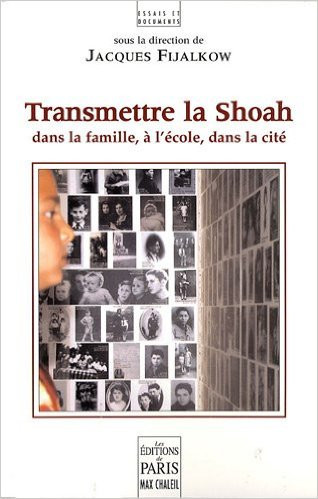 Transmettre la Shoah : Dans la famille, à l'école, dans la cité This volume deals with transmission of the history and the memory of the Shoah within the family as well as in school, in museums, in cultural productions (cinema, literature and art), and in legislation. Two countries are in the centre of the analysis : France and Israel. France with its history of the "Vel d'Hiv" and the Rivesaltes and Chambon-sur-Lignon camps. And Israel against the background of the Eichmann trial and the aftermath of "Shoah" by Lanzmann. Several contributions deal with transmission, knowledge and social representations of the Shoah. (By the editor) Holocaust Memorial Day in schools - context, process and content: a review of research into Holocaust education The Holocaust was officially remembered in Britain for the first time on 27 January 2001. This is to be an annual event and it is intended that it will provide a focus for work in schools. The paper reviews the findings of research into Holocaust education and discusses the implications for teachers intending to respond to this important initiative. (By the author) Using archival documents, memoir, and testimony to teach about Jewish families during and after the Holocaust Carson Phillips suggests the use of archival documents, memoir and recorded testimony to engage students in learning. Use the three survivor testimonies below, from Czechoslovakia, Hungary and Croatia, in conjunction with those in the Gurewitsch essay (pp. 48–55) for a rich and varied look at the fraught experiences of Jewish families struggling to survive and, ultimately, rebuild their lives. (By the publisher) Holocaust Education in Post-Communist Romania As Israeli historian Leon Volovici noted in a recent article, Romania today is marked by the concurrent presence of a prolific nationalistic media with strong anti-Semitic accents and a swell of events dedicated to the history of its Jews. This remarkable paradox is perhaps just one more example of the originality of Romania’s post-communist transition, the more so since the object of both trends is becoming less and less numerous every day: there are only about 9,000, mostly elderly Jews living in contemporary Romania. After 45 years of “relative silence” imposed by the communists and eight more years of “relevant silence” imposed by the neo-communists, as of 1998 the Holocaust is finally mentioned and discussed, but “in the third person”, as it were: it’s true, it happened, but not in Romania! (By the author) Entering the World of a Holocaust Victim: Schoolchildren Discuss a Ghetto Memoir – a Case Study Despite Adorno's famous dictum, the memory of the Shoah features prominently in the cultural legacy of the 20th century and beyond. It has led to a proliferation of works of representation and re-memorialization which have brought in their wake concerns about a 'holocaust industry' and banalization. This volume sheds fresh light on some of the issues, such as the question of silence and denial, of the formation of contemporary identities — German, East European, Jewish or Israeli, the consequences of the legacy of the Shoah for survivors and for the 'second generation,' and the political, ideological, and professional implications of Shoah historiography. One of the conclusions to be drawn from this volume is that the 'Auschwitz code’, invoked in relation to all 'unspeakable' catastrophes, has impoverished our vocabulary; it does not help us remember the Shoah and its victims, but rather erases that memory. (By the author)