
Resources
Explore a wide range of valuable resources on GCED to deepen your understanding and enhance your research, advocacy, teaching, and learning.
232 Results found
 Learning to live together: education for conflict resolution, responsible citizenship, human rights and humanitarian norms Year of publication: 2013 Author: Margaret Sinclair Corporate author: Education Above All (Qatar) Education cannot offer immediate remedies to the local and global problems that we see on the news screens every day, but it can contribute to solving them over the longer term. This book examines specifically the contribution that education for learning to live together can make, even in countries where teacher training and classroom resources are limited. Many countries have diverse populations (ethnic, linguistic, religious, etc) and seek to maintain harmony among the different groups. In some countries, however, especially where economic stress or climate change have intensified arguments over resources, tensions have led to armed conflict. This brings with it all the misery of death, injury, displacement and poverty, along with disruption of education systems. In some instances education itself has been a contributory factor to the outbreak of conflict, notably through unequal education opportunities for different groups, and through biased school curricula.Civil conflict has brought untold suffering in recent years, and in a globalised world it has negative spill-over effects to neighbouring and other countries. It is vital to develop education policies and curricular reforms that can help convey values and skills for learning to live together to young people, to help lessen tensions, within and between countries.Education policy-makers can help lay the foundations for a better future by adjusting the content and process of education to reflect skills and values for human rights, humanitarian norms, peaceful resolution of conflicts, sustainable development and other issues as elements of local, national and global citizenship.Education reform is not enough, of course, to resolve the numerous problems of our times. The focus of this volume is on the contribution that can be made through aligning the content of education to the goal of learning to live together. This work will have greater impact when it takes place within education systems and policies that are consistent with human rights values and of course when other sectors besides education make their respective contributions.This book shows that transformative education for conflict resolution and peace, for local, national and global citizenship, for human rights and humanitarian values can be implemented even under difficult conditions if there is a policy commitment to do so. Authors have provided examples and lessons learned from their own experiences as eminent practitioners in the field.
 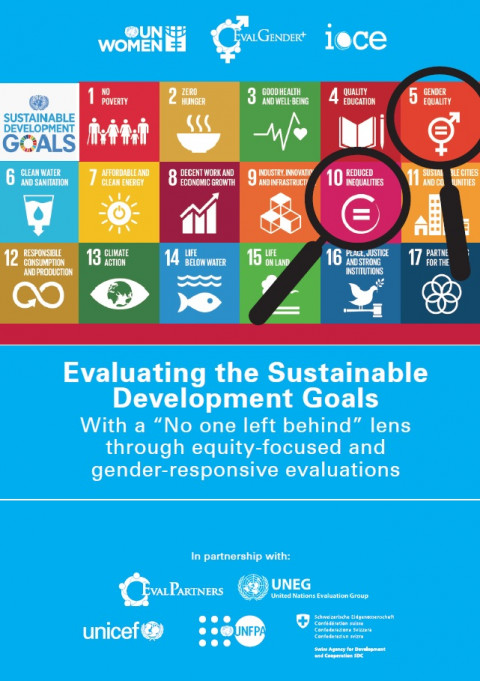 Evaluating the Sustainable Development Goals with a “No one left behind” lens through equity-focused and gender-responsive evaluation Year of publication: 2016 Author: Michael Bamberger | Marco Segone | Florencia Tateossian The purpose of this publication is to provide guidance on how to integrate an equity-focused and gender-responsive (EFGR) approach to national evaluation systems that should inform national Sustainable Development Goal (SDG) reviews. This guidance is intended to support national evaluation systems on how to integrate EFGR evaluations to inform the national reviews of SDGs. The guidance is expected to primarily serve national evaluation systems, the UN system, multilateral and bilateral development agencies, academic institutions, including specialized research centres and think tanks, private foundations, the private sector, and voluntary organizations of professional evaluators.
 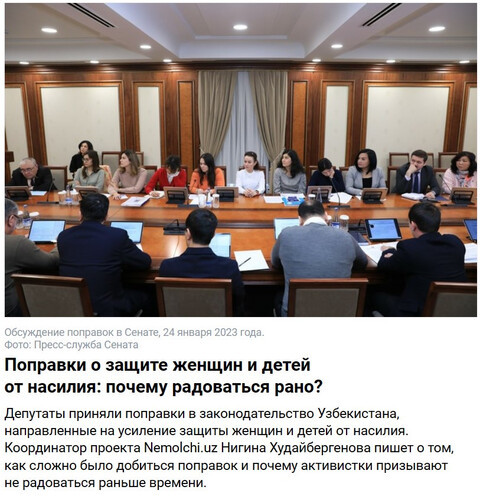 Amendments on the Protection of Women and Children From Violence: Why Is It Too Early To Rejoice? Year of publication: 2023 Author: Нигина Худайбергенова The deputies adopted amendments to the legislation of Uzbekistan aimed at strengthening the protection of women and children from violence. Nigina Khudaibergenova, the coordinator of the Project 'Nemolchi.uz'(Don't be silent) writes about how difficult it was to achieve amendments and why activists urge not to rejoice ahead of time.
  Annual Report for 2021 (UNODC Regional Office in Central Asia) Year of publication: 2022 Corporate author: UN. Office on Drugs and Crime (UNODC) This Annual Report provides an account of the main results achieved by the United Nations Office on Drugs and Crime, Regional Office for Central Asia (UNODC ROCA), in 2021. UNODC has stepped up efforts to help people in these challenging times, addressing emerging threats in line with human rights and gender equality standards, and the rule of law. Through our strategic interventions, we have contributed to strengthening peace, preventing conflict, and tackling the root causes and drivers of instability and violence.
  Human Rights: 13 Ideas Received To Be Deconstructed Year of publication: 2022 Author: Céline Branaa | Louise Pluyaud | Louise Savri Corporate author: Commission nationale consultative des droits de l'homme (CNCDH) Aimed at 14-20 year-olds, this book aims to raise awareness of human rights and reminds us of the major role they play in our lives and in the organization of contemporary society. Today, human rights are being challenged by various movements that question their usefulness, effectiveness and universality. The links between certain violations of fundamental rights, climate change, the dangers of digital technology and so many other contemporary issues are often misunderstood or even ignored. The NCCHR is convinced of the urgent need to reaffirm that human rights are the foundation of a democratic society. To this end, the members of the NCCHR set out to deconstruct 13 of the most common misconceptions heard or disseminated in the media and on social networks. Through 13 illustrated chapters, each corresponding to a preconceived idea, human rights appear at the heart of our civilization as a current and indispensable reference. Readers are invited to become actively involved in their promotion. This book is a reminder that fundamental rights are not a construct of the past, but a necessary tool for the present. Highlighting the richness of human rights, this book is an invitation to anticipate a common future in which the dignity and freedom of the human person represent an accessible promise.
 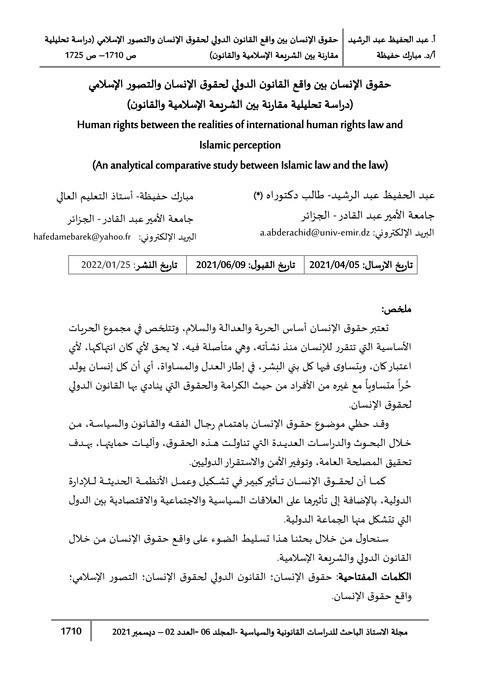 Human Rights Between The Realities of International Human Rights Law and Islamic Perception (An Analytical Comparative Study Between Islamic Law And the Law) (Journal of Professor Researcher for Legal and Political Studies; Vol.6, No.3) Year of publication: 2022 Author: Abderachid Abdelhafid | Hafeda Mebarek Corporate author: M'sila University Human rights are the basis of freedom, justice and peace. They consist of all the fundamental freedoms that have been established for human beings since their inception. They are inherent in human beings. No one shall violate them, on any account, and all human beings shall be equal, within the framework of justice and equality, that is, every human being shall be born free and equal to other individuals in terms of the dignity and rights proclaimed by international human rights law. The subject of human rights has received the attention of scholars, law and politics through numerous research and studies on human rights and their protection mechanisms, with a view to achieving public interest and international security and stability. Human rights also have a significant impact on the formation and functioning of modern regimes of international governance, as well as on the political, social and economic relations between the States that make up the international community. Through this research, we will try to highlight the reality of human rights through international law and Islamic law.
  Plan of action: world programme for human rights education; first phase Year of publication: 2006 Corporate author: UN Office of the High Commissioner for Human Rights The Plan of Action for the first phase (2005-2007) of the World Programme was adopted by all United Nations Member States in July 2005. It proposes a concrete strategy and practical guidance for implementing human rights education in primary and secondary schools. On 10 December 2004, the General Assembly of the United Nations proclaimed the World Programme for Human Rights Education (2005-ongoing) to advance the implementation of human rights education programmes in all sectors. Building on the foundations laid during the United Nations Decade for Human Rights Education (1995-2004), this new initiative reflects the international community’s increasing recognition that human rights education produces far-reaching results. By promoting respect for human dignity and equality and participation in democratic decision-making, human rights education contributes to the long-term prevention of abuses and violent conflicts. To help make human rights a reality in every community, the World Programme seeks to promote a common understanding of the basic principles and methodologies of human rights education, to provide a concrete framework for action and to strengthen partnerships and cooperation from the international level down to the grass roots.
 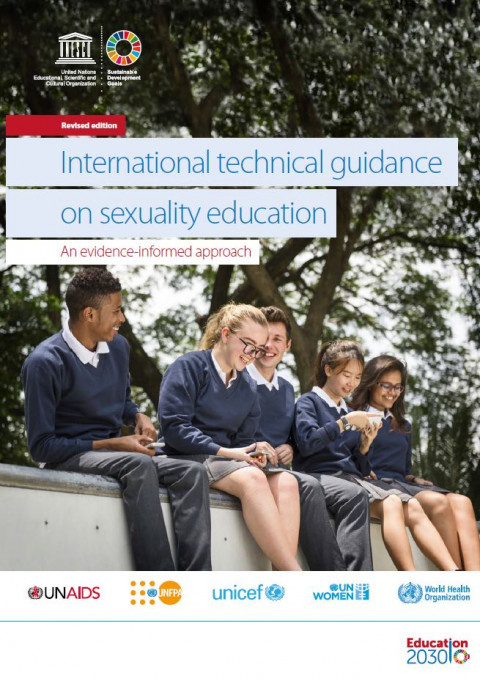 International Technical Guidance on Sexuality Education: An Evidence-Informed Approach Year of publication: 2018 Corporate author: Joint United Nations Programme on HIV/AIDS (UNAIDS) | United Nations Population Fund (UNFPA) | United Nations Children's Fund (UNICEF) | United Nations Entity for Gender Equality and the Empowerment of Women (UN Women) | World Health Organization (WHO) The UN International technical guidance on sexuality education was first published in 2009 as an evidence-informed approach for schools, teachers and health educators.Recognizing the dynamic shifts in the field of sexuality education that have occurred since then, an expanded group of UN co-publishing partners has reviewed and updated the content to respond appropriately to the contemporary needs of young learners, and to provide support for education systems and practitioners seeking to address those needs. The International technical guidance on sexuality education (revised edition) provides sound technical advice on the characteristics of effective comprehensive sexuality education (CSE) programmes; a recommended set of topics and learning objectives that should be covered in comprehensive sexuality education; and, recommendations for planning, delivering and monitoring effective CSE programmes. This revised edition of the Guidance reaffirms the position of sexuality education within a framework of human rights and gender equality, and promotes structured learning about sex and relationships in a manner that is positive, affirming, and centred on the best interests of the young person. It is based on a review of the latest evidence and lessons-learned from implementing CSE programmes across the globe. The revised Guidance reflects the contribution of sexuality education to the realization of multiple Sustainable Development Goals, notably Goal 3 on good health and well-being for all, Goal 4 on quality education for all, and Goal 5 to achieve gender equality.
  Participatory Planning to Achieve Structural Change with Equality: Citizen Participation Strategies in Multi-scale Planning Processes Year of publication: 2015 Author: Alicia Williner | Andrea Sanhueza | Carlos Sandoval Corporate author: United Nations (UN) This manual that ILPES places at the disposal of public officials and non-governmental agents working in the community, has the purpose of sharing a brief theoretical reflection on the current socio-political context through which this manual becomes important; and a set of methodological instruments that will bring the user closer to the social practice of a citizen participation process in the construction of a public management instrument. The manual is divided into two chapters: The first conceptualizes participatory multiscale planning, while also briefly introducing three topics of great importance to be incorporated into any participatory planning process and construction of public management instruments: the perspective of gender, the use of Convention 169 and Principle 10. The second chapter systematizes a set of methodological instruments that describe the stages of a citizen participation strategy to incorporate the multiscale public management instruments. The manual closes with two annexes, the last of which incorporates a set of tools that can be used in the stages of the construction of a citizen participation strategy.
  Education, Development and Citizenship in Latin America: Proposals for the Debate Year of publication: 2011 Author: Alicia Barcena | Narcis Serra Corporate author: Naciones Unidas. Comisión Económica para América Latina y el Caribe (CEPAL) | Centro de Estudios y Documentación Internacionales de Barcelona (CIDOB) Through ADI, an initiative promoted by CIDOB, the Ibero-American General Secretariat (SEGIB) and the Economic Commission for Latin America and the Caribbean (ECLAC), with the support of various sponsoring companies, it is intended to encourage academic debate along with the political debate on diverse issues crucial for the region. Through a rigorous analysis of the social, economic and political reality carried out by academics, public policymakers and other key actors in the development process in Latin America, the aim is to offer recommendations that make economic growth compatible with well-being of the majorities. This publication constitutes the fifth volume of the series and is the result of the willingness of the participating institutions to disseminate, as much as possible, the ideas and discussions that emerged in the seminar. Its reading is a fundamental element to understand the current state of education in the region, as well as the possibilities that exist in this area to continue advancing in inclusion and development.