
Resources
Explore a wide range of valuable resources on GCED to deepen your understanding and enhance your research, advocacy, teaching, and learning.
232 Results found
 From words to action; Des paroles aux actes Year of publication: 2014 Corporate author: UNESCO Since its creation in 1945, UNESCO has been working to enhance mutual understanding between peoples, founded on an ever more subtle knowledge of cultures in their rich diversity in order to promote the dignity of all through the affirmation of the principles, rights and values of our common humanity. The era of globalization characterizes our societies, in a cultural landscape which, more than ever, is permeated with diversity because of the mutual influences of peoples, communities, and of their cultural and religious practices. A major issue remains: the need to demonstrate the benefits of promoting both respect for human rights and cultural diversity, recognizing the importance of genuine intercultural dialogue in order to fight against new forms of racism, discrimination, intolerance, extremism and radicalization. UNESCO, with lengthy practical experience as an international laboratory of ideas, monitors respect for universal values, in particular by initiating research and producing various kinds of teaching tools designed for the acquisition of intercultural skills. Which skills should be mobilized or acquired in order to be able not only to respect but also to appreciate the Other in all his or her diversity. How many of these skills can be useful on both a collective level and an individual one in order to protect cultural rights, protect oneself from, or to transcend prejudice? Intercultural sensibility and aptitudes have to be explored since they refer to the willingness and capacity of people to step outside of their own logic and systems of thought in order to engage with others, and appreciate different cultural narratives especially if they are not equally valorized or recognized in a given societal context. This portfolio proposes a basic tool for capacity building in support of exchange, communication and cooperation beyond cultural, religious and national borders, allowing the emergence of a global citizenship in a safer world for all. In this perspective, this set of key resources consists of papers by international experts exploring the linkage between respect for cultural diversity and human rights, with all that that implies. It brings together other publications such asIntercultural Competences, Conceptual and Operational Framework, published by UNESCO in 2013, and documents such as Dire la Tolérance (Defining Tolerance), published in 1997 and translated into English and into Arabic, and, finally, UNESCO’s Programme of Action for a Culture of Peace and Non-Violence, A Vision in Action, published in English in 2012 and in French in 2013. Symbolically released on 10 December 2014, Human Rights Day, this multilingual and evolving publication is designed primarly to be an Open Access tool, a flagship project of the International Decade for the Rapprochement of Cultures (2013-2022). In the same spirit, its content will be enriched and developed in an e-learning format, throughout the Decade.
  Survey on Privacy in Media and Information Literacy with Youth Perspectives Year of publication: 2017 Author: Sherri Hope Culver | Alton Grizzle Corporate author: UNESCO Media and information literate individuals are more empowered to make informed decisions about their privacy online and offline, among other things. Accordingly, governments and policy-makers who are committed to ensuring that the privacy of citizens is respected should also be committed to media and information literacy (MIL) for all. If they are not, then their efforts will be less sustainable. Equally, private and public enterprises that genuinely want to respect the privacy of citizens should purposefully contribute to MIL awareness among users qua citizens. Two research surveys are referenced in this report. The first investigated youth attitudes towards MIL and social and democratic discourses. One of the seven themes addressed in the context of social and democratic discourses was privacy. The research was carried out by UNESCO. The second survey studied privacy in MIL courses globally and was conducted for UNESCO by the UNESCO-UNAOC University Network on Media and Information Literacy and Intercultural dialogue (MILID Network), and members of the Global Alliance for Partnerships in Media and Information Literacy (GAPMIL). The report responds to UNESCO’s efforts to stimulate global research into privacy in MIL. Ultimately, this report aims to provide conceptual, development and policy recommendations to foster privacy in MIL, while enabling the critical engagement of people, including young women and men, in an environment conducive to sustainable development and to freedom of expression online and offline. It seeks to provide clarity on the complex issue of how MIL and privacy intersect.
  Human rights education in the school systems of Europe, Central Asia and North America: a compendium of good practice Year of publication: 2009 Corporate author: Council of Europe | UNESCO | UN. Office of the United Nations High Commissioner for Human Rights (UN. OHCHR) | OSCE. Office for Democratic Institutions and Human Rights (ODIHR) “Human Rights Education in the School Systems of Europe, Central Asia and North America: A Compendium of Good Practice” is a compilation of 101 examples of good practice in human rights education in primary schools, secondary schools and teacher training institutions in the Organization for Security and Co-operation in Europe (OSCE) area, which is also covered by the United Nations Educational, Scientific and Cultural Organization (UNESCO), the Office of the United Nations High Commissioner for Human Rights (OHCHR) and, partially, the geographical mandate of the Council of Europe (CoE).The term “human rights education” is often used in this resource in a broader sense, to also include educationfor democratic citizenship and education for mutual respect and understanding, which are all based on internationally agreed human rights standards. These three areas are seen as interconnected and essential within educational systems in order to prepare youth to be active, responsible and caring participants in their communities, as well as at the national and global levels.Human rights education has been defined as education, training and information aimed at building a universal culture of human rights. A comprehensive education in human rights not only provides knowledge about human rights and the mechanisms that protect them, but also imparts the skills needed to promote, defend and apply human rights in daily life. Education for democratic citizenship focuses on educational practices and activities designed to help young people and adults to play an active part in democratic life and exercise their rights and responsibilities in society. Education for mutual respect and understanding highlights self-respect, respect for others, and the improvement of relationships between people of differing cultural traditions.This book aims to support quality teaching in these areas and to inspire educational policymakers (those working in education ministries and local school boards) and administrators, teachers, teacher trainers, non-formal educators and all other interested actors, as well as to facilitate networking and the exchange of experience among education professionals.
 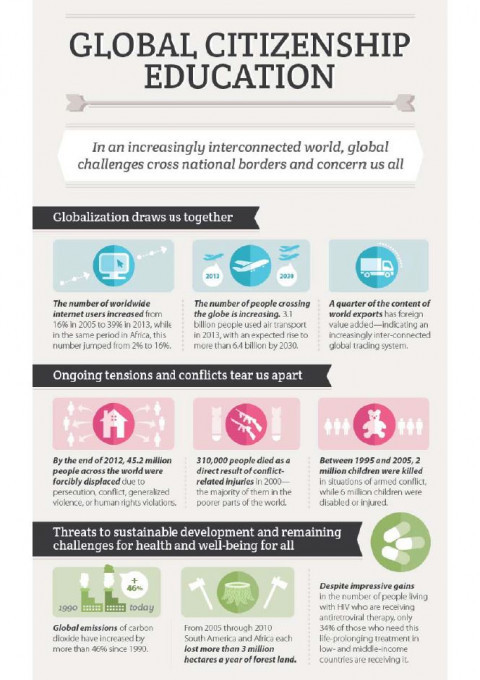 Global Citizenship Education infographic Year of publication: 2014 Corporate author: UNESCO In an increasingly interconnected world, global challenges cross national borders and concern us all. With issues like these threatening human and environmental well-being, we need to re-think the role and relevance of education. We need Global Citizenship Education. Global Citizenship Education is transformative. What are the barriers to this kind of education? What needs to change in education? What is UNESCO doing? What can you do?
 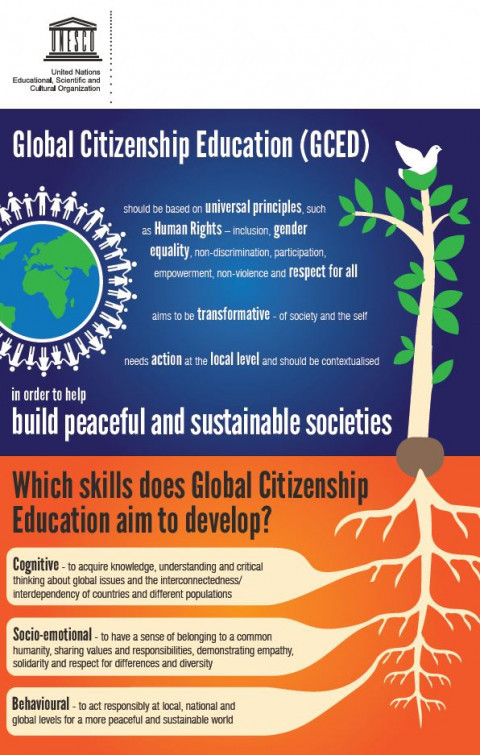 Global Citizenship Education (GCED) infographic Year of publication: 2015 Corporate author: UNESCO Which skills does Global Citizenship Education aim to develop? How can effectively implement Global Citizenship Education? Who are the key players?
  Human rights: questions and answers Year of publication: 2009 Author: Leah Levin Corporate author: UNESCO This 5th edition presents an overview of the scope and content of international human rights law, procedures to monitor its implementation, organizations and institutions working for human rights, major international events, as well as new developments and challenges. It also offers a brief commentary on the articles of the Universal Declaration of Human Rights explaining their meaning and providing examples on their practical implications. A permanent feature of this publication, and one of the reasons of its success, are the cartoons of Plantu, a well-known French political cartoonist and a devoted human rights activist.
  Introducing democracy: 80 questions and answers Year of publication: 2009 Author: David Beetham | Kevin Boyle Corporate author: UNESCO Humorously illustrated by Plantu, the famous cartoonist of the French newspaper Le Monde, this book is a valuable tool for all those who want to know more about democracy and human rights, whether it be students, activists, civil servants, or simply as interested citizens. What is democracy? What is the relation between democracy and individual rights? Is majority rule always democratic? How can democracy be maintained and improved? This book tackles these and other questions about democracy, covering six broad areas: basic concepts and principles; free and fair elections; open and accountable government; individual rights and their defence; democratic or civil society; the future of democracy.
 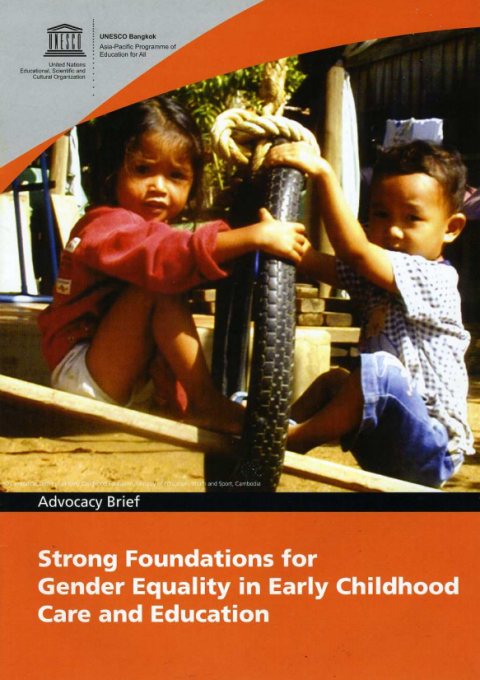 Strong foundations for gender equality in early childhood care and education: advocacy brief Year of publication: 2007 Corporate author: UNESCO The term Early Childhood Care and Education (ECCE) refers to services for children from birth to eight years of age. These include educating parents in how to care for their children and help them learn, as well as providing community-run and formal preschool programmes for pre-primary school-aged boys and girls. Given the varying needs of children from birth to eight years, educators have found it best to have different policies and strategies for children below and above three years of age. This brief focuses on the gender issues in the services provided for children who are three years of age or older in the Asia-Pacific region. Its scope is informed by UNESCO's commitment to holistic pre-primary services for this age group. The goal is to provide early childhood education that helps girls and boys succeed in primary school and in learning throughout their lives. The brief starts by looking into the growth of ECCE in the Asia-Pacific region and what is driving this growth. It explores why gender responsiveness is important in early childhood education, gives practical examples of what this looks like, and discusses the challenges of providing ECCE that equally values and benefits each girl and each boy. Flowing from this, the brief concludes with recommendations on how to make ECCE more gender responsive
  Contemporary issues in human rights education Year of publication: 2011 Corporate author: UNESCO The format of this publication presents the main strands concerning the role of human rights education as well as the key elements for its implementation. Each strand addresses current issues and challenges faced when incorporating a culture for human rights, also illustrating the collective importance of human rights education as a fundamental base for a peaceful and just society. Under each strand, a list of examples inspired by country initiatives is proposed. Education sector technical notes: human rights education Year of publication: 2013 Corporate author: UNESCO Human rights are enshrined in international law, and states have an obligation to respect, protect and fulfil them. Despite this, human rights violations remain widespread. ◗ Educating children and adults on human rights is essential. Individuals and groups must understand their rights in order to see them upheld and to ensure that their own behavior does not compromise the rights of others. ◗ States have an obligation to promote human rights and human rights education is now recognized as a right in itself. ◗ UNESCO, along with the Office of the United Nations High Commissioner for Human Rights, co-leads the World Programme for Human Rights Education (2005-ongoing).