
Resources
Explore a wide range of valuable resources on GCED to deepen your understanding and enhance your research, advocacy, teaching, and learning.
232 Results found
 Buenos Aires Recommendations Year of publication: 2007 Corporate author: PRELAC II Recognizing that education is a public good and is the key to building a more just and better world for all, the Second Intergovernmental Meeting of the Regional Education Project, PRELAC II, held in the city of Buenos Aires, on the 29th and March 30, 2007, agrees the following recommendations as criteria and lines of action for national policies and international cooperation.
  Childhood and Citizenship Year of publication: 2011 Author: Osvaldo Torre G. This publication, Niñez y Ciudadanía, is an effort of the Postgraduate Diploma, "Childhood and Public Policies", taught by the Department of Anthropology of the Faculty of Social Sciences of the University of Chile. This course has been held for 5 years, in partnership with the Chilean Association for the United Nations, ACHNU. This first publication presents a selection of those works developed by students graduated from the Diploma in 2010, in which a subject of interest for the researcher is tested and on which a rights approach is applied, which tends to evaluate the situation of the boys and girls in a different way than traditional childhood views; these works are the product of their dissertations to approve this post-title. Also included are some brief essays on the relationship between childhood and violence, elaborated by some of the students of the 2011 generation, in the idea of making available to the interested public a sample of the different forms that acquire the uses of violence on children. It also incorporates a collaboration requested to the anthropologist Dimas Santibáñez, member of the Academic Committee of the Diploma.
 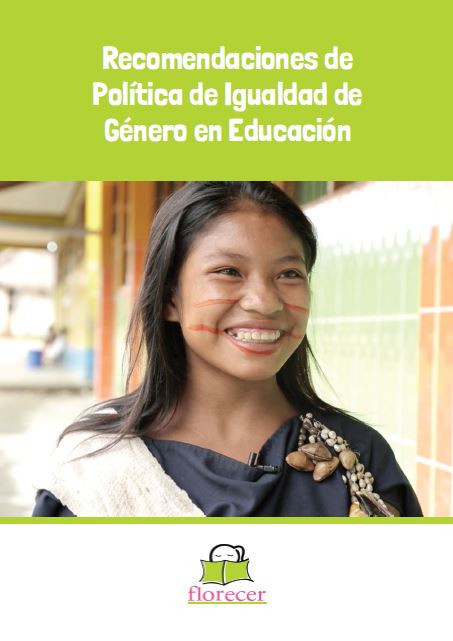 Policy Recommendations of Gender Equality in Education Year of publication: 2015 Author: Teresa Tovar Samanez Corporate author: United Nations Children's Fund (UNICEF) This document synthesizes the proposals of the Florecer Network to advance in gender equality, because we are convinced that the commitment to a more just and more human world necessarily implies the assumption of equality between men and women.
 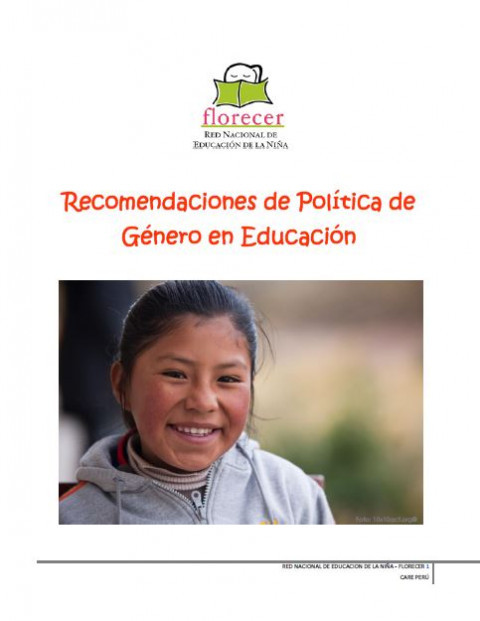 Gender Policy Recommendations in Education Year of publication: 2015 Corporate author: Red Nacional de Educación de la Niña This document synthesizes the proposals of the Florecer Network to advance in gender equality, convinced that the commitment to a more just and more human world necessarily involves the assumption of equality between men and women. The principle that the rights of women and girls are an integral, inalienable and indivisible part of universal human rights has been reaffirmed from the various international forums. Greater equity between men and women is also beneficial for the development of the country. A country with educated girls and women has a lower birth rate, improves their health and productivity conditions. This document synthesizes the main proposals of the Gender and Citizenship Forum: imperative for a quality education, organized by Red Florecer in May 2013 year. We want to put them in the hands of decision-makers and citizens in general to help concretize the mandates of equality between men and women in education. It is time not to give up dreams because they have become possible.
 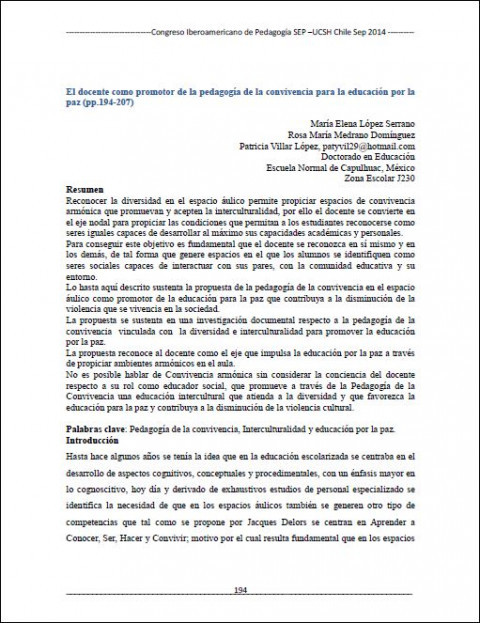 The Teacher as a Promoter of the Pedagogy of Coexistence for Education for Peace Year of publication: 2014 Author: María Elena López Serrano | Rosa María Medrano Domínguez | Patricia Villar López Corporate author: Universidad Católica Silva Henríquez Recognizing the diversity in the aulic space allows to create spaces of harmonious coexistence that promote and accept interculturality, for this the teacher becomes the nodal axis to propitiate the conditions that allow the students to recognize themselves as equal beings capable of developing their capacities to the maximum academic and personal. To achieve this goal it is essential that the teacher recognizes himself and others, in such a way that generates spaces in which students identify as social beings able to interact with their peers, the educational community and their environment. What has been described here supports the proposal of the pedagogy of coexistence in the aulic space as a promoter of education for peace that contributes to the reduction of the violence experienced in society. The proposal is based on a documentary research on the pedagogy of coexistence linked to diversity and interculturality to promote education for peace. The proposal recognizes the teacher as the axis that drives education for peace through fostering harmonious environments in the classroom. It is not possible to speak of harmonic coexistence without considering the teacher's awareness of his role as a social educator, which promotes through Pedagogy of Coexistence an intercultural education that attends to diversity and that favors education for peace and contributes to the decrease of cultural violence.
  IX and X Days of Educational Cooperation with Iberoamerica on Special Education and Educational Inclusion Year of publication: 2015 Corporate author: UNESCO Santiago This publication includes the main presentations made by experts in educational inclusion presented at the IX and X Conference on Educational Cooperation with Ibero-America on special education and educational inclusion, held in Cartagena de Indias, Colombia (2012) and Santa Cruz, Bolivia ( 2013), respectively. The workshops have been organized by the Ministry of Education of Spain with the support of the Regional Office of Education for Latin America and the Caribbean (OREALC / UNESCO Santiago). We hope that this publication will contribute to the dissemination of the reflections that RIINEE has developed on critical issues in the field of the educational inclusion of people with disabilities and / or special educational needs, and in this way, constitute a contribution to advance in the guarantee of the rights indicated in the Convention on the Rights of Persons with Disabilities, approved in 2006 by the Member States of the United Nations Organization.
  Feasibility study: establishment of an international centre for the promotion of human rights at the local and regional levels in Graz, Austria, under the auspices of UNESCO Year of publication: 2017 Author: Vandenhole, Wouter On 3 November 2016, the Government of the Republic of Austria requested (annexed to this report) the Director-General of UNESCO to initiate all necessary steps for the establishment of an International Centre for the Promotion of Human Rights at the Local and Regional Levels (hereafter: ‘the Centre’) in Graz (Styria, Austria) as a UNESCO Category 2 Centre, in application of the Integrated Comprehensive Strategy for Category 2 Institutes and Centres under the Auspices of UNESCO, adopted by the General Conference at its 37th session (res. 37 C/Resolution 93). This application stems from the long-standing commitment and efforts by the Government of the Republic of Austria, the Federal State of Styria and the City of Graz to further the implementation of human rights, both within the country and globally. The Centre will contribute, through research, capacity-building, information-sharing and international collaboration, to UNESCO programmes relating to Sustainable Development Goals 10, 11 and 16 of the 2030 Agenda for Sustainable Development, as well as to urban inclusion-related commitments of the New Urban Agenda. As regards the latter, the Centre is equally expected to feed into the work of the International Coalition of Inclusive and Sustainable Cities – ICCAR and its European Chapter, as well as into UNESCO urban initiatives and platforms.
  Teaching Two Lessons about UNESCO and Other Writings on Human Rights Year of publication: 2017 Author: Fernando Reimers This book presents two lessons for use in college or high school, to educate students on the mission and work of UNESCO as it relates to the advancement of Human Rights. It includes also a series of a short essays on Human Rights, the Right to Education, Teaching Human Rights and the role of Teachers and Universities in Teaching Human Rights which will be useful to educators interested in educating their students to advance the values of freedom and justice. For more information about this book, please visit the link below.URL: https://www.amazon.com/Teaching-Lessons-Unesco-writings-Rights/dp/1978367996#reader_1978367996 The lessons(Two Lessons About UNESCO) are designed to help high school and college students understand the mission of UNESCO, the reason the organization was created, the work it does, how it is structured and funded, and how its work relates to the Universal Declaration of Human Rights. The lessons can be taught at the High School or College level. They can be taught in a variety of courses including social studies, history, humanities, and can be integrated in courses in other disciplines. For more information, please visit the link below.URL: https://medium.com/@fernandomreimers/teaching-two-lessons-about-unesco-7531c5fe9395
 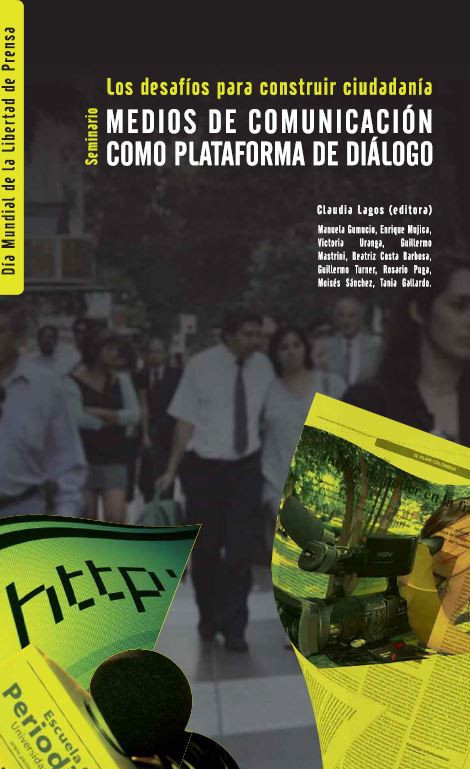 The Challenges to Build Citizenship: Media as a Platform for Dialogue Year of publication: 2010 Author: Claudia Lagos Corporate author: Universidad de Chile The OREALC / UNESCO Santiago and the UNESCO National Commission, the Regional Delegation for Cooperation in the Southern Cone and Brazil, the French Embassy in Chile, the Freedom of Expression Program of the Institute of Communication and Image of the University of Chile and the UNESCO Chair "Media and citizen participation" of the Universidad Diego Portales, commemorated the World Day for Press Freedom 2009 with the seminar "The challenges to build citizenship. Media as a platform for dialogue ", held on May 5, 2009 at the Central House of the University of Chile. The meeting, with national and international guests, made it possible to reflect on and discuss the main issues -although not the only ones- that are currently in the hands of issues related to the promotion of pluralism and diversity; the challenges for journalism and the media in a context of high technological renewal and economic crisis; the lines of work in the matter for the design and execution of public policies, and research in communication. This publication collects the presentations of the speakers during the Seminar, as well as leaves testimony of the commitments assumed by the presidential candidates that we hope will become an agenda not only for the 2010-2014 administration, but also for the political sectors that represent each one of those who signed the document.
  Collected: Educational Project about “Learning from Biographies” in General Sciences in Primary School Year of publication: 2006 Author: A. Becher Original Title: Eingesammelt: Ein Unterrichtsprojekt zum‚ “Lernen an Biographien” im Sachunterricht der Grundschule(In D. Pech, M. Rauterberg, & K. Stocklas, (Eds.). Möglichkeiten und Relevanz der Auseinandersetzung mit dem Holocaust im Sachunterricht der Grundschule, Supplement 3, pp. 17–34) The article presents a project aimed at developing suitable methods for Holocaust Education already in the German primary school. Based on Ido Abram’s three-step-program as well as Wolfgang Klafki’s critical didactics, the project has developed a biographical approach to create possibilities for identification among the students. This is tested in a 3rd grade class and is thereafter evaluated.The above abstract is taken from the International Holocaust Remembrance Alliance Education Research Project. Please also consult the full list of abstracts in 15 languages and the accompanying publication Research in Teaching and Learning about the Holocaust: A Dialogue Beyond Borders. Ed: IHRA, Monique Eckmann, Doyle Stevick, Jolanta Ambrosewicz-Jacobs, 2017, Metropol Verlag at www.holocaustremembrance.com/resources/publications.