
Resources
Explore a wide range of valuable resources on GCED to deepen your understanding and enhance your research, advocacy, teaching, and learning.
451 Results found
 School, Identity and Discrimination Year of publication: 2011 Author: Néstor López Corporate author: UNESCO IIEP Office for Latin America and the Caribbean Education, identity and school is just one more link, within the many wills that work for full equality of opportunities. As in other publications of the Institute, the wealth of perspectives is added, which give shape to sometimes pressing realities with a demand for urgent action. The publication is a new opportunity for the voices of different interlocutors to give an account, in their countries and contexts, both of the construction of identity processes, and of their recognition and respect. This also implies raising the obstacles, the contributions and the advances, to face the challenges still pending. In each work presented here, the authors-whose participation and effort we deeply appreciate-offer sharp insights on various tasks and contexts. We wish, to conclude, that this text also contributes to the reflection on the possible courses that have been adopted or that require a deepening of the educational policies, specifically in the agendas related to the themes of this publication. Escuela, identidad y discriminación Year of publication: 2011 Author: Néstor López Corporate author: UNESCO IIEP Oficina para América Latina y el Caribe Educación, identidad y escuela es solo un eslabón más, dentro de las muchas voluntades que trabajan por la plena igualdad de oportunidades. Como en otras publicaciones del Instituto, se suma la riqueza de perspectivas, que dan forma a realidades en ocasiones acuciantes con demanda de urgente acción. La publicación supone una nueva oportunidad para que las voces de distintos interlocutores den cuenta, en sus países y contextos, tanto de la construcción de procesos identitarios, como de su reconocimiento y respeto. Ello implica también plantear los obstáculos, los aportes y los avances, para afrontar los desafíos aún pendientes. En cada trabajo que aquí se presenta, los autores –cuya participación y esfuerzo agradecemos profundamente– ofrecen agudas miradas sobre diversos quehaceres y contextos. Deseamos, para concluir, que este texto también contribuya a la reflexión sobre los posibles rumbos que se han adoptado o que requieren profundización en las políticas educativas, específicamente en las agendas vinculadas con las temáticas de esta publicación.
 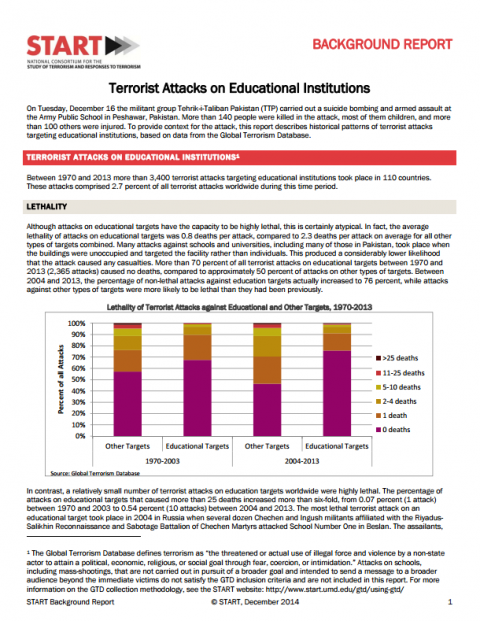 Terrorist Attacks on Educational Institutions Year of publication: 2014 Author: Erin Miller Corporate author: National Consortium for the Study of Terrorism and Responses to Terrorism (START) | Department of Homeland Security Science and Technology The report describes historical patterns of terrorist attacks targeting educations institutions dating back to 1970. Since that year, more than 3,400 terrorist attacks targeting educations institutions took place in 110 countries. These attacks comprised 2.7 percent of all terrorist attacks worldwide during this time period. Terrorist Attacks on Educational Institutions Year of publication: 2014 Author: Erin Miller Corporate author: National Consortium for the Study of Terrorism and Responses to Terrorism (START) | Department of Homeland Security Science and Technology Le rapport revient sur les attaques terroristes qui ont ciblé les institutions éducatives depuis 1970. A partir de cette année, on dénombre plus de 3.400 attaques terroristes qui avaient pour cible les institutions éducatives, dans 110 pays. Ces attaques représentent 2,7 % de l’ensemble des attaques terroristes perpétrées à travers le monde au cours de cette période.
  National identity and xenophobia in an ethnically divided society Year of publication: 2005 Author: Noah Lewin Epstein | Asaf Levanon Corporate author: UNESCO Recent studies have suggested that national identity is empirically related to negative sentiments of individuals towards foreigners. This type of analysis has hitherto been based on the notion that xenophobia is shaped by the specific nature of national identity in a given society. Representing a stronger and more exclusive perception of national identity, ethnic national identity (compared with civic national identity) is expected in this line of research to result in less favourable perceptions of immigrants. In this paper we expand this approach by arguing that, in deeply divided societies, national identity itself may have different meanings among different social groups. L'identité nationale et la xénophobie dans une société ethniquement divisée Year of publication: 2005 Author: Noah Lewin Epstein | Asaf Levanon Corporate author: UNESCO Des études récentes ont suggéré que l'identité nationale est empiriquement associée à des sentiments négatifs des individus envers les étrangers. Ce type d'analyse a été jusqu'ici fondée sur la notion que la xénophobie est façonnée par la nature spécifique de l'identité nationale dans une société donnée. Représenter une perception plus forte et plus exclusive de l'identité nationale, l'identité nationale ethnique (par rapport à l'identité nationale civique) est attendue dans cette ligne de recherche pour aboutir à la perception moins favorable des immigrants. Dans cet article, nous étendre cette approche en faisant valoir que, dans les sociétés profondément divisées, l'identité nationale elle-même peut avoir des significations différentes entre les différents groupes sociaux. Educación en pro de la 'ciudadanía mundial': marco para el debate Year of publication: 2013 Author: Sobhi Tawil Corporate author: UNESCO The notion of ‘global citizenship’ has recently gained prominence in international development discourse with the recently-adopted United Nations Secretary-General’s Global Education First Initiative (2012). Among the three priority areas outlined in this global initiative, the third aims to ‘foster global citizenship’. Education must fully assume its central role in helping people to forge more just, peaceful, tolerant and inclusive societies. It must give people the understanding, skills and values they need to cooperate in resolving the interconnected challenges of the 21st century. The notion of ‘global citizenship’, however, remains very broad, if not contested, and consequently difficult to operationalize in education. There are two possible reasons for this. Firstly, it is unclear whether the very notion of ‘global citizenship’ is a metaphor, a contradiction of terms, or an oxymoron (Davies, 2006). What does ‘global citizenship’ possibly imply both from a legal perspective, as well as from that of collective identity, sense of belonging, and civic engagement? Secondly, when applied to education, the notion of ‘global citizenship’ implies a certain degree of confusion. Is ‘global citizenship education’ (or ‘education for global citizenship’) merely an expression of a fundamental purpose of education systems? Does it also refer to a broad area of teaching and learning? If so, what are the contours of this domain? How does it relate to other often overlapping areas of learning associated with civic and political socialization?
  Education for 'global citizenship': a framework for discussion Year of publication: 2013 Author: Sobhi Tawil Corporate author: UNESCO The notion of ‘global citizenship’ has recently gained prominence in international development discourse with the recently-adopted United Nations Secretary-General’s Global Education First Initiative (2012). Among the three priority areas outlined in this global initiative, the third aims to ‘foster global citizenship’. Education must fully assume its central role in helping people to forge more just, peaceful, tolerant and inclusive societies. It must give people the understanding, skills and values they need to cooperate in resolving the interconnected challenges of the 21st century. The notion of ‘global citizenship’, however, remains very broad, if not contested, and consequently difficult to operationalize in education. There are two possible reasons for this. Firstly, it is unclear whether the very notion of ‘global citizenship’ is a metaphor, a contradiction of terms, or an oxymoron (Davies, 2006). What does ‘global citizenship’ possibly imply both from a legal perspective, as well as from that of collective identity, sense of belonging, and civic engagement? Secondly, when applied to education, the notion of ‘global citizenship’ implies a certain degree of confusion. Is ‘global citizenship education’ (or ‘education for global citizenship’) merely an expression of a fundamental purpose of education systems? Does it also refer to a broad area of teaching and learning? If so, what are the contours of this domain? How does it relate to other often overlapping areas of learning associated with civic and political socialization? Education for 'global citizenship': a framework for discussion Year of publication: 2013 Author: Sobhi Tawil Corporate author: UNESCO La notion de ‘citoyenneté mondiale’ a récemment pris de l'importance dans le discours du développement international avec la Première Initiative Éducation Modiale adoptée récemment du Secrétaire Général de l’ONU(2012). Parmi les trois domaines prioritaires énoncés dans cette initiative mondiale, la troisième vise à ‘favorsier citoyenneté mondiale'. L'éducation doit assumer pleinement son rôle central en aidant les gens à forger plus justes, des sociétés pacifiques, tolérantes et inclusives. Il faut donner aux gens la compréhension, les compétences et les valeurs dont ils ont besoin de coopérer pour résoudre les défis interdépendants du 21ème siècle. La notion de ‘citoyenneté mondiale’, cependant, reste très large, sinon contestée, et par conséquent difficile à appliquer dans l'éducation. Il y a deux raisons possibles pour cela. Tout d'abord, il est difficile de savoir si la notion même de ‘citoyenneté mondiale’ est une métaphore, une contradiction dans les termes, ou un oxymore (Davies, 2006). Qu'est-ce que la ‘citoyenneté mondiale’ implique peut-être à la fois d'un point de vue juridique, ainsi que de celle de l'identité collective, le sentiment d'appartenance et l'engagement civique? Deuxièmement, lorsqu'il est appliqué à l'éducation, la notion de ‘citoyenneté mondiale’ implique un certain degré de confusion. Est-ce que 'éducation à la citoyenneté mondiale’(ou ‘éducation pour la citoyenneté mondiale’) est seulement une expression d'un objectif fondamental des systèmes éducatifs? Est-ce qu'il se réfère également à un large domaine de l'enseignement et l'apprentissage? Si oui, quels sont les contours de ce domaine? Comment est-elle liée à d'autres domaines qui se recoupent souvent de l'apprentissage associés à la socialisation civique et politique?
 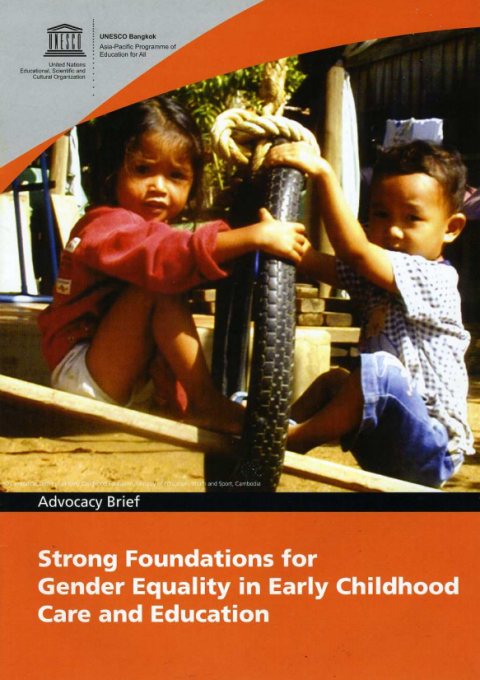 Strong foundations for gender equality in early childhood care and education: advocacy brief Year of publication: 2007 Corporate author: UNESCO The term Early Childhood Care and Education (ECCE) refers to services for children from birth to eight years of age. These include educating parents in how to care for their children and help them learn, as well as providing community-run and formal preschool programmes for pre-primary school-aged boys and girls. Given the varying needs of children from birth to eight years, educators have found it best to have different policies and strategies for children below and above three years of age. This brief focuses on the gender issues in the services provided for children who are three years of age or older in the Asia-Pacific region. Its scope is informed by UNESCO's commitment to holistic pre-primary services for this age group. The goal is to provide early childhood education that helps girls and boys succeed in primary school and in learning throughout their lives. The brief starts by looking into the growth of ECCE in the Asia-Pacific region and what is driving this growth. It explores why gender responsiveness is important in early childhood education, gives practical examples of what this looks like, and discusses the challenges of providing ECCE that equally values and benefits each girl and each boy. Flowing from this, the brief concludes with recommendations on how to make ECCE more gender responsive